
Matthew 28
Matthew 28 announces the resurrection of Jesus, exposes the deliberate unbelief of those who suppress the truth, and closes with the risen King commissioning His disciples. The empty tomb is joined by the personal appearance of Jesus, the worship of His followers, and the false report spread by His enemies. On the mountain in Galilee, Jesus declares that all authority in heaven and on earth has been given to Him, then sends His disciples to make disciples of all the nations. The Gospel that began with Immanuel closes with the promise that the risen Lord will be with His people always, even to the end of the age.
Matthew 28: The King With All Authority and Always With His People
Matthew’s final chapter begins at the dawn of the first day of the week, the day we call Sunday. The Sabbath had ended, and Mary Magdalene and “the other Mary” came to look at the grave. Matthew has already identified this other Mary as “Mary the mother of James and Joseph” in Matthew 27:56, and she had remained with Mary Magdalene opposite the tomb when Joseph of Arimathea buried Jesus in Matthew 27:61.
These women had witnessed His crucifixion, watched His burial, and now returned to the place where His body had been laid. They came expecting to find a sealed grave. Instead, they became the first people in Matthew’s account to hear that Jesus had risen from the dead.
The timing carries theological significance. The resurrection took place as a new week began, and with it came the beginning of the new creation. God created light on the first day in Genesis 1, and now, on the first day of the week, the One who called Himself “the light of the world” rose victorious over death.
Jesus had entered the darkness of judgment, borne the sins of His people, and been laid in the grave. At dawn, death’s hold was broken. The resurrection declares that His sacrifice had been accepted, the curse had been borne, and the new creation had begun in Him.
Matthew then says, “And behold, there was a great earthquake, for an angel of the Lord descended from heaven and came and rolled away the stone and sat upon it.” An earthquake had already accompanied the death of Jesus in Matthew 27:51. The earth shook when He gave up His spirit, and it shook again as His resurrection was revealed.
Creation itself bears witness to the significance of these events. The death and resurrection of Christ concern the whole created order because sin brought death and corruption into the world, while the resurrection begins the work that will end with the liberation of creation from its slavery to corruption.
The angel did not roll away the stone to allow Jesus to escape. Jesus had already risen. The stone was removed so that the witnesses could enter and see that the tomb was empty. The angel then sat upon the stone, displaying complete authority over the grave that the religious leaders had attempted to secure.
The chief priests and Pharisees had obtained a guard, sealed the stone, and taken every human measure to keep the tomb closed. Heaven overturned their precautions in a moment. The angel’s position upon the stone resembles the posture of a victor sitting over something that has been conquered. The sealed tomb could not hold the Son of God.
Matthew describes the angel’s appearance as “like lightning” and his clothing as “white as snow.” Similar descriptions appear throughout Scripture when heavenly glory is revealed. Daniel saw the Ancient of Days wearing clothing “like white snow” in Daniel 7:9, and the angel who appeared to Daniel had a face “like the appearance of lightning” in Daniel 10:6. These descriptions communicate heavenly purity, glory, and power.
The guards responded exactly as mortal men often respond when confronted by heavenly glory: “the guards quaked from fear of him and became like dead men.” The scene echoes the pattern seen in Daniel 10, where heavenly glory leaves Daniel without strength and fallen before the messenger. The men appointed to guard the dead became deathlike, while the One they guarded had risen to life.
Their military strength provided no protection against one angel sent by God. Matthew’s wording links their trembling with the earthquake itself. The earth shook, and the guards shook with it. They became powerless witnesses to an act they could neither prevent nor suppress.
The angel then addressed the women: “Do not be afraid; for I know that you are looking for Jesus who has been crucified.” The women also had reason to tremble. The angel, however, distinguished them from the guards. The guards feared because they stood against the work of God. The women feared because they had encountered a heavenly messenger while seeking Jesus. The angel therefore comforted them and identified the One they sought as “Jesus who has been crucified.”
The angel continued, “He is not here, for He has risen, just as He said.” Those final words expose the disciples’ failure to believe Jesus. He had repeatedly told them that He would be killed and raised on the third day. The resurrection therefore fulfilled His own explicit promise. He did not rise unexpectedly because events had taken a surprising turn. He rose “just as He said.” His word governed the whole course of His suffering, death, and resurrection.
The women were then invited to examine the evidence: “Come, see the place where He was lying.” Biblical faith does not depend upon a vague inward feeling. The tomb had contained His body, and now it was empty. The women could inspect the place for themselves.
Christianity rests upon an event that took place in history. Jesus truly died, His body was truly buried, and on the third day He truly rose. The empty tomb is not the whole witness to the resurrection. It forms part of the historical witness that is soon joined by the appearance of the risen Christ Himself.
Having shown them the empty tomb, the angel gave them a command: “And go quickly and tell His disciples that He has risen from the dead.” The women became the first messengers of the resurrection in Matthew’s Gospel. They had remained near Jesus through His death and burial, and now God entrusted them with the news that He was alive. Their message was specific: Jesus had risen from the dead and would meet His disciples in Galilee, just as He had promised before His arrest.
The women left “with fear and great joy.” Those responses belong together in this scene. They feared because they had encountered the power of God in an event beyond anything they had known. They rejoiced because death had not defeated their Lord. They did not remain beside the tomb analysing what had happened. They ran to obey the command they had received.
As they went, Jesus Himself met them and greeted them with a common greeting, essentially, “Hello.” Matthew’s emphasis rests on the encounter itself. The women had already seen the empty tomb and heard the angel’s announcement, but now the risen Jesus stood before them and spoke to them personally. Their faith did not rest on an empty grave alone. Jesus Himself revealed that He was alive.
The women “came up and took hold of His feet and worshiped Him.” Their action confirms that Jesus had risen bodily. He was no spirit or vision. They grasped His feet. The same Jesus whose feet had been pierced now stood alive before them. Their worship also reveals His divine identity. Throughout Matthew, Jesus receives worship, and after His resurrection this worship becomes the immediate and fitting response of those who recognise Him. The risen Christ does not reject their worship because He is worthy to receive it.
Jesus repeated the angel’s assurance: “Do not be afraid.” He then said, “Go and report to My brothers to leave for Galilee, and there they will see Me.” The angel had called them “His disciples,” while Jesus called them “My brothers.” This carries particular weight after the disciples had abandoned Him. Peter had denied Him, the others had fled, and none had displayed the faithfulness they had promised. Jesus nevertheless spoke of them as His brothers.
This language reflects the grace secured through His death and resurrection. The risen Son brings His people into His own relationship with the Father. Psalm 22, which Jesus had quoted from the cross, moves from suffering and apparent abandonment to vindication and proclamation: “I will recount Your name to my brothers” in Psalm 22:22.
Hebrews 2:11–12 applies that verse to Christ and says, “He is not ashamed to call them brothers.” By calling the disciples “My brothers,” Jesus declares that their failure has not cancelled His purpose for them. His atoning death, meaning His death that satisfied God’s justice and removed the guilt of their sin, has established the ground upon which they belong to the family of God.
Matthew then turns from the women’s faithful report to the guards’ corrupt report. “Some of the guard came into the city and reported to the chief priests all that had happened.” The chief priests received testimony from men they themselves had placed at the tomb. The guards could tell them about the earthquake, the angel, the removed stone, and the empty grave. The evidence did not lead the chief priests to repentance. They assembled with the elders and devised another act of deception.
They gave the soldiers “a large sum of money” and instructed them to say, “His disciples came by night and stole Him away while we were asleep.” The story contradicts itself. Sleeping men could not know who had removed the body. The claim also required the soldiers to admit that they had failed in the duty assigned to them.
The leaders therefore promised, “If this is heard before the governor, we will win him over and keep you out of trouble.” The same leaders who had manipulated Pilate into authorising the crucifixion now offered to manipulate him again to protect the guards.
Matthew had already shown Judas accepting money to betray Jesus. Now the guards accepted money to conceal the evidence of His resurrection. The religious leaders used money first to deliver Jesus to death and then to spread a lie after He had defeated death. Their conduct fulfils the pattern Jesus described in John 3:19: “the Light has come into the world, and men loved the darkness rather than the Light, for their deeds were evil.”
The resurrection does not automatically produce faith in everyone who encounters its evidence. The chief priests received a truthful report and chose deception because acknowledging the resurrection would have required them to confess that the One they condemned was the Messiah and Son of God.
The false story also reveals the helplessness of Christ’s enemies. They could not produce His body. They could only attempt to explain why it was missing. Their accusation that the disciples had stolen it stands against everything Matthew has shown about the disciples. These men had fled in fear when Jesus was arrested.
They were in no condition to overpower trained guards, move the sealed stone, remove the body, and then willingly suffer persecution and death for a resurrection they knew to be false. The lie spread because people often accept a weak explanation when it allows them to reject an unwelcome truth.
Matthew says, “this story was widely spread among the Jews, and is to this day.” He wrote in a setting where this accusation continued to circulate. His account directly answers it by showing that the guards knew what had happened and that the religious leaders paid them to report something else. From the moment the resurrection was announced, the truth was proclaimed and the lie was circulated alongside it. The church’s mission therefore takes place amid deliberate resistance to the gospel.
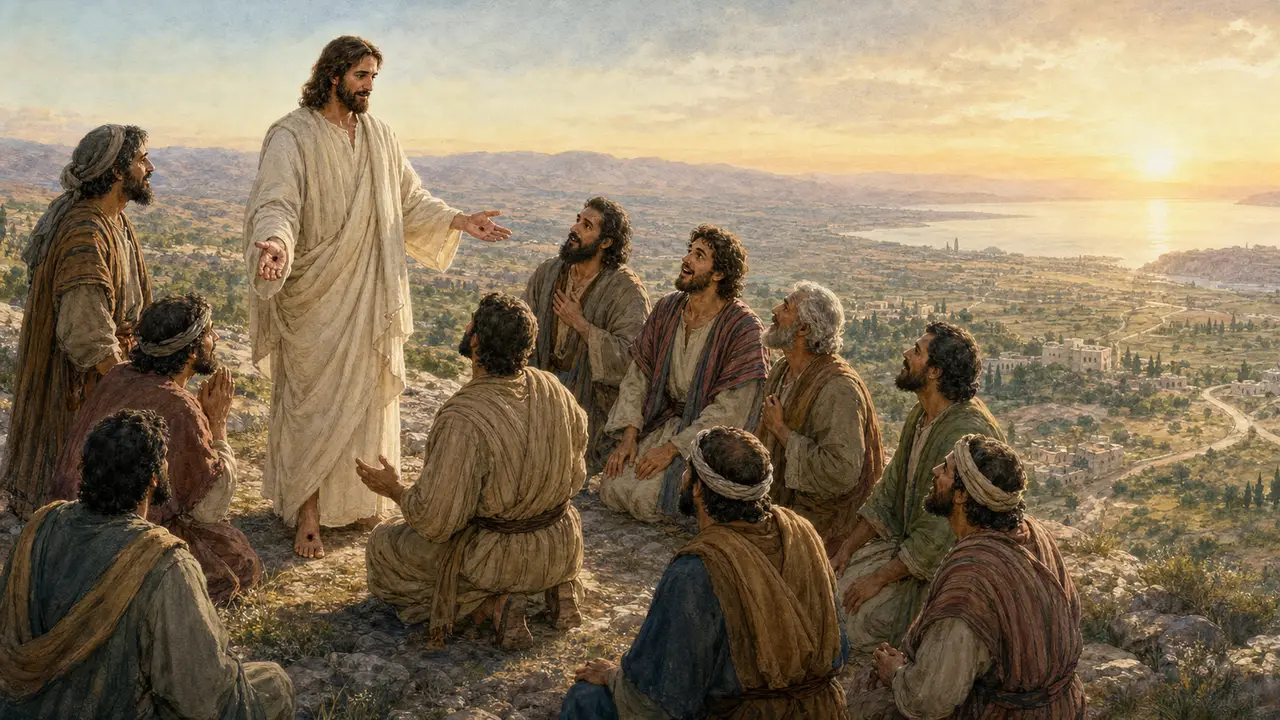
The narrative then returns to the disciples: “But the eleven disciples proceeded to Galilee, to the mountain which Jesus had designated.” The reference to “the eleven” keeps Judas’s betrayal before the reader. The apostolic group bears the mark of failure and loss, but Jesus still gathers them and commissions them. Their authority will rest entirely upon His authority.
Matthew does not identify the mountain. Mountains have played an important role throughout his Gospel. Jesus resisted Satan on a very high mountain, taught His disciples on a mountain, fed the crowds in a mountainous place, and revealed His glory at the transfiguration on a high mountain.
In the Old Testament, mountains frequently served as places where God revealed Himself and commissioned His servants, as at Sinai with Moses and Horeb with Elijah. Matthew leaves this mountain unnamed, while still placing the disciples once again in a place of divine revelation. The risen King gathers them on a mountain to declare His universal authority and establish their mission to the nations.
“When they saw Him, they worshiped Him; but some doubted.” The word translated “doubted” can describe hesitation or uncertainty rather than settled unbelief. Matthew presents the disciples honestly. They worshiped the risen Christ, but some still struggled to comprehend what stood before them.
The resurrection exceeded every category they possessed. Jesus did not wait for them to become impressive, fearless, or intellectually complete before commissioning them. He approached them and grounded the mission in His own authority.
Jesus declared, “All authority has been given to Me in heaven and on earth.” These words strongly echo Daniel 7:13–14, where “One like a Son of Man” comes before the Ancient of Days and receives dominion, glory, and a kingdom so that “all the peoples, nations, and men of every tongue might serve Him.”
His dominion is everlasting and His kingdom will never be destroyed. Jesus had repeatedly called Himself the Son of Man, and His resurrection reveals that the suffering Son of Man has now entered the royal authority promised in Daniel.
The statement also belongs with Psalm 110:1, where Yahweh says to David’s Lord, “Sit at My right hand until I put Your enemies as a footstool for Your feet.” Jesus had already applied that psalm to Himself in Matthew 22:41–46.
His resurrection and exaltation establish Him as the enthroned Messiah who reigns at the Father’s right hand. Daniel 7 provides the clearest background for the scope of His words, while Psalm 110 contributes to the wider biblical picture of the Messiah’s royal enthronement.
“All authority” means that no realm lies outside Christ’s rule. He possesses authority in heaven and upon earth, over angels and rulers, nations and kingdoms, life and death, salvation and judgment.
The Father has given this authority to the Son as the reward and vindication of His obedient work. Philippians 2:8–11 says that because Christ humbled Himself to the point of death on a cross, God highly exalted Him and bestowed on Him the name above every name, so that every knee will bow and every tongue confess that Jesus Christ is Lord.
The commission begins with the word “therefore.” Because Jesus possesses all authority, His disciples must go. The mission of the church rests upon the present reign of Christ. The disciples do not attempt to establish a kingdom for an absent or uncertain ruler. They proclaim the gospel of the King who has defeated death and received dominion over all nations.
Jesus commanded them, “Go therefore and make disciples of all the nations.” The central command is “make disciples.” Going, baptising, and teaching describe how that command is carried out. The disciples had followed Jesus, listened to His teaching, witnessed His works, received His correction, and learned obedience under His authority. They were now to call people from every nation into the same life of faith and obedience.
The movement to “all the nations” fulfils the direction of the whole biblical story. It reaches back to Daniel 7, where the Son of Man receives dominion so that all the peoples, nations, and men of every tongue might serve Him. Matthew 28 shows how that royal dominion begins to be announced among the nations: the risen Son of Man sends His servants to make disciples. I
t also fulfils the promise to Abraham: “In you all the families of the earth will be blessed” in Genesis 12:3. Israel had been called to be a kingdom of priests among the nations, and the prophets foretold that the Servant of Yahweh would be a light to the nations so that God’s salvation might reach to the end of the earth.
Jesus had first sent the twelve to “the lost sheep of the house of Israel” in Matthew 10:6. After His death and resurrection the mission extends openly to every nation. The blessing promised to Abraham now goes out through the gospel of Abraham’s promised Seed.
Making disciples includes “baptizing them in the name of the Father and the Son and the Holy Spirit.” Jesus speaks of one “name,” while naming the Father, the Son, and the Holy Spirit. This is one of Scripture’s clearest statements of the triune identity of God.
The Father is God, the Son is God, and the Holy Spirit is God, and there is one God. Christian baptism therefore places the disciple under the revealed name and authority of the one true God, who eternally exists as Father, Son, and Holy Spirit.
To be baptised into this name signifies identification with God’s saving work and entrance into the visible community of Christ’s disciples. Baptism does not describe a private religious preference. It publicly marks a person as belonging to the Father, redeemed through the Son, and made alive by the Holy Spirit. The formula also places the Son and the Holy Spirit alongside the Father within the singular divine name. No creature could occupy this position.
Jesus then commanded the apostles to teach the nations “to keep all that I commanded you.” The gospel calls people to faith in Christ, and faith produces obedience to Christ. Disciples must learn His commands and keep them. The apostles were not authorised to invent a new moral system or reduce the teaching of Jesus to a small set of preferred sayings. They were to teach “all” that He had commanded.
The word “keep” means more than remembering or discussing His teaching. It means observing, guarding, and obeying it. The Sermon on the Mount, the commands concerning forgiveness, purity, prayer, truthfulness, love, discipline, service, and faithfulness all belong to the teaching entrusted to the church. Obedience does not purchase salvation. Christ purchased salvation through His death and confirmed it through His resurrection. Those whom He saves become His disciples, and disciples submit to their King.
This commission also defines the continuing work of the church. The church must proclaim Christ so that people become disciples, baptise those who confess Him, and teach them to obey everything He commanded. Evangelism that seeks professions of faith without lifelong discipleship falls short of the commission. Teaching that fills the mind while refusing obedience also falls short. Christ commands the church to form disciples whose whole lives come under His authority.
Matthew closes with the promise, “And behold, I am with you always, even to the end of the age.” These words bring the Gospel back to its beginning. In Matthew 1:23, Jesus was identified as Immanuel, meaning “God with us.” At the end of Matthew, the risen Jesus promises, “I am with you always.” The child called Immanuel is the crucified and risen King who remains with His people as they carry the gospel to the nations.
This promise draws upon the repeated assurance God gave His servants throughout the Old Testament. Yahweh told Isaac, “I am with you.” He told Jacob, “I am with you and will keep you wherever you go.” He told Moses, “Certainly I will be with you.” He told Joshua, “Just as I have been with Moses, I will be with you; I will not fail you or forsake you.” When Jesus promises His own abiding presence, He speaks with the authority and identity of Yahweh. He promises more than encouragement from a distance. He promises that He Himself will be with His disciples.
His presence continues “always,” which can carry the sense of “all the days,” through every day until the completion of the age. He is with His people in faithful ministry, persecution, weakness, suffering, obedience, and death. His presence does not mean that the mission will be free from opposition. Matthew has just shown the first organised lie against the resurrection. His promise means that no opposition can remove His people from His rule or prevent Him from accomplishing His purpose.
The resurrection therefore leads directly into mission. Jesus has conquered death, received the kingdom promised to the Son of Man, and opened the blessing of Abraham to the nations. His disciples go because He reigns. They baptise into the name of the Father, the Son, and the Holy Spirit because salvation belongs to the triune God.
They teach obedience because Jesus is Lord. They continue through opposition because the One who sends them remains with them. The church’s confidence rests upon the word of the risen Christ: all authority belongs to Him, and He will never abandon His people.