
Hebrews 12
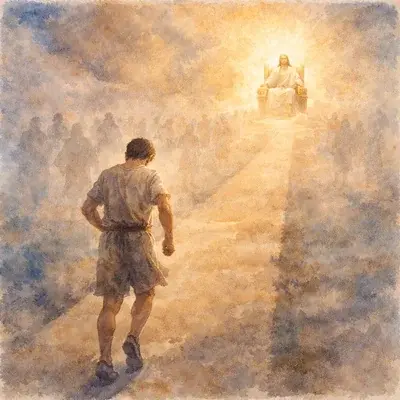
Hebrews 12 follows directly from the testimony of the faithful in chapter 11. Their lives show that faith endures, even when the promise is not yet seen. Because of that, this chapter calls believers to persevere. It explains how endurance works in the life of the church: by fixing our eyes on Jesus, by understanding suffering as the Father’s discipline, by strengthening one another, and by refusing to turn away from the One who speaks from heaven. The chapter moves from the race of faith to the holiness God produces in His children, and then to the final reality of an unshakable kingdom secured through the Son.
Hebrews 12 Explained: Discipline, Holiness, and the Unshakable Kingdom
Hebrews chapter 12 brings all the teaching of the previous chapters together and applies it to the life of the church.
The Son has been shown to be greater than angels, greater than Moses, the eternal High Priest, the mediator of a better covenant, and the one whose sacrifice has perfected for all time those who are being sanctified.
Chapter 11 then showed what faith looks like across history. Now chapter 12 draws the conclusion: because that is true, persevere.
The chapter opens with “therefore.” Because a great cloud of witnesses has testified through endurance, we are to run with endurance the race set before us.
The witnesses are not spectators watching us. Many suffered and died in faith. The word translated “witness” is martus, which is where we get the word “martyr.” Their lives testify that faith perseveres even when it leads to suffering.
The Christian life is described as a race. Everything that hinders must be cast aside. The sin that so easily entangles must be put off.
Throughout Hebrews, sin is fundamentally unbelief, the lie that tells the heart Christ’s once-for-all sacrifice is not enough and pushes us back into thinking we can earn God’s approval by the things we do.
Faith, as chapter 11 showed, trusts in God’s word. Anything that competes with confidence in Christ must be removed.
The focus then moves from the witnesses to Christ Himself. We are not told to fix our attention on the people of faith.
We run by fixing our eyes on Jesus. Earlier, in chapter 2, we were warned to pay much closer attention to what we have heard, lest we drift away. Fixing our eyes on Jesus is how we do it. He is the Apostle and High Priest of our confession. He is the author and perfecter of faith. Perseverance begins and continues with sustained attention to Him.
He endured persecution for the joy set before Him, the joy of accomplishing the Father’s will and bringing many sons to glory, despising the shame of the cross.
He obeyed when obedience meant suffering. Chapter 2 said He was perfected through sufferings to bring many sons to glory. Chapter 5 said He learned obedience through what He suffered.
He is now seated at the right hand of the throne of God, as chapter 1 declared when the Son made purification for sins and sat down, marking the completion of His priestly work. His reign is established, and we run secure in the knowledge that He is bringing many sons to glory.
“Consider Him who has endured such hostility by sinners against Himself.” If believers face opposition, they must reckon with what Christ endured. He faced rejection, persecution, violence, and death. Hebrews adds, “You have not yet resisted to the point of shedding blood.” He did. That comparison guards us from losing heart.
Hebrews teaches them to understand their suffering as discipline. The quotation from Proverbs addresses sons: “My son, do not regard lightly the discipline of the Lord.”
God deals with believers as sons. Chapter 2 said Christ brings many sons to glory. Chapter 12 shows how the Father prepares those sons. A father who never disciplines does not love. Hebrews states plainly that if someone is without discipline, he is illegitimate and not a son. Discipline therefore confirms sonship.
Earthly fathers discipline imperfectly and only for a time. God disciplines for our good, so that we may share His holiness. Holiness has been central to this letter. Without holiness no one will see the Lord. Discipline is painful in the moment, and the text calls it sorrowful, but it yields the peaceful fruit of righteousness in those trained by it. The Father uses hardship to shape His children into obedient sons.
Because discipline has a purpose, believers are not to collapse under it. “Strengthen the hands that are weak and the knees that are feeble.” This language comes from Isaiah 35, where fearful people are told that God Himself is coming to save.
Weak hands and trembling knees describe those close to losing heart. In Hebrews, suffering and discipline have created the same danger. The answer is the same: remember that God is at work for your salvation.
The command is corporate. Strengthen weak hands means restore courage in those whose confidence is fading. Throughout this letter, confidence rests on Christ’s finished sacrifice and His present priesthood. Strengthening the weak therefore means directing one another back to Him.
Steady feeble knees means help one another remain firm in obedient faith. Verse 13 explains why, so that what is lame may be healed rather than put further out of joint. The danger is drifting from what we have heard. The goal is restored stability in Christ.
“Make straight paths for your feet” continues the imagery. Isaiah 35 speaks of a highway for the redeemed. A straight path is a clear path of obedience. In Hebrews, that means removing whatever draws the heart back toward unbelief and keeping our eyes fixed on the Son.
“Pursue peace with all men, and the sanctification without which no one will see the Lord.” Holiness is not optional. Chapter 10 said Christ has perfected for all time those who are being sanctified. Those perfected by His sacrifice are being changed. Faith produces obedience. A life untouched by holiness gives no evidence of sharing in Christ.
The assembly must also see to it that no one falls short of the grace of God. This echoes chapter 4, where the wilderness generation fell short because they did not unite the promise with faith. The warnings in chapters 3, 6, and 10 showed that some remain among the covenant people without ever truly believing. Falling short describes that condition. Nearness to the assembly is not the same as faith.
The warning about a root of bitterness comes from Deuteronomy. A heart that turns away from the Lord does not remain isolated. It spreads and damages many.
Esau illustrates this clearly. He belonged to the covenant family and possessed the birthright, yet he treated it as worthless. He sold it for a single meal. Later he wept, but he found no place for repentance. His grief centred on what he had lost, not on sin against God.
Covenant privilege can be despised. A person may remain within the visible assembly and yet lack saving faith.
Hebrews then contrasts Sinai and Zion. At Sinai the mountain burned with fire, darkness, and storm. The people begged that no further word be spoken. Boundaries were set. Even Moses trembled. Sinai revealed God’s holiness and the distance created by sin. Chapters 3 and 4 showed that that generation did not enter rest because of unbelief.
“But you have come to Mount Zion and to the city of the living God, the heavenly Jerusalem.” Through Jesus, the mediator of a new covenant, believers have access to that heavenly reality.
Chapters 8 to 10 showed that this covenant is superior, founded on better promises and secured by a better sacrifice. Now Hebrews explains what that access means.
We have come to myriads of angels, gathered in joyful worship before God. Zion is not empty. Heaven is alive with praise.
We have come to the church of the firstborn, whose names are enrolled in heaven. This speaks of status and inheritance. In Christ, we are counted as heirs. Our names are not written on earth but in heaven itself.
We have come to God, the Judge of all. The God of Zion is the same holy God revealed at Sinai. He is perfectly just and holy. We stand before Him only because of Christ’s perfect mediation.
We have come to the spirits of the righteous made perfect. Chapter 11 ended by saying that the saints of old were not made perfect apart from us. Now that perfection is secured in Christ. All who belong to Him are brought to completion.
And we have come to Jesus, the mediator of a new covenant, and to the sprinkled blood that speaks better than the blood of Abel. Abel’s blood cried out for judgment. Christ’s blood speaks forgiveness. It is His blood that makes Zion a place of welcome rather than terror.
The God who descended at Sinai is the same God who now brings His people to Zion, and access comes only through the mediator whose sacrifice has satisfied His justice.
Therefore do not refuse Him who is speaking. Hebrews chapter 1 began by saying that God has spoken in His Son. To refuse the Son now is to turn from the living God who speaks from heaven. Those who refused the warning at Sinai did not escape.
And those who turn away from Him who now speaks will not escape either. The wilderness generation heard but did not believe. So also, anyone who hears the Son and rejects Him will not enter the kingdom, no matter how close they are to the assembly.
Haggai 2:6 declares that God will once more shake the heavens and the earth, the sea and the dry land. He once shook the earth at Sinai, and He will shake heaven and earth again. This shaking removes what is created and temporary. As Hebrews 1 says of the Son, “They will perish, but You remain… Like a garment they will also be changed. But You are the same.” Creation will be changed. The Son remains.
“We are receiving a kingdom which cannot be shaken.” Daniel spoke of a kingdom that will never be destroyed. Hebrews has shown that the Son reigns forever. That kingdom rests on His finished work.
Because of this, we are to show gratitude and offer acceptable service with reverence and awe. Grace does not diminish God’s holiness. The chapter closes with the reminder from Deuteronomy: “Our God is a consuming fire.” The God of Zion is the God of Sinai.
Hebrews 12 calls us to endure because Christ endured, to receive the Father’s discipline as sons, to pursue holiness, and to worship with reverence before the holy God. The race continues, but the kingdom we receive cannot be shaken.
God has spoken in His Son.
Those who belong to Him hear His voice and persevere in faith. But those who refuse Him will not escape judgment, when God shakes heaven and earth.