
Galatians 2
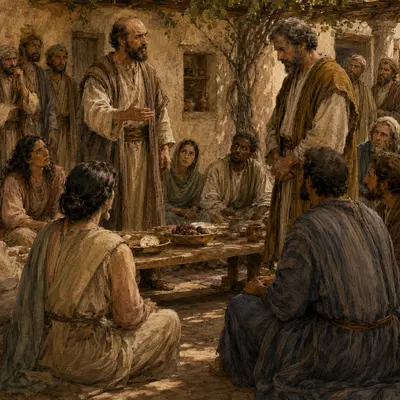
Galatians 2 shows Paul defending the gospel in Jerusalem and Antioch. The apostles recognised his ministry to the Gentiles, Titus was not compelled to be circumcised, and Paul opposed Peter when his conduct compromised the truth that sinners are justified by faith in Christ and not by works of the Law.
Galatians 2 Explained: Justification by Faith, Not by Works
Galatians 2 continues Paul’s defence of the gospel he received from Christ. Chapter 1 showed that Paul’s apostleship did not come from men and that his gospel was not taught to him by men. God revealed His Son to Paul and appointed him to proclaim Christ among the Gentiles.
Chapter 2 now shows that this same gospel was recognised by the apostles in Jerusalem, defended against false brothers who wanted to enslave Gentile believers, and then defended again when Peter’s conduct in Antioch was no longer straightforward about the truth of the gospel. The chapter moves from Jerusalem to Antioch, and then into Paul’s explanation of justification by faith in Christ and not by works of the Law.
Paul begins, “Then after fourteen years I went up again to Jerusalem with Barnabas, taking Titus along also.” This continues the timeline from chapter 1. Paul had already said that he went into the regions of Syria and Cilicia after his brief visit to Jerusalem.
Paul says, “And I went up because of a revelation.” This is an important detail. Paul did not go to Jerusalem because the apostles summoned him, and he did not go because his gospel needed human approval. God directed him to go.
The same God who revealed His Son to Paul now sent him to Jerusalem, where Paul would lay before the recognised leaders the gospel he had been preaching among the Gentiles. This visit did not make Paul’s gospel dependent on Jerusalem. It showed that the apostles in Jerusalem did not correct his gospel, did not add circumcision to it, and did not require Titus, a Greek believer, to live as a Jew in order to be received in Christ.
Paul then says, “I laid out to them the gospel which I preach among the Gentiles, but I did so in private to those who were of reputation.” Paul is not saying that he preached to Gentiles while he was in Jerusalem. He means that he explained to the recognised Christian leaders in Jerusalem the gospel he had been preaching among the Gentiles.
Paul did not go to Jerusalem to receive his gospel from the apostles. He laid his message before them so that the unity of the gospel would be clear. The same Christ was being proclaimed to Jew and Gentile.
Paul adds that he did this privately “lest somehow I might be running, or had run, in vain.” He is not saying he feared his gospel might be false. He has already made clear that his gospel came through a revelation of Jesus Christ.
His concern was that the Gentile mission could be damaged if the recognised apostles in Jerusalem were seen to be divided from him. A public dispute at that point could have strengthened the false brothers and confused the churches. So Paul goes to Jerusalem in order to present the gospel before those of reputation, and the result shows unity between Paul, Peter, James, and John.
Titus makes the issue concrete. Paul says, “But not even Titus, who was with me, though he was a Greek, was compelled to be circumcised.” Titus was not an abstract case. He was a Gentile believer standing with Paul in Jerusalem.
If the recognised apostles believed Gentile believers had to be circumcised for full standing in Christ, Titus would have been the moment to require it. But they did not compel him. That fact shows that the false brothers were not speaking for the Apostles.
Paul then identifies the threat clearly: “But this was because of the false brothers secretly brought in, who had sneaked in to spy out our freedom which we have in Christ Jesus, in order to enslave us.” These men are not described as confused believers needing patient correction. Paul calls them false brothers.
They came in secretly. They wanted to spy out the freedom believers have in Christ. Their goal was slavery. This shows the seriousness of the issue. The demand that Gentiles be circumcised was not a harmless tradition or a cultural preference. It attacked the freedom Christ had given His people.
That freedom is “in Christ Jesus.” Paul is not defending freedom from God, freedom from holiness, or freedom to sin. He is defending freedom from being enslaved under circumcision and the works of the Law as the ground of acceptance with God.
Gentiles do not need to become Jews to belong to Christ. They do not need the covenant of circumcision to be counted as God’s people. Their standing is in Christ, and to place them under the Law as the basis of righteousness is to enslave them.
Paul says, “But we did not yield in subjection to them for even a moment, so that the truth of the gospel would remain with you.” That sentence gives the reason for Paul’s refusal. He is not being stubborn for the sake of personal pride. He resists because the truth of the gospel is at stake.
If Titus had been compelled to be circumcised, the action itself would have preached a false message. It would have said that faith in Christ was not enough, and that Gentile believers needed circumcision to be fully accepted. Paul refuses to yield because the gospel must remain intact for the churches.
Paul then returns to the recognised leaders in Jerusalem. “But from those who were of high reputation, what they were makes no difference to me; God shows no partiality, well, those who were of reputation contributed nothing to me.” Paul is not being disrespectful. He recognises their place, and he later names James, Cephas, and John as pillars.
But no man’s reputation stands above the gospel. God shows no partiality. Even the most respected leaders in Jerusalem did not add anything to Paul’s message. They did not supply what was missing. They did not correct his gospel. They recognised the grace God had given him.
Paul says, “But on the contrary, seeing that I had been entrusted with the gospel to the uncircumcised, just as Peter had been to the circumcised, for He who worked in Peter unto his apostleship to the circumcised worked in me also unto the Gentiles.” The distinction is not two gospels, one for Jews and one for Gentiles.
There is one gospel, but two fields of labour. Peter had been entrusted with an apostleship to the circumcised, and Paul had been entrusted with the gospel to the uncircumcised. The same God worked through both. The mission differed in direction, but the gospel remained the same.
James, Cephas, and John recognised this. Paul says they were “reputed to be pillars,” and they gave to Paul and Barnabas “the right hand of fellowship.” This shows agreement, partnership, and public recognition. The apostles were not divided over whether Gentile believers needed circumcision for full standing in Christ.
Paul and Barnabas would go to the Gentiles, and James, Cephas, and John would go to the circumcised. Their ministries were distinct, but they stood together in the same gospel.
They asked only that Paul and Barnabas remember the poor, “the very thing I also was eager to do.” This request does not add a condition to the gospel. It shows the practical fruit of fellowship.
The gospel unites Jew and Gentile in Christ, and that unity expresses itself in care for needy believers. Paul does not treat mercy as a rival to doctrine. He is eager to do it. But care for the poor does not replace the gospel, and it does not become the ground of justification. It flows from the fellowship created by Christ.
Verse 11 then moves the scene from Jerusalem to Antioch. Paul writes, “But when Cephas came to Antioch, I opposed him to his face, because he stood condemned.” The confrontation did not happen during the private meeting with the recognised apostles in Jerusalem. It happened later, when Peter came to Antioch.
This matters for the flow of the chapter. In Jerusalem, Paul’s gospel to the Gentiles was recognised, Titus was not compelled to be circumcised, and the apostles gave Paul and Barnabas the right hand of fellowship. But in Antioch, Peter’s conduct contradicted that recognition. He had already acknowledged the Gentile mission, yet when pressure came, he withdrew from Gentile believers.
Paul explains what happened. “For prior to the coming of certain men from James, he used to eat with the Gentiles, but when they came, he began to shrink back and separate himself, fearing the party of the circumcision.”
Before these men arrived, Peter ate with Gentile believers. That table fellowship showed that Gentiles in Christ were not unclean outsiders. They were Christian brothers. They belonged at the same table because they belonged to the same Lord.
But when certain men came from James, Peter began to withdraw. Paul says he did this because he feared the party of the circumcision. This connects back to chapter 1, where Paul said that if he were still trying to please men, he would not be a slave of Christ.
The fear of man is one of the ways gospel compromise takes hold. Peter knew better, but fear led him to act against what he knew. He did not need to preach a false sermon to damage the gospel. His own conduct sent a false message.
The false brothers in Jerusalem and the men who later came from James are not necessarily the same physical people. But the pressure moved in the same direction. In Jerusalem, false brothers wanted to bring Gentile believers into slavery by attacking their freedom in Christ. In Antioch, the arrival of men from James led Peter to withdraw from Gentile believers, making them appear incomplete unless they lived like Jews.
The setting changes, and the people may not be identical, but the danger is the same. Gentile believers are being treated as though faith in Christ is not enough unless they also live like Jews.
Paul says these men came “from James,” and that detail should not be passed over too quickly. They had some real connection with James, whether James had sent them, whether they came from his church, or whether they claimed his authority in some way. The text does not tell us exactly what James intended, and we should not pretend to know more than Paul tells us.
But the irony is striking. In Galatians, men connected with James were involved in pressure that obscured justification by faith in Christ. Today, many do something similar with the letter of James. They come “from James,” not the man in Jerusalem, but the epistle that bears his name, and they use James 2 to weaken the very truth Paul defends in Galatians 2: that a man is justified by faith in Christ and not by works of the Law.
But James is not the problem. James the man did not teach another gospel, and James the letter does not teach justification by works as the ground of righteousness before God. The problem is the misuse of James. James exposes dead faith. Paul exposes false righteousness. James says that a faith without works is dead. Paul says that works cannot justify the ungodly. These are not rival doctrines. They are two attacks on two different errors.
Verse 13 shows that the hypocrisy spread widely: the rest of the Jews joined Peter, and even Barnabas was carried away. If Peter and Barnabas could be pulled into this, it is possible that James himself had also been affected by the same pressure, or that men connected to him were using his name to press the issue further than he intended.
What Paul makes clear is that their arrival changed Peter’s conduct, and Peter’s conduct was no longer straightforward about the truth of the gospel.
Paul then says, “And the rest of the Jews joined him in hypocrisy, with the result that even Barnabas was carried away by their hypocrisy.” This shows how quickly gospel compromise spreads. Peter withdrew, the rest of the Jews followed him, and even Barnabas was carried away.
Barnabas had stood beside Paul in the Gentile mission. He had gone with Paul to Jerusalem. He had seen Titus not compelled to be circumcised. Yet even he was pulled along. The pressure was not small. It was strong enough to fracture table fellowship in the church and to make Gentile believers appear second-class.
This is why Paul opposed Peter publicly. “But when I saw that they were not straightforward about the truth of the gospel, I said to Cephas before everyone…” The issue was public, so the correction had to be public. Peter’s withdrawal did not affect only his private conscience. It affected the whole church.
His behaviour taught others to separate from Gentile believers. His conduct implied that Gentiles in Christ were still not fully clean unless they lived like Jews. That is why Paul says they were not straightforward about the truth of the gospel.
Paul’s question exposes the contradiction: “If you, being a Jew, live like the Gentiles and not like the Jews, how is it that you compel the Gentiles to live like Jews?” Peter knew that fellowship with God did not require Gentiles to take on Jewish identity. His previous table fellowship proved that.
By eating with Gentiles, Peter had already been living as though the old separation between Jew and Gentile had been overcome in Christ. But when he withdrew, his conduct compelled Gentiles to live like Jews. He made them feel the pressure to adopt Jewish ways if they wanted full fellowship. Paul sees that as a denial of the gospel in practice.
Paul then gives the doctrine behind the rebuke. “We are Jews by nature and not sinners from among the Gentiles; nevertheless knowing that a man is not justified by the works of the Law but through faith in Jesus Christ.” Paul speaks as a Jew to another Jew. Jews had the Law, the covenants, and the promises.
They were not Gentile sinners in the covenantal sense. But Peter knew that a man is not justified by works of the Law. The Law cannot make a sinner righteous before God. Justification means being declared righteous in God’s sight. Paul says that does not come through works of the Law, but through faith in Jesus Christ.
Then Paul applies it personally: “even we have believed in Christ Jesus, so that we may be justified by faith in Christ and not by the works of the Law.” This is the centre of Paul’s argument. Even Jewish believers, who possessed the Law, had to believe in Christ to be justified.
If Jews are justified by faith in Christ and not by works of the Law, then Gentiles must not be compelled to live like Jews. Paul closes the sentence with the broadest possible statement: “since by the works of the Law no flesh will be justified.” No flesh means no one. Jew or Gentile, no sinner will be justified by works of the Law.
This strikes at the heart of the false gospel troubling Galatia. The issue is not simply circumcision as one isolated ritual. Circumcision was the presenting issue because it marked Gentiles as taking on life under the Law. But Paul widens the argument to works of the Law.
The problem is using Law-observance as the basis of righteousness before God. The Law is not evil, and obedience to God is not evil. But works of the Law cannot justify sinners. To add them to Christ as the ground of acceptance with God is to deny the grace of God.
Paul then answers a likely objection: “But if, while seeking to be justified in Christ, we ourselves have also been found sinners, is Christ then a minister of sin? May it never be!” If Jewish believers leave behind Law-observance as the basis of righteousness and seek justification in Christ, does that make Christ a servant of sin?
Does Christ lead Jews into sin by bringing them into fellowship with Gentiles? Paul answers this in his strongest terms: “May it never be!” Christ is not a minister of sin. The problem is not Christ. The problem is rebuilding what the gospel has torn down.
Paul says, “For if I rebuild what I have once destroyed, I prove myself to be a transgressor.” The transgression would be to return to the Law as the basis of righteousness after abandoning it for Christ. Paul had already torn down that way of seeking standing before God. If he now rebuilt it, he would prove himself to be in the wrong.
Peter’s withdrawal was dangerous because it began to rebuild the wall that Christ had torn down. It treated Gentile fellowship as a problem again. It implied that old covenant boundary markers still decided who could sit together as clean before God.
Paul then says, “For through the Law I died to the Law, so that I might live to God.” The Law itself brought Paul to the end of the Law as a means of righteousness. It exposed sin. It condemned the sinner. It showed that righteousness could not come through human obedience.
Through the Law, Paul died to the Law, so that he might live to God. He no longer lives under the Law as the way to be justified. He lives to God through union with Christ.
This brings Paul to one of the strongest statements in the letter: “I have been crucified with Christ, and it is no longer I who live, but Christ lives in me.” Paul is not using this as a detached devotional phrase. It belongs to the argument about justification and the Law.
The old Paul, seeking righteousness through his own standing under the Law, has died with Christ. His life under condemnation has ended because he has been united to Christ in His death. He no longer stands before God on the basis of Law-works, Jewish identity, zeal, or tradition. He stands in Christ.
Yet Paul still lives. “And the life which I now live in the flesh I live by faith in the Son of God.” His physical life continues, but it is now defined by faith. This is not faith in faith. It is faith in the Son of God. Christ is the object, foundation, and life of the believer.
Paul does not say that he lives by returning to the Law, or by adding works to Christ, or by seeking human approval. He lives by faith in the Son of God.
Then Paul shows how personal the gospel is to him: “who loved me and gave Himself up for me.” In chapter 1, Paul said Christ “gave Himself for our sins.” Here he brings that same truth onto his own life. The Son of God loved me and gave Himself up for me.
These are not abstract arguments. Christ loved Paul, the former persecutor, and gave Himself for him. That is the grace Paul refuses to set aside. The Son of God did not give Himself so that sinners could finish the work by circumcision or works of the Law. He gave Himself to save them.
Paul closes the chapter with the unavoidable conclusion: “I do not set aside the grace of God, for if righteousness comes through the Law, then Christ died needlessly.” This is the heart of the matter. To seek righteousness through the Law is to set aside the grace of God. It does not deepen the gospel. It denies it.
If righteousness could come through the Law, Christ did not need to die. Paul will not accept that conclusion. Christ did not die needlessly. His death was necessary because sinners cannot be justified by works of the Law. That is why Paul said in chapter 1 verse 6: “I marvel that you are so quickly deserting Him who called you by the grace of Christ.”
Turning to works-based salvation means deserting God.
Galatians 2 teaches that the truth of the gospel must be preserved in doctrine and in conduct. In Jerusalem, Paul refused to submit to false brothers who wanted to enslave Gentile believers. In Antioch, he opposed Peter because Peter’s behaviour denied the fellowship created by the gospel. The issue was not only what men said with their mouths, but what their actions taught about Christ.
If Jews and Gentiles are justified by the same Christ, through the same faith, then Gentile believers cannot be treated as second-class members of God’s people. The Son of God loved His people and gave Himself for them. Therefore righteousness cannot come through the Law, and nothing can be added to Christ as the ground of acceptance with God.