
Luke 9
Jesus sends out the Twelve to proclaim the kingdom of God, and Herod asks who this man is. Jesus feeds five thousand in a desolate place, Peter confesses Him as the Christ of God, and Jesus teaches that the Son of Man must suffer and that His followers must take up their cross daily. On the mountain the Father declares, "This is My Son, My Chosen One; listen to Him!" Then Jesus sets His face to go to Jerusalem.
Luke 9 continues the question that has been building through the previous chapters: who is Jesus? In chapter 8 the disciples asked, “Who then is this, that He commands even the winds and the water, and they obey Him?” In chapter 9 Herod asks essentially the same question: “who is this man about whom I hear such things?” By the middle of the chapter Peter will answer, “The Christ of God,” and then on the mountain the Father Himself will answer from heaven: “This is My Son, My Chosen One; listen to Him!” The chapter therefore moves from questions about Jesus’ identity, to confession, to divine testimony, and then to what it means to respond rightly to the One the Father has identified.
Jesus begins by calling the Twelve together and giving them “power and authority over all the demons and to heal diseases.” The authority is His gift: they do not possess it independently, and the mission is His, not theirs. He sends them “to preach the kingdom of God and to heal the sick”, and verse 6 says that they went throughout the villages “proclaiming the gospel and healing everywhere”.
The kingdom of God is God’s rule, exercised through the King He has promised, and it frames this whole chapter. Luke uses the phrase five times: in the sending of the Twelve in verse 2, in Jesus’ teaching of the crowds in verse 11, in the promise of verse 27 that some will see it before they die, and twice in the closing calls to discipleship in verses 60 and 62. The chapter begins with the kingdom being proclaimed in the villages and ends with the question of who is fit for it.
The word “gospel” means good news. In the wider ancient world it could be used for announcements of victory, the accession of a ruler, or other public news associated with kingship and triumph. Luke has already given the content of this good news in his opening chapters: God has acted to fulfil His covenant promises, His King has come, and His kingdom is drawing near. The apostles therefore go out as heralds announcing what God is doing through Jesus.
Jesus tells His apostles to take nothing for the journey: no staff, bag, bread or money, and no second tunic. The point is dependence. They are not to secure themselves before they obey the mission; they are to go as those who depend upon God to provide for them through the hospitality of those who receive the message.
When a house receives them, they are to remain there until they leave the city. When a city does not receive them, they are to shake the dust off their feet “as a testimony against them”. That action carries the language of judgment. The message of the kingdom requires a response, and to reject the messengers Jesus sends is to come under judgment. Luke will come back to the word “receive” twice more before the chapter ends.
The word therefore begins to spread beyond Jesus Himself. In chapter 8 Jesus was travelling through cities and villages proclaiming the kingdom; now the Twelve do the same under His authority, and the seed continues to be scattered.
The result is that Herod hears “of all that was happening”. Some say John has risen from the dead, others that Elijah has appeared, and others that one of the prophets of old has risen again. Herod says, “I myself had John beheaded, but who is this man about whom I hear such things?” That question becomes the controlling question of the chapter. The possible answers circulating among the people are all inadequate. John, Elijah and the prophets are all important figures, but Jesus cannot finally be explained by placing Him within the category of another prophet.
When the apostles return, Jesus takes them away toward Bethsaida, but the crowds follow, and He welcomes them, speaks to them about the kingdom of God and heals those who need healing. As the day ends, the Twelve want the crowd sent away, “for here we are in a desolate place.” Jesus answers, “You give them something to eat!” He takes the five loaves and two fish, looks up to heaven, blesses and breaks them, and keeps giving them to the disciples to set before about five thousand men. Everyone eats, everyone is satisfied, and twelve baskets of broken pieces remain.
The setting recalls Israel in the wilderness, where Yahweh fed the people He had brought out of Egypt, the people He had redeemed in fulfilment of His covenant with Abraham, Isaac and Jacob. There is also a prophetic background in 2 Kings chapter 4, where Elisha feeds one hundred men with twenty barley loaves, and they eat and have some left over “according to the word of Yahweh.” Jesus now feeds thousands with far less. So the feeding of the five thousand is another answer to Herod’s question. Who is this man? He is the One who provides for God’s people in the wilderness as Yahweh did, who surpasses the prophets, and in whom the kingdom He has been proclaiming is beginning to appear.
The twelve baskets also fit the wider pattern of the chapter. Jesus handed the bread to the disciples to distribute, and although Luke does not say that each of the Twelve ended up holding a basket, the count is hard to miss. The same men who said, “We have no more than five loaves and two fish,” and who had just been sent out with no bread for their journey, are left with more than they started with. Jesus told them, “You give them something to eat!” and when they gave what He put in their hands, there was more than enough. We should not invent a detailed symbolism that Luke does not explain, but the number also keeps the Twelve, and the Israel they were sent to, in view.
The identity question then becomes explicit. While Jesus is praying alone, with His disciples nearby, He asks, “Who do the crowds say that I am?” Their answers are the same reports Herod heard: John the Baptist, Elijah, or one of the prophets of old risen again. Then Jesus makes the question personal: “But who do you say that I am?” Peter answers, “The Christ of God.” This is the first time in Luke that one of the disciples gives the correct confession so directly. Jesus is the Christ, the Messiah, God’s promised King, but Peter has the correct title before he fully understands what that title means.
Jesus warns them not to tell anyone, and then explains what the Christ must do: “The Son of Man must suffer many things and be rejected by the elders and chief priests and scribes, and be killed and be raised up on the third day.” Son of Man is the title Jesus most often uses for Himself, and it comes from Daniel chapter 7. There Daniel sees one “like a Son of Man” coming “with the clouds of heaven,” and to Him is given “dominion, Glory, and a kingdom,” an everlasting dominion that will not be taken away. That is what makes verse 22 so startling: the One who receives the kingdom must be rejected and killed. The word “must” places the suffering, rejection, death and resurrection of Jesus inside His messianic mission. They are not accidents that interrupt it. Whatever expectations Peter and the other disciples may have attached to “Christ”, Jesus defines His Messiahship through suffering before glory.
He then explains what that means for anyone who follows Him: “If anyone wishes to come after Me, let him deny himself, and take up his cross daily and follow Me.” Modern readers can easily weaken that language into the idea of enduring ordinary difficulties, but Jesus’ hearers would not have heard it that way. The cross was a Roman instrument of execution, and to carry a cross was to walk toward death. Jesus is calling His disciples to surrender the right to preserve themselves at any cost and to follow Him even where obedience may involve suffering, rejection and death. Luke adds the word “daily”, so cross-bearing is the continuing shape of following Jesus rather than a single dramatic moment.
Jesus explains, “whoever wishes to save his life will lose it, but whoever loses his life for My sake, he is the one who will save it,” and then asks, “what is a man profited if he gains the whole world, and loses or forfeits himself?” The point follows directly from the cross image. A person can preserve everything the world values and still lose himself before God. Belief and obedience therefore belong together. Peter has confessed who Jesus is, and Jesus now explains what following the Christ requires. A confession that remains only in the mouth while refusing the path Jesus commands is the very life that is lost.
Jesus then makes the stakes eternal: “whoever is ashamed of Me and My words, the Son of Man will be ashamed of him when He comes in His glory, and the glory of the Father and of the holy angels.” The Son of Man of Daniel chapter 7 will keep that word on the day He comes, so a person’s eternal standing before God turns on their response to Jesus and His words.
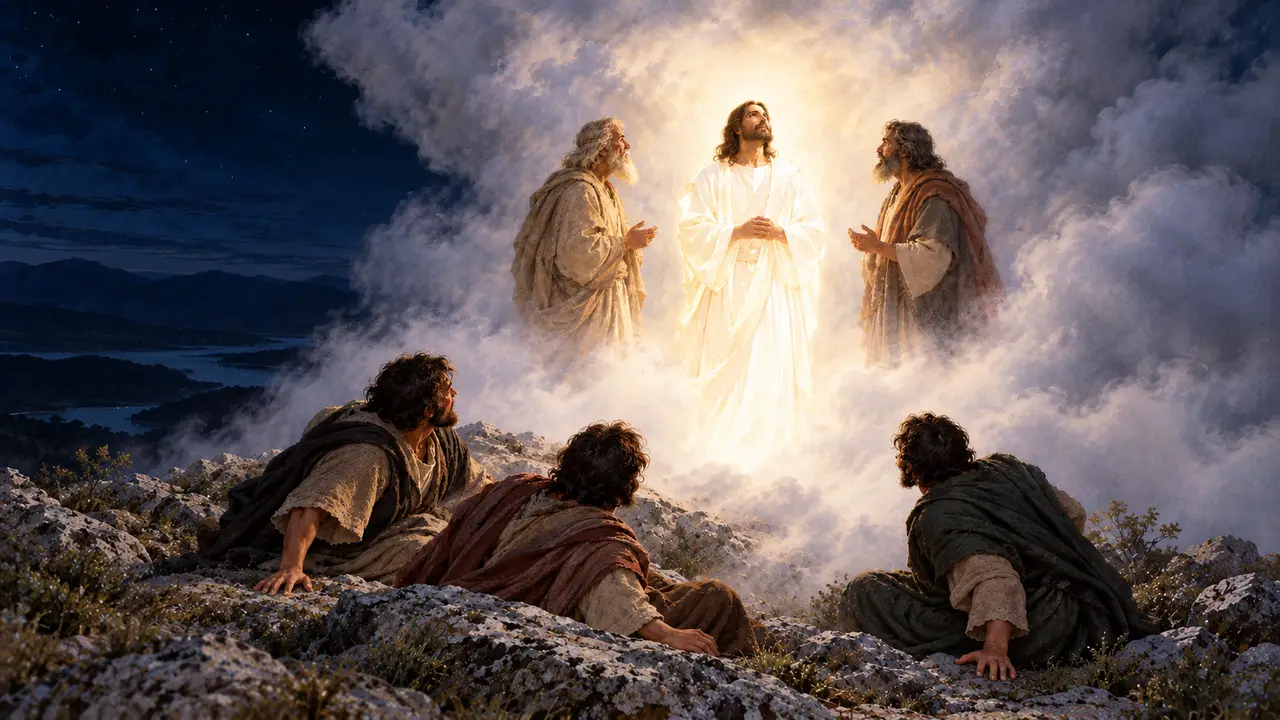
Then He says, “there are some of those standing here who will not taste death until they see the kingdom of God.” Luke immediately tells us that about eight days later Jesus takes Peter, John and James up the mountain to pray. That close connection points to the Transfiguration as the fulfilment of what Jesus has just said. Luke does not use that word, which is the name the church has given to this change in Jesus’ appearance; he describes it. As Jesus prays, the appearance of His face becomes different and His clothing becomes white and gleaming.
Luke ties the scene to verse 26 through the word “glory”. Jesus has just spoken of the Son of Man coming “in His glory”. Now Moses and Elijah appear “in glory”, and when the disciples, who had been overcome with sleep, are fully awake, “they saw His glory”. The glory Jesus promised for His coming is shown in advance on the mountain.
Moses represents the Law, and Elijah stands among the greatest of the prophets. Both encountered Yahweh on a mountain: Moses received the Law at Sinai and entered the cloud of Yahweh’s presence, and Elijah later came to Horeb and encountered Yahweh there. Now both stand with Jesus, and Luke tells us what they are discussing: “His departure which He was about to fulfill at Jerusalem.” The Greek word translated “departure” is exodos, the word from which we get “exodus”. Moses and Elijah are speaking with Jesus about His exodus.
The first exodus was Yahweh’s great act of deliverance in the Old Testament, bringing Israel out of slavery through judgment and redemption, and He did it because He remembered His covenant with Abraham, Isaac and Jacob. Now Jesus is about to accomplish a greater exodus at Jerusalem through His suffering, death, resurrection and ascension, in keeping with the same covenant promise. The road to Jerusalem is therefore the place where God’s saving purpose will be accomplished, not only the road to an execution.
As Moses and Elijah are leaving, Peter says, “Master, it is good for us to be here; let us make three booths: one for You, and one for Moses, and one for Elijah.” Luke adds that Peter did not realise what he was saying, and the proposal itself shows why: it places Jesus, Moses and Elijah side by side, one booth for each. Eight days earlier Peter confessed Jesus as “The Christ of God,” but he still does not grasp who the Christ is, and the Father is about to tell him.
While he is still speaking, a cloud forms and overshadows them. Throughout the Old Testament the cloud marks Yahweh’s presence. It covered Sinai, and when the tabernacle was finished, “the cloud covered the tent of meeting, and the glory of Yahweh filled the tabernacle.” Later the glory cloud filled the temple. Peter wanted to build booths; Yahweh answers with the cloud of His own dwelling presence. The disciples are afraid as they enter the cloud.
Then the Father speaks: “This is My Son, My Chosen One; listen to Him!” That is heaven’s answer to the question running through the chapter. Herod asked who this man is, the crowds guessed, Peter confessed Him as the Christ of God, and now the Father says, “This is My Son.” Jesus is not another prophet standing beside Moses and Elijah, and the Father’s words answer Peter’s three booths by identifying Him uniquely.
“Chosen One” carries the language of Isaiah chapter 42, where Yahweh says of His Servant, “Behold, My Servant, whom I uphold; My chosen one in whom My soul is well-pleased.” The Servant in Isaiah is the One Yahweh appoints to accomplish His purpose, and that same Servant will later set His face toward suffering.
The command “listen to Him” carries us back to Deuteronomy chapter 18, where Moses told Israel, “Yahweh your God will raise up for you a prophet like me from among you, from your brothers; you shall listen to him.” That was Yahweh’s covenant promise of a coming prophet whom Israel must hear. Now Moses himself stands on the mountain, and the Father says of Jesus, “listen to Him!” Yahweh has kept His word: Jesus is the prophet Moses said would come after him. The command also picks up the warning of chapter 8, where Jesus said, “So beware how you listen,” and named as His mother and brothers “these who hear the word of God and do it.” Now the Father names the One who must be heard.
When the voice has spoken, “Jesus was found alone.” Moses and Elijah disappear, and Jesus remains as the One to whom the Law and the Prophets have borne witness. The Transfiguration therefore stands at the theological centre of the chapter.
The next day they come down the mountain and are met at once by demonic power and unbelief. A man shouts from the crowd concerning his only son: a spirit seizes the boy, makes him scream, throws him into convulsions and mauls him. The father says, “I begged Your disciples to cast it out, and they could not.” The chapter began with Jesus giving the Twelve “power and authority over all the demons”. The authority was real, and the failure was theirs. Jesus names the cause: “You unbelieving and perverse generation, how long shall I be with you and put up with you?”
That language recalls the Song of Moses in Deuteronomy chapter 32, where Yahweh says of Israel, “they are a perverse generation, Sons in whom is no faithfulness.” Yahweh gave that song to Israel as “a witness for Me against the sons of Israel,” because He knew they would turn to other gods and break His covenant once they entered the land. Jesus takes up the words of that covenant witness. The old unbelief remains even while God’s Messiah stands among them, and the disciples are not exempt from it.
Jesus commands that the boy be brought to Him, and even as the boy approaches, the demon slams him to the ground and throws him into a convulsion. Jesus rebukes the unclean spirit, heals the boy and gives him back to his father. Luke says, “they were all astonished at the majesty of God.” Jesus is the One who acted, but the crowd credits what they have seen to the majesty of God. Whether or not they grasp it, they have given a truer answer to Herod’s question than Herod could: in what Jesus does, God Himself is at work.
But while everyone is still marvelling at all that He is doing, He turns to His disciples and says, “Put these words into your ears; for the Son of Man is going to be delivered into the hands of men.” The timing is deliberate. The crowd is astonished at divine majesty, the disciples have just seen Jesus exercise absolute authority over an unclean spirit, and this is the moment He chooses. The disciples must not define the Messiah only through visible triumph and miraculous power, because the glorious Son whom demons obey will willingly be delivered into human hands.
Luke then says the disciples do not understand the statement, that “it was concealed from them so that they would not perceive it,” and that they are afraid to ask Him about it. The Father has just said, “listen to Him!” Jesus has just said, “Put these words into your ears.” And still they do not understand. Their failure is real, but Luke’s wording shows that God Himself is withholding their understanding for now. Luke follows this thread through the Gospel. At the third prediction of His death in chapter 18, “this statement was hidden from them,” and only after the resurrection, in chapter 24, does Jesus open “their minds to understand the Scriptures.” The disciples will not understand the cross until it has happened, and even their incomprehension sits within God’s timing.
An argument then starts among them about which of them might be the greatest. Jesus has just told them that He will be delivered into the hands of men, and they are discussing rank. Jesus knows what they are thinking in their heart, takes a child and stands him by His side, and says, “Whoever receives this child in My name receives Me, and whoever receives Me receives Him who sent Me; for the one who is least among all of you, this is the one who is great.” A child possessed little social status or power, and Jesus identifies Himself with someone the world would regard as insignificant. The word “receive” from verse 5 returns here four times in a single sentence. Greatness found in the least fits the path Jesus Himself is taking. The Christ reaches glory through humiliation, so the disciple cannot pursue greatness through status, recognition and rank while following a Master who is going toward rejection and death.
John then tells Jesus that they saw someone casting out demons in His name and tried to hinder him “because he does not follow along with us.” This reveals another misunderstanding. The authority belongs to Jesus, not to the Twelve, and they are not the owners of His name or His kingdom. They could not cast the demon out of the boy, and now they try to stop someone who is casting out demons in Jesus’ name. Jesus answers, “Do not hinder him, for he who is not against you is for you.” The kingdom is larger than their own group and their own sense of importance.
Then Luke reaches one of the great turning points of the Gospel: “when the days for Him to be taken up were soon to be fulfilled, He set His face to go to Jerusalem.” From this verse onward Luke’s Gospel becomes a journey to Jerusalem, and that journey occupies the next ten chapters until Jesus comes to the city in chapter 19. “Taken up” looks beyond the cross to His ascension, the completion of the exodus Moses and Elijah spoke of on the mountain. Jesus knows what waits for Him there, and now He turns toward it deliberately. “He set His face” communicates resolve: Jesus is not carried unwillingly toward the cross.
There may also be an echo here of the Servant of Isaiah, the same chosen Servant the Father’s voice recalled on the mountain. In Isaiah chapter 50 the Servant says, “I have set My face like flint.” The Servant moves toward suffering in obedience to Lord Yahweh, and Jesus now does the same.
Messengers go ahead into a Samaritan village to make arrangements for Him, but the village does not receive Him, because He is journeying with His face toward Jerusalem. That rejection reflects the deep hostility between Jews and Samaritans. The Samaritans rejected Jerusalem as the proper centre of worship, and Jesus’ journey toward Jerusalem identifies Him with the destination they opposed.
James and John see this and ask, “Lord, do You want us to command fire to come down from heaven and consume them?” Their suggestion has Old Testament precedent. In 2 Kings chapter 1, Elijah calls down fire from heaven upon men sent by King Ahaziah, and James and John have just seen Elijah on the mountain. They remember the prophet of judgment, and they have not understood the mission of Jesus.
Jesus turns and rebukes them, and they go on to another village. Some manuscripts include the longer statement, “You do not know what kind of spirit you are of, for the Son of Man did not come to destroy men’s lives, but to save them.” The LSB brackets these words because the earliest manuscript evidence does not contain them consistently, so we cannot confidently say they formed part of Luke’s original text. The secure text is enough. With this village the word “receive” has come full circle. In verse 5 Jesus told the Twelve that when a town did not receive them, they were to shake the dust off their feet as a testimony against them. Now a village does not receive Jesus Himself, and James and John reach for fire. Judgment on those who reject Him is real, as verse 26 has already made clear, but it belongs to the Son of Man when He comes in His glory, not to the disciples now. He continues toward Jerusalem, where He Himself will be rejected and killed.
The chapter closes with three encounters that bring the question down onto anyone who claims to follow Jesus. As they go along the road, someone says, “I will follow You wherever You go.” Jesus answers, “The foxes have holes and the birds of the air have nests, but the Son of Man has nowhere to lay His head.” Again Jesus calls Himself the Son of Man, the figure in Daniel chapter 7 to whom is given dominion over all peoples and a kingdom that will not be destroyed. That same Son of Man has nowhere to lay His head. The One who will receive everything has nothing now, because His road runs through the cross before glory, and anyone who follows Him must understand the road they are joining.
Jesus says to another, “Follow Me.” The man answers, “Lord, permit me first to go and bury my father.” Jesus says, “Allow the dead to bury their own dead; but as for you, go and proclaim everywhere the kingdom of God.” The statement is deliberately severe. Whether the man’s father has just died, or whether he means that he wishes to remain at home until his father eventually dies, Luke does not tell us. Either way, Jesus uses “dead” in two senses. Those who remain outside the kingdom are spiritually dead, and they can attend to the burying of the physically dead. The man Jesus has called has a living task: to proclaim the kingdom of God. The point turns on the word “first”. The call of Jesus cannot be placed behind another obligation and postponed indefinitely.
Another says, “I will follow You, Lord, but first permit me to say farewell to those at home.” Jesus answers, “No one, after putting his hand to the plow and looking back, is fit for the kingdom of God.” The image recalls the call of Elisha in 1 Kings chapter 19. Elisha is ploughing when Elijah calls him, and Elisha asks permission to kiss his father and mother before he follows. Elijah lets him go, and Elisha sacrifices his oxen, boils their flesh using the ploughing equipment as fuel, and then follows. Jesus’ demand is even greater. The call of the kingdom requires undivided allegiance, and once the hand is on the plough, the eyes must remain forward.
Once the Father has spoken from the cloud, the question running through the rest of Luke 9 becomes whether the disciples will actually listen. Jesus tells them He will suffer, and they argue about greatness. He teaches them about receiving the least, and they try to hinder someone acting in His name. He sets His face toward Jerusalem, and James and John want to call down fire on those who do not receive Him. Then others claim they will follow Him while still placing other things first.
Luke therefore does more than identify Jesus; he shows what follows from His identity. If Jesus is the Christ of God, the Father’s Son, the Chosen One and the prophet Moses promised, then His word carries absolute authority. He must be heard, He must be believed, and He must be followed, and the one who is ashamed of Him and His words will find the Son of Man ashamed of him when He comes in His glory. Because His road runs through the cross before glory, following Him means taking up the cross daily, surrendering claims to status and security, and setting our own faces in the direction He leads without looking back. The chapter that began with the kingdom proclaimed in the villages ends on the road to Jerusalem, with the King going ahead of His disciples to accomplish His exodus.