
Exodus 10
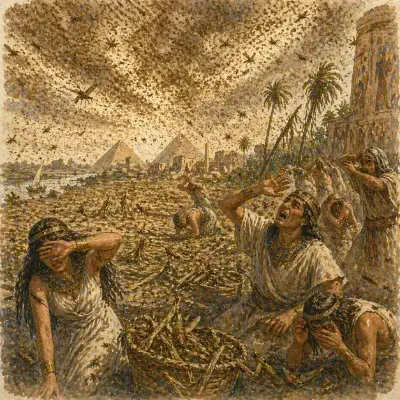
Exodus 10 brings the plague cycle to its final stage before the death of the firstborn, as Yahweh sends locusts to strip the land bare and then covers Egypt in a darkness that can be felt. These judgments do more than devastate the nation; they reveal Yahweh’s purpose in hardening Pharaoh’s heart and performing these signs among Egypt. The chapter shows the complete collapse of Egypt’s power, the exposure of its gods, and the growing distinction between Egypt and Israel. At the same time, Yahweh declares that these events are to be remembered and recounted by future generations, so that His people will know that He is Yahweh.
Exodus 10 Explained: The Plagues of Locusts and Darkness
Exodus 10 begins by explaining Yahweh’s purpose in sending the plagues.
Before the first plague of the chapter is described, Yahweh says to Moses, “Come to Pharaoh, for I have hardened his heart and the heart of his servants with firmness, that I may set these signs of Mine among them, and that you may recount in the hearing of your son and of your grandson how I dealt severely with the Egyptians, and how I put My signs among them, that you may know that I am Yahweh.”
This is the most explicit covenantal explanation given in the plague cycle. Earlier Yahweh had spoken of making His name known to Pharaoh and to Egypt, but here He speaks of Israel’s future.
The signs are given for the sake of Israel’s memory, so that fathers will recount to their sons and grandsons what Yahweh did, and so that every generation will know that He is the God who overthrows kings, shatters nations, and keeps His covenant.
Judgment on Egypt functions as salvation-history for Israel. The plagues are not a temporary crisis; they are a permanent testimony meant to shape the faith and worship of Yahweh’s chosen people.
Moses and Aaron then deliver Yahweh’s command to Pharaoh with the directness of prophetic speech. They stand before Pharaoh and say, “Thus says Yahweh, the God of the Hebrews, ‘How long will you refuse to humble yourself before Me?”
Pharaoh no longer denies Yahweh’s power; his rebellion now rests in pride, and pride drives him to resist the clear word of God.
Because of this refusal, Yahweh announces the locusts, which will consume everything the hail left behind. Moses speaks the words and then leaves without debate because Pharaoh has nothing left to say.
When Pharaoh’s servants intervene, pleading, “Do you not yet know that Egypt is destroyed?”
They see what Pharaoh will not admit. Yahweh’s judgments have already ruined the land. Their plea doesn’t come from repentance but from fear of a superior King whose power they cannot escape.
Pharaoh summons Moses again and offers a limited concession, allowing only the men to go. This reveals his continued attempt to maintain control.
Moses refuses because Israel is not a delegation but a people called to serve Yahweh in full. Their sons and daughters must go, and even their livestock must remain with them.
Pharaoh responds with anger and drives the men out, showing that his heart remains set against Yahweh’s command.
Yahweh then instructs Moses to stretch out his hand, and an east wind blows across the land throughout the night. At dawn the locusts arrive with a density “never seen before nor will be seen again.”
They darken the land by their vast number and consume every remaining green thing. The devastation is total. This plague reverses the earlier mercy shown to Egypt through Joseph in the book of Genesis.
Under Joseph, Yahweh preserved Egypt by storing grain so that many would live. Now Egypt loses grain, fruit, and vegetation because it has cursed Abraham’s seed.
The covenant word from Genesis 12 stands behind this judgment: the one who curses Israel will be cursed. The God who once preserved Egypt now strips them of sustenance because they have set themselves against His chosen people.
Pharaoh again calls for Moses and Aaron “in haste” and uses the language of sin, acknowledging that he has acted against Yahweh.
But his words lack the obedience that would mark true humility. He asks only for relief. Moses prays, and Yahweh sends a strong west wind that removes the locusts so completely that “not a single locust remained in all the territory of Egypt.”
The removal mirrors the invasion in its thoroughness, showing Yahweh’s command over the land, the wind, and the boundaries of nations. Yet Pharaoh refuses to let Israel go, and Yahweh strengthens his heart again.
The next plague arrives without warning. Yahweh commands Moses to stretch out his hand toward the sky, and darkness falls on Egypt. This is not an ordinary darkness but “a darkness which may be felt,” a thick and suffocating absence of light that endures for three days.
Egypt’s movement ceases; no one rises or sees another. This plague strikes at the centre of Egyptian religion. Their highest deity, Ra, was believed to cross the sky in his solar boat each day, bringing light and order. Now the sun-god of Egypt does not appear at all.
Yahweh withholds light by the mere raising of Moses’ hand. The Creator who once said, “Let there be light,” now reverses the first act of creation and plunges Egypt into a gloom that resembles the formless darkness before creation.
Later, when Jesus speaks of being cast into ‘the outer darkness,’ He reveals the same reality, that separation from Yahweh’s presence is a place without light, movement, or hope, and the darkness over Egypt gives a visible form to that judgment.
The distinction Yahweh makes between Egypt and Israel becomes visible again: Israel has light where they live, showing Yahweh’s presence with His chosen people even as the land around them is cast into utter darkness.
Pharaoh summons Moses once more and offers another partial release, allowing the people to go while insisting that the herds remain. Moses refuses because Israel cannot yet know what sacrifices Yahweh will require. Every animal must go with them.
This final refusal triggers Pharaoh’s rage, and he dismisses Moses with a death threat: “In the day you see my face you shall die.” Moses answers with finality, “As you have spoken; I shall never see your face again.”
With those words the negotiation ends. Pharaoh has rejected Yahweh’s word, and the way is now open for Yahweh to act without further warning. The next encounter between Pharaoh and the power of Yahweh will be the night of judgment.
Exodus 10 therefore leads directly to the threshold of the final plague by showing how Yahweh hardens hearts, preserves His people, overthrows false gods, and undoes creation to judge a nation that opposes Him.
The signs that devastate Egypt become the testimony Israel will recount to their children, anchoring their knowledge of Yahweh in His mighty acts.
He removes light from Egypt but gives light to His own. He strips the land bare but preserves the people He has chosen.
He brings Pharaoh to the edge of final judgment so that the knowledge of Yahweh may resound in every nation under heaven, and so that every generation of His chosen people may know and confess: There is no God but Yahweh.