
Hebrews 1
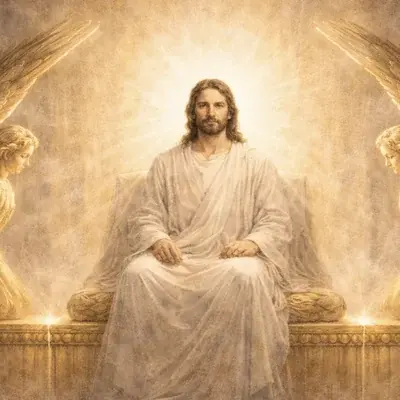
Hebrews was written to a Jewish Christian congregation, a church shaped by the Scriptures, covenants, and worship of Israel. Hebrews 1 opens by addressing that audience at the most fundamental level. It declares that the God who spoke long ago through the prophets has now spoken decisively in His Son. Before calling believers to endurance, the chapter establishes who Jesus is: the final Word of God, superior to angels, enthroned as Son, and worthy of worship. Everything that follows in the letter rests on this opening claim.
God Has Spoken by His Son | Christ Above Angels
The book of Hebrews opens by explaining how God has revealed himself in history. God spoke long ago to the fathers in the prophets, and He did so in many portions and in many ways. This describes the Old Testament as it actually comes to us.
God did not speak once, in a single moment, or in a single form. He spoke across centuries, through many men, into many situations. Sometimes He spoke directly, as He did at Mount Sinai; sometimes He spoke through angels. At other times He spoke to prophets through visions and dreams. All of it was God speaking, and all of it carried His authority.
At the same time, Scripture is clear about the shape of that revelation. It came in portions. No prophet ever delivered the entire counsel of God. Moses did not, Isaiah did not, Daniel did not. Each one spoke God’s words, but each one spoke within a larger unfolding story.
The Old Testament was always moving forward. It was building expectation, building hope in the coming Messiah; however, it left certain things unresolved. It was not lacking because it was flawed, but because God intentionally left it incomplete, pointing forward to something greater.
Hebrews then tells us that we now live at that destination. In these last days, God has spoken to us in His Son. “The last days” is not a general way of saying “recently”. It is language taken directly from the Old Testament, especially from the book of Daniel.
In Daniel 2, Nebuchadnezzar dreams of a great statue made of different materials. The head is gold, the chest and arms are silver, the torso is bronze, the legs are iron, and the feet are iron mixed with clay. Daniel explains that each part represents a kingdom. One kingdom follows another. Each rises, rules for a time, and then gives way to the next.
The statue is not reworked or improved. Instead, a stone appears, cut without human hands. It strikes the statue at its feet, and the entire structure collapses. Gold, silver, bronze, iron, and clay are all crushed and blown away. Then the stone grows and becomes a great mountain that fills the whole earth. Daniel explains that this stone represents a kingdom established by God Himself, a kingdom that will never be destroyed and will never pass to another people.
That moment is what Daniel presents as the end of the age. Human kingdoms come to an end, and God’s kingdom takes their place. Daniel also sees one like a Son of Man being led before the Ancient of Days, receiving dominion, glory, and a kingdom that will not pass away. When Hebrews speaks of “the last days”, it is saying that this moment has arrived. The stone has struck. The kingdom has begun. History has entered its final phase, not because every event has already unfolded, but because the decisive act has taken place.
This is why Hebrews says that God has spoken in His Son. The prophets spoke God’s words, but the Son is God’s own self-revelation. God is no longer revealing Himself through fragments, or in a way that is veiled. In the Son, He reveals Himself personally. What was anticipated in the Old Testament is now present in Christ. There is no further stage beyond this. There is no later revelation that completes or corrects what God has now made known in His Son.
Hebrews then begins to describe who this Son is, and it does so in seven ways, the perfect number of ways, showing the son’s absolute supremacy.
First, the Son is the one whom God appointed heir of all things. In the Old Testament, the heir receives authority, inheritance, and rule. Hebrews expands that idea to its fullest extent. The Son is heir not of a land or a nation, but of everything that exists.
Second, through Him God made the worlds. The universe itself came into being through Him. He stands at the beginning of all things.
Third, the Son is the radiance of God’s glory. In the Old Testament, God’s glory refers to His manifested presence, the visible weight of who He is. When Moses came down from Sinai after speaking with Yahweh, his face shone with reflected glory so intensely that he had to veil it.
Later, that same glory filled the tabernacle and, in time, the temple. Hebrews says that this glory shines forth in the Son. God’s glory does not merely rest upon Him. It comes out from Him.
Fourth, the Son is the exact representation of God’s nature. This is not the language of resemblance. It is the language of shared essence. The Son does not represent God approximately. He is the exact, perfect image of God.
Fifth, the Son upholds all things by the word of His power. Creation does not run on its own. Everything continues to exist because the Son actively sustains it by His power. This is sustained, ongoing, divine rule.
Sixth, the Son accomplished cleansing for sins. The language is final. The work is complete. Under the old covenant, sacrifices were repeated because sin was never fully dealt with. Here, the cleansing has been accomplished.
Seventh, the Son sat down at the right hand of the Majesty on high. This draws directly on the imagery of the tabernacle and the temple. There were no chairs for priests. They stood because their work was never finished. The mercy seat symbolised God’s throne, but no priest ever sat there. The Son sits because His work is complete, and because He reigns. Sitting here is not rest alone. It is enthronement.
After this complete description, Hebrews turns to angels.
Angels appear frequently throughout the Old Testament as God’s messengers and servants, clearly identified in scenes such as the angels who visit Abraham before going on to Lot, the visions given to Daniel, Isaiah’s vision of the heavenly throne room, and the prophetic encounters recorded by Zechariah.
Angels deliver messages from Yahweh. They execute judgment. They surround God’s throne. At times, people fall before them in fear or attempt to worship them. Because of this, angels could easily be misunderstood as the highest possible mediators between God and mankind.
Hebrews addresses this directly. The Son has become so much better than the angels, having inherited a more excellent name than they. This does not describe a change in His divine nature. The Son has already been identified as Creator and exact representation of God. The becoming refers to His exaltation in history following His completed work.
From verse 5 onward, Hebrews allows the Old Testament to speak for itself. Seven passages from the Old Testament are quoted, showing that God has been saying the same thing all along, in different ways, and consistently pointing forward to His Son.
Psalm 2 is quoted first: “You are My Son, today I have begotten You.” In its original setting, this psalm describes the public enthronement of the king. The “today” refers to the declaration of royal status, not the beginning of existence. Hebrews applies this to Jesus to show that His resurrection and exaltation reveal Him openly as the King the psalm anticipated.
The promise from 2 Samuel 7 follows: “I will be a Father to Him and He shall be a Son to Me.” This promise was given to David concerning his royal line. Hebrews shows that it finds its full meaning in Christ. The future tense speaks of the establishment of the king in history, not the beginning of sonship.
God then commands the angels to worship the Son. Worship belongs to God alone. Angels do not worship servants. By commanding the angels to worship him, Scripture shows that the Son is not a created being, but God. The title “firstborn” speaks of rank and inheritance, not creation. The Son holds the highest place.
Psalm 104 is quoted to describe angels. They are winds and flames, swift and powerful, yet created and sent. They act according to God’s command. They are servants.
Psalm 45 is then applied to the Son: “Your throne, O God, is forever and ever.” Scripture addresses the Son as God and speaks of His eternal rule. His kingdom is marked by righteousness. God anoints the Son, showing that the Son is fully God, while remaining distinct from the Father.
Psalm 102 follows. This psalm was originally addressed to Yahweh as Creator. Hebrews applies it directly to the Son. He founded the earth. The heavens are the work of His hands. Creation will wear out, but the Son remains. He will change it, but He Himself does not change. His years will not come to an end.
Psalm 110 closes with enthronement: “Sit at My right hand, until I put Your enemies as a footstool for Your feet.” God never said this to an angel. No angel shares God’s throne. The Son reigns until every enemy is subdued.
The chapter ends by defining the role of angels. They are ministering spirits, sent to serve those who will inherit salvation, and 1 Peter 3:22 makes explicit that they serve under the authority of the Son. He is the Creator, the enthroned King, and the one through whom God has spoken in these last days.
Hebrews 1 teaches that God has spoken finally and fully in His Son. The last days are now because the kingdom Daniel saw has begun. Angels, though glorious servants, stand far below the Son. Jesus is God revealed, God enthroned, and God worshipped. To hear Jesus is to hear God Himself.