
Luke 11
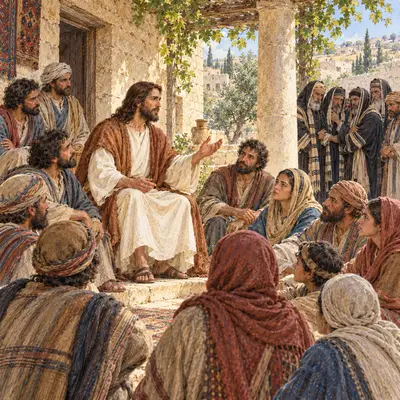
Jesus teaches His disciples to pray and promises that the Father will give the Holy Spirit to those who ask Him. He casts out a demon by the finger of God, and some say He works by Beelzebul. A woman calls His mother blessed, and Jesus answers that the blessed are those who hear the word of God and keep it. He warns a generation demanding a sign that something greater than Solomon and Jonah is here, then pronounces woes on the Pharisees and scholars of the Law.
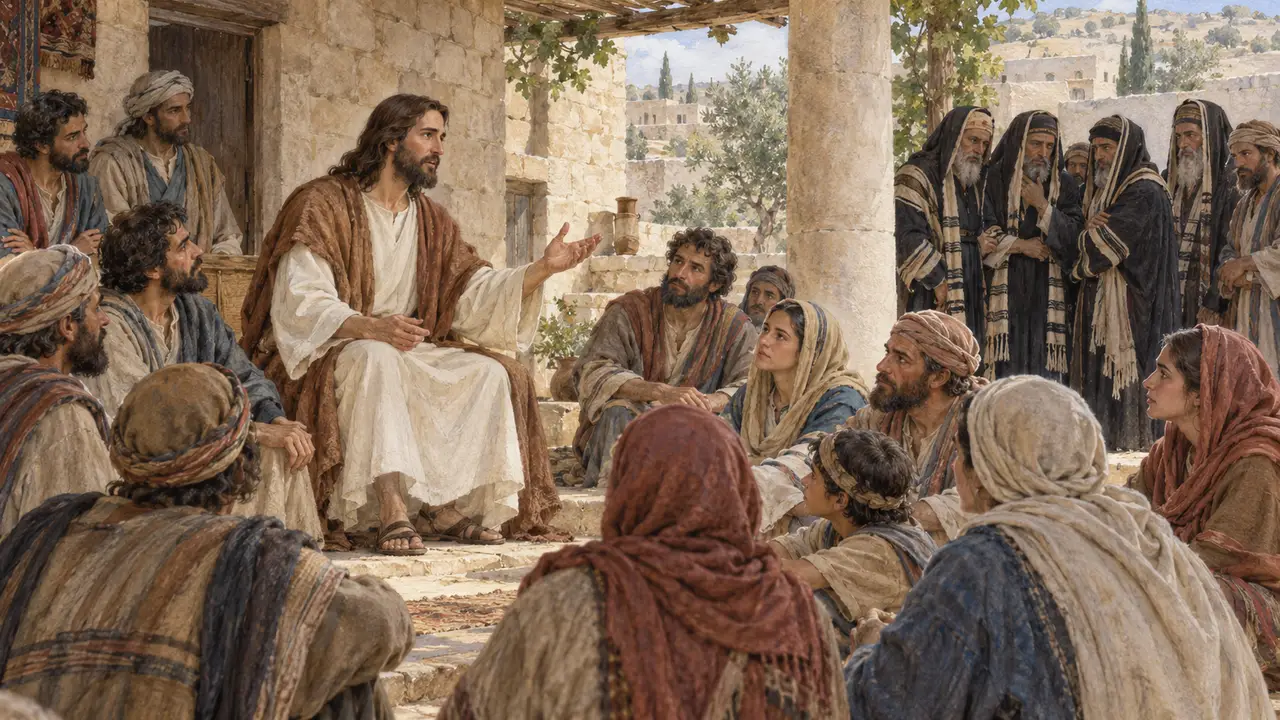
Luke 11 follows directly from the scene that closed the previous chapter, where Mary sat “at the Lord’s feet, listening to His word,” and Jesus said she had chosen the one necessary thing. Behind that scene stands the Father’s command on the mountain in Luke chapter 9: “This is My Son, My Chosen One; listen to Him!” Luke 11 is dominated by Jesus speaking. He teaches His disciples to pray, explains His victory over the demons, defines who is truly blessed, warns a generation that demands a sign, and finally exposes the Pharisees and scholars of the Law at a meal table. All through the chapter, people hear Him, and the question Luke presses is what they do with what they hear. The chapter opens with a disciple saying, “Lord, teach us to pray,” and it closes with the scribes and Pharisees “plotting to catch Him in something He might say.”
The chapter begins with Jesus Himself at prayer. When He finishes, one of His disciples asks, “Lord, teach us to pray just as John also taught his disciples.” The request comes from watching Jesus. Luke has shown Him praying at His baptism, before choosing the Twelve, before Peter’s confession and on the mountain of the Transfiguration, and the disciples have seen enough to know that they want to pray as He does.
Jesus answers, “When you pray, say: ‘Father, hallowed be Your name.’” The first word sets the whole prayer in place. Jesus, the Son who in the previous chapter said that no one knows who the Father is “except the Son, and anyone to whom the Son wills to reveal Him,” now gives His disciples the right to address God as Father. They come to God through the Son, and they come as children. The first request is that the Father’s name be hallowed, which means treated as holy, honoured and set apart above every other name. The second is “Your kingdom come,” the arrival of God’s rule, which is exactly what Jesus has been announcing and what the Seventy proclaimed in every town they entered. The prayer begins with God’s name and God’s kingdom before it reaches any of the disciples’ own needs.
Then the prayer turns to dependence: “Give us each day our daily bread.” When Yahweh gave Israel manna in the wilderness, the people were to gather “a day’s portion every day,” as Exodus chapter 16 puts it. Bread was given one day at a time so that Israel would learn to depend on Yahweh every day. The disciples are taught the same posture, and they have already lived it. When Jesus sent out the Twelve in Luke chapter 9, they were to take no bread and no money for the journey, and the Seventy in chapter 10 went out the same way, depending on the hospitality God provided. What they learned on the mission they are now to practise in prayer every day. They ask the Father for what they need today and come back to Him tomorrow.
“And forgive us our sins, for we ourselves also forgive everyone who is indebted to us.” Sin is described as a debt owed to God, and the disciple who asks to be released from that debt must release others from what they owe him. Jesus is not saying that forgiving others earns God’s forgiveness. He is saying that a person who has received forgiveness from the Father cannot go on holding the debts of others against them. The prayer ends with “lead us not into temptation,” a request that the Father keep His children from being brought into trials that would overcome them. The whole prayer is the speech of people who know they depend on God for bread, for forgiveness and for protection.
Jesus then tells a story about a man who has a guest arrive at midnight with nothing to set before him. He goes to his friend’s house and asks for three loaves, and the friend calls out from inside that the door is shut and the children are in bed, and he will not get up. Jesus says that even if the man will not get up because he is his friend, “because of his persistence he will get up and give him as much as he needs.”
The story is built on a comparison from the lesser to the greater. God is not being compared to the reluctant friend, as though the Father must be worn down before He will act. The point is that even a sleepy, unwilling neighbour eventually gives what is asked, so how much more will the Father, who is neither reluctant nor asleep, give to His children. Jesus draws the conclusion directly: “So I say to you, ask, and it will be given to you; seek, and you will find; knock, and it will be opened to you,” and in the next verse He attaches a promise to each command.
Jesus then moves the comparison inside the family. No father gives his son a snake when he asks for a fish, or a scorpion when he asks for an egg. Then comes the argument: “If you then, being evil, know how to give good gifts to your children, how much more will your heavenly Father give the Holy Spirit to those who ask Him?” Jesus calls His hearers “evil” without pausing to soften the word. Even sinful fathers give good things to their children. The heavenly Father, who has no evil in Him at all, gives far more.
The climax of that sentence is the gift itself. The Lord’s Prayer asked for daily bread, and the story of the friend at midnight was about loaves, so we might expect Jesus to finish with food or provision. Instead He names the Holy Spirit. Jesus does not promise that the Father will give His children whatever they happen to want. A good father gives what is good for his son, and the Father gives what is truly good, and the highest good He names is His Spirit. The greatest gift the Father gives to those who ask Him is God Himself dwelling in them. The disciples who asked to be taught to pray are told that the Father is ready to give them His own Spirit, and Luke will show that gift poured out on the day of Pentecost in Acts chapter 2.
Luke then moves to a scene in which Jesus casts out a demon that had made a man mute. When the demon leaves, the man speaks and the crowds marvel. The responses divide immediately. Some say, “He casts out demons by Beelzebul, the ruler of the demons.” Others, “testing Him, were seeking from Him a sign from heaven.” Both responses refuse what is in front of them. The first group cannot deny that the demon has gone, so they attribute the work to Satan. The second group has just seen a man freed from a demon and still demands something more from heaven.
The demand for a sign does not come from people who have been given no signs. The crowds following Jesus have seen Him heal the sick, cleanse lepers, raise the dead and cast out demons. In Luke chapter 9, in a desolate place where there was nothing to eat, Jesus took five loaves and two fish, and “looking up to heaven, He blessed them,” and about five thousand men ate until they were satisfied, with twelve baskets of broken pieces left over. Israel in the wilderness had been fed with bread Yahweh rained down from heaven, and Jesus had fed the crowds in the wilderness with bread He blessed looking up to heaven. They have already been given signs from heaven. To ask for another is not a request for evidence. It is unbelief, and Jesus treats it as unbelief.
Jesus knows their thoughts and answers the first accusation with plain logic. A kingdom divided against itself is laid waste, and Satan does not tear down his own work. Then Jesus turns the accusation back on His accusers: “And if I by Beelzebul cast out demons, by whom do your sons cast them out? For this reason, they will be your judges.” There were Jewish exorcists in Israel, and the accusers did not claim that they worked by Satan’s power. If they condemn Jesus for the same kind of work, their own sons stand as witnesses against their inconsistency.
Then Jesus says, “But if I cast out demons by the finger of God, then the kingdom of God has come upon you.” The phrase “the finger of God” comes from Exodus chapter 8. When Pharaoh’s magicians could not reproduce the plague of gnats, they said to Pharaoh, “This is the finger of God.” The verse continues: “But Pharaoh’s heart was hardened with strength, and he did not listen to them, as Yahweh had spoken.” Yahweh was bringing His people out of slavery, and even Pharaoh’s own magicians recognised His hand, but Pharaoh refused to listen. Jesus now places His own work in the same pattern. His victory over the demons is God’s power breaking the grip of an enslaver, and those who attribute it to Beelzebul are standing where Pharaoh stood, seeing the finger of God and refusing to listen.
Jesus then gives a picture of what is happening. Satan is the strong man, fully armed and guarding his house, and while he guards it his possessions are undisturbed. Jesus is “someone stronger than he,” who attacks him, overpowers him, strips away the armour he relied on and distributes his plunder. Each exorcism is a sign that the stronger One has come and is plundering Satan’s house. In Luke chapter 10 Jesus said, “I was watching Satan fall from heaven like lightning,” and here He explains how that fall takes place.
That conflict leaves no neutral ground: “He who is not with Me is against Me and he who does not gather with Me, scatters.” If the kingdom of God has arrived in Jesus, then every person stands either with Him or against Him. The crowd cannot watch the conflict from a safe distance as spectators. Those who accuse Him and those who demand more signs are not standing in the middle; Jesus says they are against Him.
Jesus follows this with a warning about what happens after a demon is driven out. The unclean spirit wanders through waterless places seeking rest, finds none, and returns to the house it left. When it returns, “it finds it swept and put in order.” It then brings seven other spirits more evil than itself, “and the last state of that man becomes worse than the first.” The house has been cleaned, but it has been left empty. Deliverance from evil is not enough if the person is not then filled with something else. Jesus has just spoken of the Father giving the Holy Spirit to those who ask, and He has just said that whoever does not gather with Him scatters. A life that has been tidied up but has not come under the rule of Christ is left open to a worse condition than before. Luke will return to the same problem at the Pharisee’s table, where outward cleanness hides an inward state that is full of wickedness.
While Jesus is saying these things, a woman in the crowd calls out, “Blessed is the womb that bore You and the breasts at which You nursed.” In that culture, praising a man’s mother was a way of praising the man himself. She is saying, in effect, how blessed the woman must be who gave birth to such a son. She has seen something true about Jesus, and her words are an expression of admiration.
Jesus answers, “On the contrary, blessed are those who hear the word of God and keep it.” He does not deny that His mother is blessed. Luke has already recorded Elizabeth’s words to Mary in Luke chapter 1, and Elizabeth said why Mary was blessed: “And blessed is she who believed that there would be a fulfillment of what had been spoken to her by the Lord.” Mary’s blessedness was rooted in her response to the word of God. When the angel spoke to her she answered, “may it be done to me according to your word.” The woman in the crowd locates Mary’s blessedness in her womb and her breasts. Jesus locates it where Elizabeth located it, in hearing God’s word and keeping it. The woman pronounces Mary blessed for bearing Jesus, while Luke has already told us that Mary was blessed because she believed.
Jesus has made the same point before. In Luke chapter 8, when He was told that His mother and brothers were standing outside, He said, “My mother and My brothers are these who hear the word of God and do it.” Physical closeness to Jesus, even the unique privilege of being His mother, does not replace hearing and keeping the word of God. These two verses stand almost at the centre of the chapter, and they state the standard by which every other person in it is measured. Martha’s sister Mary heard and was commended. Those who said He worked by Beelzebul heard Him and accused Him. Those who wanted a sign heard Him and asked for more. Admiration of Jesus is not the same thing as obedience to Him. The question Jesus puts to the woman in the crowd is the question the whole chapter puts to everyone who hears Him.
As the crowds increase, Jesus returns to those who demanded a sign. “This generation is a wicked generation; it seeks a sign, and yet no sign will be given to it but the sign of Jonah. For just as Jonah became a sign to the Ninevites, so will the Son of Man be to this generation.” Luke records this saying without the reference to Jonah’s three days in the fish that Matthew includes. In Luke’s account the emphasis falls on Jonah himself. Jonah walked into Nineveh and proclaimed the word of God, and Jonah chapter 3 records no miracle performed there. The people of Nineveh “believed in God” and repented in sackcloth. Jonah was the sign. The Son of Man standing before this generation and speaking to them is the sign they have been given, and they are asking for another. The Ninevites heard a prophet preach and believed God; this generation has seen the works of the kingdom and will not believe.
Jesus then calls two Gentile witnesses. The Queen of the South will rise up at the judgment and condemn this generation, because she came from the ends of the earth to hear the wisdom of Solomon, “and behold, something greater than Solomon is here.” In 1 Kings chapter 10, the queen of Sheba “heard the report about Solomon concerning the name of Yahweh,” and she travelled a vast distance “to test him with riddles.” She came to test, and when she heard his wisdom she acknowledged it. The people around Jesus are also testing Him, Luke has told us, but they refuse what they hear. The men of Nineveh will also stand up at the judgment and condemn this generation, because they repented at Jonah’s preaching, “and behold, something greater than Jonah is here.”
Solomon was the wisest king Israel ever had, and Jonah was a prophet whose preaching brought a whole Gentile city to repentance. Jesus says that something greater than both is standing in front of this generation. Gentiles responded to lesser wisdom and a lesser prophet, while Israel has the greater wisdom and the greater prophet in her own towns. At the judgment, these Gentiles will rise up and condemn this generation. The principle from Luke chapter 10 applies again: greater revelation brings greater accountability, and covenant privilege offers no protection to those who refuse the One the covenant pointed to.
Jesus then speaks of a lamp. No one lights a lamp and hides it in a cellar or under a basket; it goes on the lampstand so that those who enter may see the light. The light has already been lit and set where everyone can see it. Jesus Himself, His word and His works, is the light God has placed before this generation. The problem lies with the one looking at it. “The eye is the lamp of your body; when your eye is clear, your whole body also is full of light, but when it is bad, your body also is full of darkness.” If the eye is bad, the same light produces no illumination at all.
So Jesus warns, “Therefore watch out that the light in you is not darkness.” Those who demand a sign imagine that they lack evidence. Jesus says they lack sight. More signs will not cure a bad eye, because the problem is unbelief in the one looking. This echoes what Jesus said after the parable of the sower in Luke chapter 8, where He spoke of the lamp on the lampstand and then said, “So beware how you listen.” In both places the lamp is connected with how a person receives the word. Jesus closes with the promise that a body full of light, “with no dark part in it,” will be “wholly illumined, as when the lamp illumines you with its rays.”
After this a Pharisee invites Jesus to a meal, and Jesus reclines at the table. The Pharisee is astonished that Jesus has not first ceremonially washed before eating, a ritual of purification the Pharisees practised before meals. Jesus answers the Pharisee’s silent surprise directly: “Now you Pharisees clean the outside of the cup and of the platter, but inside of you, you are full of robbery and wickedness.” He moves at once from the cup to the man.
“You foolish ones, did not He who made the outside make the inside also?” God created the whole person. He is not concerned with the outside of a man and indifferent to his heart. The Creator sees and judges both, and ceremonial washing cannot hide an unclean heart from Him. Then Jesus says, “But give that which is within as charity, and then all things are clean for you.” The cure for robbery is generosity. The heart that has been grasping must be given over to God and expressed in mercy to others.
Jesus then pronounces three woes on the Pharisees. A woe is a solemn declaration of grief and judgment, the language the prophets used when announcing God’s judgment on Israel and the nations. The first concerns their tithing. They give God a tenth even of mint, rue and every garden herb, and they disregard “justice and the love of God.” Jesus does not condemn the tithing. He says, “these are the things you should have done without neglecting the others.” The problem is that their careful attention to small observances had become separated from justice and the love of God, which are at the heart of the Law. In the previous chapter the scholar of the Law summarised it as loving God with all the heart and the neighbour as oneself, and these Pharisees have tithed their herbs and neglected both.
The second woe is for their love of the best seats in the synagogues and respectful greetings in the marketplaces. Their religion has become a means of receiving honour from men. The third: “you are like concealed tombs, and the people who walk over them are unaware of it.” Under the Law of Moses, Numbers chapter 19 says that anyone who touches “a human bone or a grave, shall be unclean for seven days.” An unmarked grave was dangerous because a person could walk over it and become defiled without knowing. The Pharisees were intensely concerned with ceremonial purity, and Jesus says they are themselves the hidden source of defilement. People come into contact with them, follow their teaching and are made unclean without realising it. The ones most careful to avoid uncleanness are spreading it.
At this point one of the scholars of the Law speaks up: “Teacher, when You say these things, You insult us too.” He apparently expects Jesus to make an exception for his group or soften what He has said. Instead Jesus pronounces three woes on the lawyers as well. The first: “you weigh men down with burdens hard to bear, and you yourselves will not even touch the burdens with one of your fingers.” They multiplied rules and obligations for others to carry and offered no help to those weighed down by them. Jesus casts out demons “by the finger of God” to set people free, while these scholars will not lift a finger to relieve the burdens they place on others.
The second woe is that they build the tombs of the prophets their fathers killed. Jesus says, “So you are witnesses and approve the deeds of your fathers.” Their fathers killed the prophets, and the sons finish the job by burying them in honour. Honouring a dead prophet costs nothing. The real test is how a person responds to the living word of God when it is spoken to him, and these men are about to show that they would treat God’s present messenger exactly as their fathers treated the prophets.
Jesus says the wisdom of God declared that it would send prophets and apostles, that some would be killed and persecuted, and that the blood of all the prophets shed since the foundation of the world would be charged against this generation, “from the blood of Abel to the blood of Zechariah, who was killed between the altar and the house of God.” Abel is the first murder recorded in Scripture, in Genesis chapter 4, where his blood cries out to Yahweh from the ground. Zechariah is the son of Jehoiada the priest in 2 Chronicles chapter 24. The Spirit of God came upon him and he warned the people that they had forsaken Yahweh, and at the command of the king they stoned him in the court of the house of Yahweh. As he died he said, “May Yahweh see and avenge!” This generation did not personally shed all that blood. It is charged with it because it stands in the same line. These men possess the Scriptures that record what was done to the prophets, they build memorials to them, and they are repeating the same rejection against the One the prophets pointed to. The generation that rejects the greatest Prophet of all will bear the accumulated guilt of every generation that rejected the prophets before Him.
The final woe is the climax of the whole chapter: “Woe to you, scholars of the Law! For you have taken away the key of knowledge; you yourselves did not enter, and you hindered those who were entering.” These men were entrusted with the Scriptures and charged with teaching Israel to understand them. The Scriptures point to Christ, and the scholars possessed the key to understanding God’s word. They took it away. They did not enter themselves, and they stood in the doorway preventing others from entering. Those who should have been the first to hear and keep the word of God refused it and kept others from it. The chapter that began with a disciple saying, “Lord, teach us,” reaches its lowest point with Israel’s teachers locking the door to knowledge.
Luke then shows the result. When Jesus leaves, the scribes and Pharisees turn very hostile and press Him with questions on many subjects, hoping to trap Him in His words. They have heard Jesus speak with more wisdom than Solomon and more authority than Jonah, and they respond by trying to catch Him out. Mary sat at His feet listening to His word. The scribes and Pharisees sit near Him and listen for something to use against Him.
Luke 11 shows the full range of responses to the word of Jesus, and through it all Jesus speaks with an authority no one else in the chapter possesses. He reveals the Father and gives His disciples the right to call God Father. He overpowers Satan and plunders his house. He stands greater than Solomon and greater than Jonah while a generation demands another sign. He interprets the Law, exposes the heart and pronounces judgment on the teachers of Israel. The light has been set on the lampstand, the stronger One has come, and the Father has spoken: “listen to Him!” Luke 11 challenges us to ask whether the word of God, when we hear it, is received and kept, or whether the light in us is darkness.