
Luke 4
The Spirit leads Jesus into the wilderness, where Satan tests whether the beloved Son will use His identity and power apart from His Father's purpose. Jesus answers every temptation from Scripture and remains faithful where Israel failed. He then returns to Galilee, reads Isaiah's promise of the Spirit-anointed One in the Nazareth synagogue and declares it fulfilled in Himself, provoking a rejection that nearly costs Him His life. In Capernaum His authority over demons and disease confirms what He has claimed: the kingdom of God has arrived in Him, and He is sent to proclaim it further still.
Luke 4 Explained: The Son Tested, the Kingdom Announced
Luke 4 continues directly from the end of the previous chapter. At Jesus’ baptism the Father declared, “You are My beloved Son, in You I am well-pleased.” Luke then traced Jesus’ genealogy back through David and Abraham to “Adam, the son of God”. Now Jesus enters the wilderness, and the question of His identity immediately comes under testing.
Jesus is “full of the Holy Spirit” and is led by the Spirit in the wilderness for forty days. The forty days recall Israel’s forty years in the wilderness, where Yahweh led His people, tested them and taught them to depend upon Him. Deuteronomy 8:2 says that Yahweh led Israel in the wilderness “these forty years” in order to humble and test them, to know what was in their heart and whether they would keep His commandments.
Here, Luke makes a deliberate comparison between Israel and Jesus. Israel was called Yahweh’s son in Exodus 4:22, but Israel repeatedly failed in the wilderness through grumbling, unbelief and disobedience. Jesus enters the wilderness as the beloved Son and remains faithful where Israel failed.
The first temptation comes after Jesus has eaten nothing for forty days and is hungry. The devil says, “If You are the Son of God, tell this stone to become bread.” The question is not whether Jesus has the power to make bread. The question is whether He will use His identity and power as the Son to escape the testing into which the Spirit has led Him.
Jesus answers from Deuteronomy 8:3:
“Man shall not live on bread alone.”
That verse comes from the section where Moses explains why Yahweh allowed Israel to hunger and then fed them with manna. Deuteronomy says that Yahweh did this “that He might make you know that man does not live by bread alone”. Israel became hungry and grumbled against Yahweh. Jesus becomes hungry and continues trusting His Father.
The devil is therefore inviting Jesus to use His power independently of the Father’s purpose. Jesus refuses. His identity as the Son does not give Him freedom to act apart from His Father. It binds Him to faithful obedience.
The second temptation concerns dominion and glory. The devil shows Jesus “all the kingdoms of the world in a moment of time” and says that he will give Jesus their dominion and glory if Jesus worships him.
Jesus really is the promised King. Psalm 2, which stands behind the Father’s words at His baptism, promises the nations to the Son:
“Ask of Me, and I will surely give the nations as Your inheritance,
And the ends of the earth as Your possession.”
The nations belong within the Son’s promised inheritance, but the devil offers Jesus a path to dominion through disobedience. He offers the kingdom through worship of Satan rather than through obedience to the Father.
Jesus answers from Deuteronomy 6:13:
“You shall worship the Lord your God and serve Him only.”
Israel repeatedly failed at this point. Yahweh had redeemed His people and commanded them to worship Him alone, but they repeatedly turned after other gods. Jesus refuses every form of dominion that requires disobedience to His Father.
The temptation therefore offers Jesus a shortcut. He can have glory without the path appointed by God. Jesus will not take His kingdom on Satan’s terms. The road to His reign will follow the Father’s purpose, even when that road later passes through rejection, suffering and the cross.
The third temptation returns directly to Jesus’ sonship. The devil takes Him to Jerusalem, places Him on the pinnacle of the temple and says:
“If You are the Son of God, throw Yourself down from here.”
This time the devil himself quotes Scripture. He uses Psalm 91:
“He will command His angels concerning You to guard You,”
and:
“On their hands they will bear You up,
Lest You strike Your foot against a stone.”
A person can quote biblical words and still use them against the purpose of God. Satan takes a promise of God’s protection and turns it into an invitation to force God to prove Himself.
Jesus answers from Deuteronomy 6:16:
“You shall not put the Lord your God to the test.”
That verse reaches back to Israel’s failure at Massah. In Exodus 17 the people questioned whether Yahweh was really among them. Exodus 17:7 says that they tested Yahweh by asking, “Is Yahweh among us or not?”
Jesus refuses to do what Israel did. The Father has already declared Him to be His beloved Son. Jesus does not need to manufacture a crisis in order to force His Father to prove Himself.
Throwing Himself from the temple and demanding supernatural rescue would appear to be faith, but it would actually express unbelief. Faith trusts what God has said and obeys Him. It does not deliberately create danger in order to demand evidence that God is trustworthy.
The three temptations therefore test what Jesus will do with His identity as the Son. Will He provide for Himself apart from the Father’s purpose? Will He take dominion through false worship? Will He force His Father to prove His protection? Each time Jesus refuses the shortcut and remains the obedient Son.
The whole account also continues Luke’s emphasis on the Holy Spirit. Jesus enters the wilderness “full of the Holy Spirit”. He is led by the Spirit through the testing. After the devil leaves Him, Jesus returns to Galilee “in the power of the Spirit”. The Spirit who descended upon Him at His baptism now leads Him into testing and empowers his ministry.
Luke says that the devil leaves Jesus “until an opportune time”. The conflict has not ended. Satan has failed to turn the Son away from obedience, but opposition will return as Jesus moves towards Jerusalem and the cross.
Jesus then returns to Galilee and begins teaching in the synagogues. His reputation spreads through the surrounding district, and Luke brings Him to Nazareth, His home town.
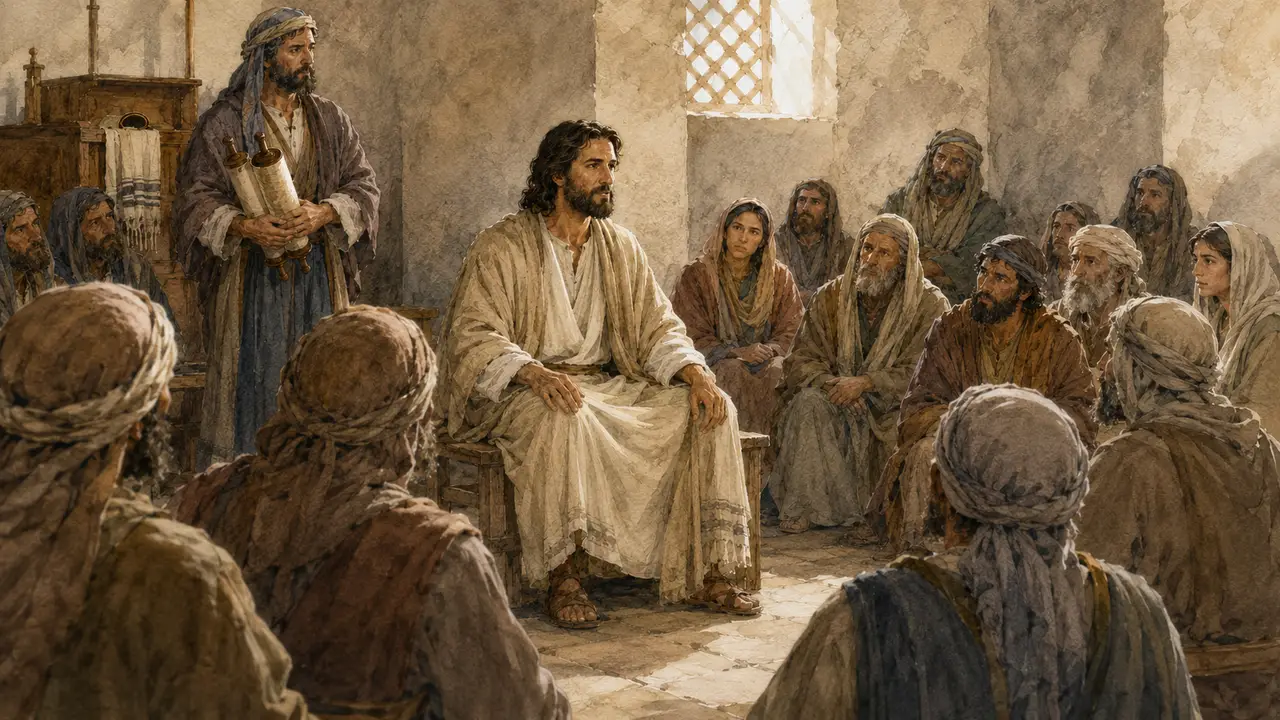
Jesus enters the synagogue on the Sabbath, as was His custom, stands to read, and receives the scroll of Isaiah. He finds the place where it is written:
“The Spirit of the Lord is upon Me,
Because He anointed Me to preach the gospel to the poor.
He has sent Me to proclaim release to the captives,
And recovery of sight to the blind,
To set free those who are oppressed,
To proclaim the favorable year of the Lord.”
The quotation comes principally from Isaiah 61, with language also drawn from Isaiah 58. Isaiah 61 describes the one upon whom the Spirit of Lord Yahweh rests because Yahweh has anointed him to proclaim good news, release and restoration.
Luke 3 has already shown the people wondering whether John might be the Christ. John denied it and pointed to One greater than himself. At Jesus’ baptism the Spirit descended upon Him. Now Jesus reads this prophecy about the Spirit-anointed One and says:
“Today this Scripture has been fulfilled in your hearing.”
Until this point, the explicit statements about Jesus’ identity have come from others. The Father named Him the beloved Son at the Jordan. The devil twice put that same identity to the test in the wilderness. Here Jesus speaks for Himself for the first time, and He does not leave it to inference. “Christ” means Anointed One, the very word Isaiah has just used of the man on whom Yahweh’s Spirit rests. By declaring this passage fulfilled in Himself, Jesus identifies Himself as Yahweh’s Spirit-anointed One. The question Luke raised in chapter 3, whether John might be “the Christ”, now has an unmistakable answer. Jesus is the Christ.
Isaiah’s language speaks of good news to the poor, release to captives, sight to the blind and freedom for the oppressed. “The favorable year of the Lord” also recalls the Jubilee of Leviticus 25, when liberty was proclaimed, Israelite servants were released and ancestral property returned to its family. Isaiah takes that language of release and applies it to Yahweh’s promised restoration. Jesus now announces that this promised age has arrived in Him.
The people initially respond with amazement. They marvel at “the gracious words” coming from His lips, but then they ask:
“Is this not Joseph’s son?”
Luke has already told us that Jesus was only “as was supposed” the son of Joseph. The Father has declared Him to be His beloved Son. Jesus has just identified Himself as Isaiah’s Spirit-anointed One. Nazareth reduces Him to the man they think they already know.
They know His family. They know where He grew up. Their familiarity with Jesus becomes part of their refusal to recognise His true identity.
Jesus exposes the demand He knows will follow: if reports of His works at Capernaum are true, Nazareth will expect the hometown prophet to do the same there.
Jesus answers:
“Truly I say to you, no prophet is welcome in his hometown.”
He then gives two Old Testament examples.
During the days of Elijah there were many widows in Israel, but Elijah was sent to a widow at Zarephath in Sidon. During the days of Elisha there were many lepers in Israel, but none of them was cleansed except Naaman the Syrian.
Both examples involve Gentiles receiving God’s mercy during periods of serious unbelief within Israel.
Jesus is not saying that Israel has no place in God’s saving purpose. He is confronting the assumption that belonging to Israel gives anyone a claim upon God’s grace. John has already warned the crowds not to say, “We have Abraham for our father.” Jesus now gives examples from Israel’s own Scriptures showing that Yahweh has always remained free to show mercy beyond Israel.
The point exposes unbelief beneath covenant privilege. The widow at Zarephath received the prophet Yahweh sent to her, and Naaman eventually submitted to the word given through Elisha. Meanwhile many within Israel remained unbelieving.
The people understand the implication, and their admiration turns immediately to rage.
They drive Jesus out of the city and take Him to the edge of the hill intending to throw Him down. The town that knows Him as “Joseph’s son” attempts to kill the One whom the Father has declared to be His beloved Son.
Jesus has also placed Himself within the pattern of the rejected prophets. John has just been imprisoned after confronting Herod. Now Jesus says that no prophet is welcome in his hometown, and His own town attempts to murder Him.
This rejection anticipates the movement of the Gospel as a whole. Jesus will proclaim God’s salvation within Israel, face rejection, and Luke will later show the gospel moving outward to the nations.
Jesus passes through their midst and goes on His way. Luke does not explain how He escapes, and there is no need to speculate. Their attempt to destroy Him fails. His mission will not end according to the will of an angry crowd.
Jesus then goes to Capernaum and teaches on the Sabbath. The people are amazed because “His message was with authority”.
A man in the synagogue is possessed by an unclean demon, and the demon cries out:
“What do we have to do with You, Jesus the Nazarene? Have You come to destroy us? I know who You are—the Holy One of God!”
The demon knows who Jesus is.
That creates a striking contrast with Nazareth. The people who grew up around Jesus ask, “Is this not Joseph’s son?” The demon recognises Him as “the Holy One of God”.
The demon is a hostile witness. Its knowledge does not amount to faith or obedience, but the spiritual enemy recognises the identity that the people of Nazareth reject.
Jesus rebukes it:
“Be quiet and come out of him!”
The demon obeys. It throws the man down but comes out without harming him.
The people respond with amazement:
“What is this message? For with authority and power He commands the unclean spirits and they come out.”
Jesus’ works now confirm what He has just declared. He does not simply claim to be Isaiah’s Spirit-anointed Messiah. His authority demonstrates that the kingdom He proclaims is arriving in His own person and work.
He announces release to captives, and now a man held by an unclean spirit is released.
Jesus does not bargain with the demon or appeal to some higher earthly authority. He commands it directly, and it obeys. His word carries authority over the spiritual powers opposing God’s kingdom.
Jesus then enters Simon’s home, where Simon’s mother-in-law is suffering from a high fever. Jesus stands over her and “rebuked the fever”, and it leaves her immediately.
Luke uses the same language of rebuke that he has just used when Jesus commands the demon. Luke does not say that the fever itself is demonic. The point is that Jesus’ authority reaches across different forms of suffering. Evil spirits obey Him, and disease also yields to His command.
As the sun sets, people bring the sick to Him, and Jesus lays His hands upon each one and heals them. The works continue to reveal the authority of the One Isaiah announced.
Demons come out of many people shouting:
“You are the Son of God!”
Jesus rebukes them and refuses to allow them to speak.
Luke explains why:
“because they knew Him to be the Christ.”
This chapter has now gathered several statements about Jesus’ identity. The Father has declared Him to be His beloved Son. Satan has challenged Him as the Son of God. Jesus has identified Himself as Isaiah’s Spirit-anointed One. The demon calls Him the Holy One of God. Other demons call Him the Son of God, and Luke explains that they know Him to be the Christ.
The demons therefore understand something that many people around Jesus still do not understand.
Jesus will not permit them to become His authorised witnesses. They speak truth about His identity, but they belong to the kingdom He has come to defeat. Jesus controls the revelation of who He is. Even the demons must be silent when He commands them.
When day comes, Jesus leaves for a secluded place, but the crowds seek Him out and try to prevent Him from leaving.
Jesus answers:
“I must proclaim the good news of the kingdom of God to the other cities also, for I was sent for this purpose.”
The words “I must” continue a theme Luke introduced when Jesus was twelve years old and said that He had to be in His Father’s house. Jesus lives under the purpose of His Father. His mission determines where He goes and what He does.
The people of Capernaum want to keep Him for themselves, but Jesus has been sent to proclaim the kingdom elsewhere as well.
The kingdom of God now gives us the larger framework for everything Jesus has done in the chapter. His teaching announces the kingdom. His authority over demons demonstrates the kingdom’s power over Satan. His healings demonstrate the kingdom confronting disease and the bodily consequences of the fall. His proclamation in Nazareth announces the restoration promised through Isaiah.
Luke 4 therefore continues the revelation of Jesus’ identity that began in the previous chapter. The Father has declared Him to be His beloved Son, and now that identity is tested, proclaimed, rejected, recognised and demonstrated.
Jesus refuses every shortcut offered by the devil because His identity and mission belong wholly to His Father. He will receive the kingdom according to the Father’s purpose, proclaim the good news for which He was sent, and exercise the authority that belongs to the beloved Son. Luke has told us who Jesus is. Luke 4 begins to show us what that identity means.