
Luke 1
Luke opens his Gospel by grounding it in careful, apostolic eyewitness testimony, then traces the announcements of two miraculous births: John to the priest Zechariah and his wife Elizabeth, and Jesus the Son of David to the virgin Mary. Old Testament promises to Abraham and David converge in these announcements, while Zechariah's unbelief and Mary's faith stand in deliberate contrast as both children arrive exactly as God had spoken.
Luke opens his Gospel by explaining why he has written it. “Many have undertaken to compile an account of the things that have been fulfilled among us.” Luke is not the first person to write about Jesus. Accounts were already circulating, and the events had come down from those who “from the beginning were eyewitnesses and servants of the word”.
Luke was the travelling companion of the apostle Paul, the physician whom Paul calls “the beloved physician” in Colossians 4:14. He was a partner in the apostolic mission, and here he grounds his Gospel in the eyewitness testimony handed down from the beginning. He has carefully investigated what they handed down, arranged it in orderly sequence, and written it for Theophilus “so that you may know the certainty about the things you have been taught”, recording what happened and showing how God brought to pass what He had already spoken in Scripture.
Luke places the Gospel within identifiable history: “In the days of Herod, king of Judea”. These events happened under a known ruler, in known places, among people whose lives stood firmly within the history and worship of Israel. Luke introduces Zechariah, a priest from the division of Abijah, and Elizabeth, a woman descended from Aaron. Both belong to Israel’s priestly line, and Luke describes them as “righteous in the sight of God, walking blamelessly in all the commandments and righteous requirements of the Lord”. Their barrenness therefore does not reflect divine judgment for wickedness.
Their circumstances immediately recall several Old Testament accounts. Elizabeth is barren, and both she and Zechariah are advanced in years. The pattern repeats throughout the Old Testament: Sarah before Isaac in Genesis 18 and 21, Rebekah before Jacob and Esau in Genesis 25, Rachel before Joseph in Genesis 30, and Hannah before Samuel in 1 Samuel 1. In each case God intervened where natural strength could not produce the promised child.
Hannah’s account gives the closest parallel because the son God gives her becomes a prophet whose ministry marks a major transition in Israel. The parallel is deliberate: another barren woman, another divinely given child, another prophet whose birth signals that God is beginning a new stage in the fulfilment of His word.
Zechariah is performing his priestly service when the lot falls to him to enter the sanctuary of the Lord and burn incense. The whole scene reaches back to the worship Yahweh established through Moses. Exodus 30:1–10 gives the instructions for the altar of incense, which stood before the veil in the tabernacle, and later in the temple. The story of Gospel fulfilment therefore begins in the temple, with a priest carrying out the service prescribed under the old covenant.
An angel of the Lord appears beside the altar of incense. Zechariah is afraid, but the angel tells him that his prayer has been heard and that Elizabeth will bear a son. He must call the child John. The angel says that John “will be great in the sight of the Lord”, will abstain from wine and strong drink, and “will be filled with the Holy Spirit while yet in his mother’s womb”.
The prohibition concerning wine and strong drink recalls the language of Numbers 6 concerning the Nazirite vow, a vow of separation to Yahweh that included abstaining from wine and leaving the hair uncut. It also echoes Judges 13, where an angel gives Samson’s mother the same instruction before his birth and calls him “a Nazirite to God from the womb”. Luke does not call John a Nazirite, but the language marks him out, like Samson, as one whom God sets apart for His service from before birth.
Gabriel then explains John’s ministry through the words of Malachi. John “will turn many of the sons of Israel back to the Lord their God”, and “he will go before Him in the spirit and power of Elijah, to turn the hearts of the fathers back to the children”. Malachi 4:5–6 says, “Behold, I am going to send you Elijah the prophet before the coming of the great and awesome day of Yahweh. And he will turn the hearts of the fathers to their children and the hearts of the children to their fathers.” Gabriel takes that prophecy and applies it to John. John will fulfil the promised Elijah-like role.
John will turn Israel back to “the Lord their God”, and then Gabriel says that John “will go before Him”. That is, the Lord God of Israel. As Luke’s Gospel unfolds, John prepares the way for Jesus. Luke therefore begins identifying Jesus through Old Testament passages concerning the coming of Yahweh Himself.
John will also “make ready a people prepared for the Lord”. Malachi 3:1 says the same thing: “Behold, I am going to send My messenger, and he will prepare the way before Me.” Yahweh promises a messenger who will prepare His way. Gabriel now identifies John as that messenger. John’s ministry will call Israel to repentance, turn the disobedient “to the attitude of the righteous”, and prepare the people for the coming of the Lord.
Zechariah responds in disbelief. “How will I know this? For I am an old man and my wife is advanced in years.” Gabriel replies by identifying himself as the angel who stands before God and says that God sent him to bring this good news.
Gabriel’s judgment fits the offence. “You shall be silent and unable to speak until the day when these things take place, because you did not believe my words.” Zechariah rejects Gabriel’s words, so God takes away Zechariah’s own words until Gabriel’s words come to pass. Later, when the family asks Zechariah what the child should be called, they communicate with him by signs, which indicates that his affliction also involved deafness. He failed to listen in faith to the word sent from God, and for the duration of the sign he loses his hearing.
Zechariah’s unbelief does nothing to hinder the angel’s promise. Gabriel says that his words “will be fulfilled in their proper time”. God’s word does not depend upon Zechariah’s confidence in it. The people wait outside while Zechariah remains in the sanctuary longer than expected. When he finally emerges, he cannot speak, and they realise that he has seen a vision. He completes his period of priestly service and returns home.
Elizabeth then conceives, exactly as Gabriel said, and remains in seclusion for five months, though Luke does not explain why. She understands her pregnancy as an act of the Lord’s mercy. Barrenness carried public shame in the ancient world, even though Luke has already made clear that Elizabeth’s condition did not arise from wickedness. God looks upon her and removes her disgrace, just as He looked upon other barren women in Israel’s history. At the same time, His mercy towards Elizabeth serves a much larger purpose, because the child in her womb will prepare Israel for the Messiah.
In the sixth month Gabriel is sent again, this time to Nazareth in Galilee, to a virgin named Mary, betrothed to Joseph, whom Luke identifies as a man “of the house of David”. Luke places David into the account before Gabriel announces anything about Jesus. The covenant promise of 2 Samuel 7 already stands behind what follows.
Gabriel tells Mary that she has found favour with God and will conceive and bear a son whom she must name Jesus. He then explains who this Son will be: “He will be great and will be called the Son of the Most High, and the Lord God will give Him the throne of His father David, and He will reign over the house of Jacob forever, and there will be no end of His kingdom.”
Luke deliberately sets John and Jesus beside one another. John “will be great in the sight of the Lord”. Jesus “will be great and will be called the Son of the Most High”. John will serve as a prophet. Jesus will receive the throne of David. John will prepare a people. Jesus will reign over the house of Jacob forever. John stands before the Lord; Jesus bears the title Son of the Most High and possesses an eternal kingdom.
Gabriel’s words draw directly from the Davidic covenant in 2 Samuel 7:12–16. Yahweh promised David, “I will raise up one of your seed after you” and “I will establish the throne of his kingdom forever”. Solomon partially fulfilled that promise, but every Davidic king after him died, and the throne eventually disappeared from Jerusalem.
Gabriel now announces the Son of David whose reign will truly have no end. Isaiah 9:6–7 also stands behind this promise, where the coming Son sits “on the throne of David and over his kingdom” and establishes it “from then on and forevermore”. Luke presents Jesus as the King in whom these promises are fulfilled.
Mary asks, “How will this be, since I am a virgin?” She asks how the announced conception will happen, and Gabriel answers her. “The Holy Spirit will come upon you, and the power of the Most High will overshadow you; and for that reason the holy Child shall be called the Son of God.”
God Himself will bring about the conception through the Holy Spirit. No human father will produce this child. Gabriel also uses the language of overshadowing, which recalls Exodus 40:34–35, where the cloud covered the tent of meeting and the glory of Yahweh filled the tabernacle. The language fits the wider biblical theme of God coming to dwell among His people. The child conceived in Mary is holy, the Son of the Most High, the Son of David, and the Son of God.
Gabriel then tells Mary that Elizabeth, “who was called barren”, has already reached the sixth month of pregnancy. He concludes, “For nothing will be impossible with God.” The wording takes us back to Genesis 18:14. When Sarah laughed at the promise that she would bear Isaac in her old age, Yahweh asked Abraham, “Is anything too difficult for Yahweh?” Luke places that same truth at the centre of both miraculous births. The God who gave Isaac to Abraham and Sarah has given John to Zechariah and Elizabeth, and He will now bring about the virgin conception of Jesus.
Mary responds, “Behold, the slave of the Lord; may it be done to me according to your word.” Her response reveals her faith: she receives Gabriel’s word and submits herself to it.
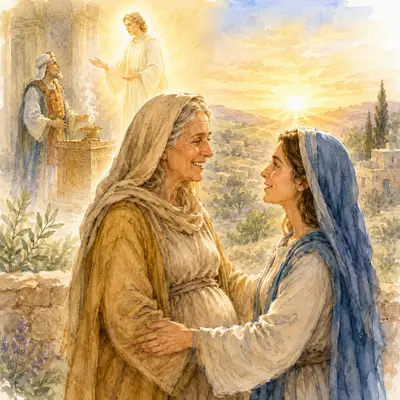
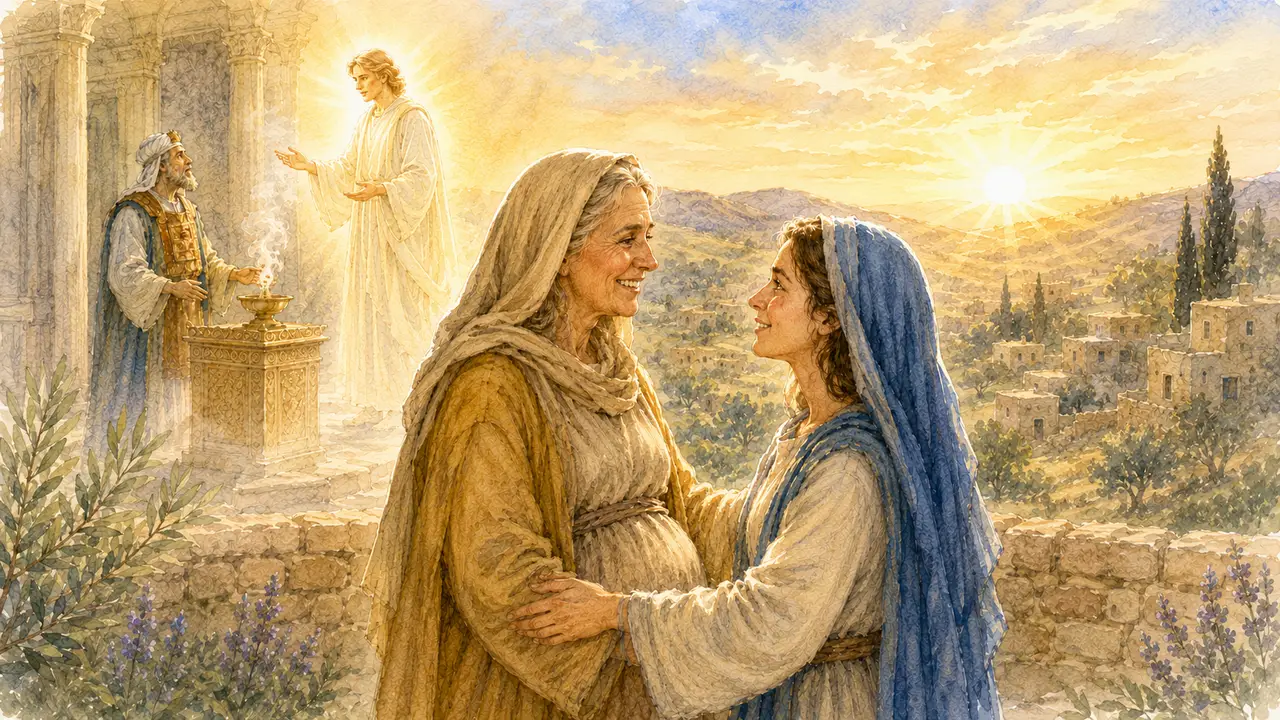
Mary then travels quickly into the hill country of Judah and enters the house of Zechariah and Elizabeth. The sequence strongly supports the conclusion that Gabriel’s announcement has just informed her of Elizabeth’s pregnancy. Elizabeth’s five months in seclusion help explain why Mary apparently has not heard the news through ordinary family channels: her elderly relative’s pregnancy becomes a confirming sign given through Gabriel, and Mary goes to see her at once.
When Elizabeth hears Mary’s greeting, the baby leaps in her womb and Elizabeth is filled with the Holy Spirit. John’s relationship to Jesus already begins before either child is born. Gabriel had said that John would be filled with the Holy Spirit while still in his mother’s womb, and now Luke shows that promise coming to pass. The prophet who will later point Israel to Jesus responds with joy to His presence before birth.
Elizabeth cries out, “Blessed are you among women, and blessed is the fruit of your womb!” She then asks, “How has it happened to me, that the mother of my Lord would come to me?” Elizabeth calls the still-unborn Jesus “my Lord”. Luke continues to build His identity. Gabriel has called Him the Son of the Most High, the Son of God and the everlasting Son of David. Elizabeth now confesses Him as Lord.
Her next words sharpen the contrast between Mary and Zechariah: “Blessed is she who believed that there would be a fulfillment of what had been spoken to her by the Lord.” Zechariah did not believe Gabriel’s words and lost his speech. Mary believed that the Lord would fulfil what He had spoken. Luke began the chapter by referring to “the things that have been fulfilled among us”. Gabriel said his words “will be fulfilled in their proper time”. Elizabeth now blesses Mary because she believed there would be “a fulfillment”.
Mary’s song reveals how thoroughly Scripture has shaped her faith. She begins, “My soul magnifies the Lord, and my spirit has rejoiced in God my Savior.” Mary understands herself as someone who needs God’s salvation. She calls Him “God my Savior” and then speaks of His grace towards her: “He has looked upon the humble state of His slave”. Future generations will call her blessed because “the Mighty One has done great things for me”. Mary directs the praise towards what God has done.
Her song draws heavily from Hannah’s prayer in 1 Samuel 2:1–10. Hannah rejoices in Yahweh after the birth of Samuel and praises Him as the God who brings down the powerful, raises the lowly, feeds the hungry and overturns the pride of mankind. Mary speaks in the same pattern. Hannah says, “Those who were hungry cease to hunger”, while Mary says, “He has filled the hungry with good things”. Hannah says Yahweh “raises the poor from the dust” and “exalts the needy from the ash heap”, while Mary says that God “has exalted those who were humble”. Hannah’s song ends by looking forward to Yahweh giving strength “to His king” and exalting “the horn of His anointed”. Mary now sings as the promised Davidic King grows in her womb.
Mary also draws upon the Psalms. “His mercy is upon generation after generation toward those who fear Him” closely echoes Psalm 103:17: “But the lovingkindness of Yahweh is from everlasting to everlasting on those who fear Him”. Her words, “He has filled the hungry with good things”, echo Psalm 107:9: “For He has satisfied the thirsty soul, and the hungry soul He has filled with what is good.”
“He has done a mighty deed with His arm” recalls the repeated Old Testament language of Yahweh’s saving power. Exodus 6:6 says that Yahweh would redeem Israel “with an outstretched arm”. Isaiah 52:10 says, “Yahweh has bared His holy arm in the sight of all the nations, that all the ends of the earth may see the salvation of our God.” Mary now speaks of God acting again with His mighty arm as He brings His promised salvation near.
She also says that God “has scattered those who were proud in the thoughts of their heart”, “has brought down rulers from their thrones”, and “sent away the rich empty-handed”, the same pattern of opposing pride and exalting the humble already seen in Hannah’s prayer and throughout the Psalms. Mary interprets what God is doing through the Messiah within that pattern.
Her song then moves directly into covenant fulfilment: “He has given help to Israel His servant, in remembrance of His mercy, as He spoke to our fathers, to Abraham and his seed forever.” These words draw on Genesis 12:1–3, Genesis 17 and Genesis 22:16–18. God promised Abraham that He would bless him, multiply his seed and bring blessing to the nations through that seed. Mary sees the conception of Jesus as God acting according to what He “spoke to our fathers”.
Luke has now brought together the promises to Abraham and David: Gabriel’s announcement of the everlasting Son of David, and Mary’s song of God’s mercy to Abraham’s seed, converge in the same child.
Mary remains with Elizabeth for about three months and then returns home. Luke then turns to the birth of John. Elizabeth gives birth exactly as Gabriel said, and her neighbours and relatives hear that “the Lord had magnified His great mercy toward her”. God has fulfilled His word again.
On the eighth day they come to circumcise the child. This practice reaches back to Genesis 17, where God gave circumcision to Abraham as the sign of His covenant. The family expects the child to receive his father’s name, but Elizabeth says, “No, but he shall be called John.” Their relatives object because no one in the family bears that name, so they make signs to Zechariah and ask what he wants the child called.
Zechariah writes, “His name is John.” Gabriel had said before the child was conceived, “you will call his name John”. Zechariah now acts in submission to the word he previously refused to believe, and the sign comes to its appointed end. Immediately his mouth opens, his tongue loosens, and he begins blessing God.
Fear comes upon the people living around them, and the events spread throughout the hill country of Judea. They ask, “What then will this child be?” Luke answers by saying that “the hand of the Lord was indeed with him”. John has been set apart for the prophetic ministry Gabriel announced before his conception.
Zechariah then receives the Holy Spirit and prophesies. Significantly, his prophecy begins with the salvation God will accomplish through the house of David before he says anything directly about his own son: “Blessed be the Lord God of Israel, for He visited and accomplished redemption for His people, and raised up a horn of salvation for us in the house of David His servant.”
The language of “visited” comes from the Old Testament, where God visits His people in order to act. Ruth 1:6 says that Yahweh “had visited His people to give them food”. Zechariah now declares that God has visited His people again, this time to accomplish redemption.
The “horn of salvation” also comes from Old Testament language. Psalm 18:2 calls Yahweh “my shield and the horn of my salvation”. A horn is a common biblical image of strength, especially the strength of a king. Zechariah says that God has raised up this horn “in the house of David His servant”. Psalm 132:17 also looks forward to God causing “the horn of David to spring up”. This hope is fulfilled in Jesus.
Zechariah then says that God has acted “as He spoke by the mouth of His holy prophets from of old”. Luke began with “the things that have been fulfilled among us”, and Zechariah now places the coming salvation within the entire prophetic witness.
“Salvation from our enemies, and from the hand of all who hate us” closely echoes Psalm 106:10, which says that Yahweh “saved them from the hand of the one who hated them and redeemed them from the hand of the enemy”. Under Roman occupation, Zechariah’s language would naturally include hope for deliverance from those who oppressed Israel. As the prophecy continues, however, Zechariah identifies the deepest form of salvation as “the forgiveness of their sins”. Luke allows both dimensions to stand. God will establish His King, defeat His enemies and deal with the guilt of His people before Him.
Zechariah again anchors this salvation in the Abrahamic covenant: “To show mercy toward our fathers, and to remember His holy covenant, the oath which He swore to Abraham our father”. Genesis 22:16–18 records Yahweh swearing by Himself that Abraham’s seed would possess the gate of his enemies and that all the nations of the earth would be blessed through his seed. Zechariah now sees God acting according to that oath.
The purpose of this deliverance is that God’s people, “being rescued from the hand of our enemies, might serve Him without fear, in holiness and righteousness before Him all our days”. Exodus stands behind this pattern as well. Yahweh repeatedly told Pharaoh, “Let My people go, that they may serve Me.” God redeems a people so that they may belong to Him, worship Him and walk before Him in holiness.
Only then does Zechariah turn directly to John: “And you, child, will be called the prophet of the Most High, for you will go on before the Lord to make ready His ways.” Isaiah 40:3 stands directly behind these words: “A voice is calling, ‘Prepare the way for Yahweh in the wilderness; make smooth in the desert a highway for our God.’” Malachi 3:1 also says, “Behold, I am going to send My messenger, and he will prepare the way before Me.” Zechariah applies these promises to John.
Luke therefore identifies precisely who Jesus is. Isaiah says that the messenger prepares the way for Yahweh. Malachi says that the messenger prepares the way before Yahweh. John goes before Jesus. Luke places Jesus in the position occupied by Yahweh in those Old Testament prophecies.
John will “give to His people the knowledge of salvation by the forgiveness of their sins”. Here Luke begins to explain the salvation that Jesus brings. Israel has earthly enemies, but sin places the people themselves under guilt before God. Salvation requires forgiveness.
That forgiveness comes “because of the tender mercy of our God”. Mercy has filled the whole chapter. Elizabeth speaks of the Lord removing her disgrace. Mary sings of His mercy upon those who fear Him and His mercy towards Abraham. Zechariah says that God acts “to show mercy toward our fathers”. Now he says that the forgiveness of sins comes because of God’s tender mercy.
Zechariah then speaks of “the Sunrise from on high” who will visit us, “to shine upon those who sit in darkness and the shadow of death, to direct our feet into the way of peace”. Isaiah 9:2 stands prominently behind this language: “The people who walk in darkness will see a great light; those who live in the land of the shadow of death, the light will shine on them.” Isaiah 60:1–2 also calls Zion to arise because her light has come while darkness covers the earth. Malachi 4:2 speaks of “the sun of righteousness” rising with healing in its wings. Zechariah gathers this prophetic light imagery and applies it to the coming salvation.
Luke closes the chapter with John growing and becoming strong in spirit, living in the desolate regions until the day of his public appearance to Israel. John waits for the time God has appointed. Everything Gabriel said about him will soon begin to unfold.
Luke began with “the things that have been fulfilled among us”, and every major line in the chapter leads to Jesus. John is great in the sight of the Lord; Jesus is great and is called the Son of the Most High. John is a prophet; Jesus is the eternal King. John prepares the way; Jesus is the Lord whose way he prepares. Jesus is the promised Son of David, the fulfilment of God’s oath to Abraham, the horn of salvation raised up for His people, the One who brings forgiveness of sins, and the light that shines upon those sitting in darkness and the shadow of death. Luke begins his Gospel by showing God fulfilling His word in history and bringing His covenant promises together in His Son.