
Exodus 15
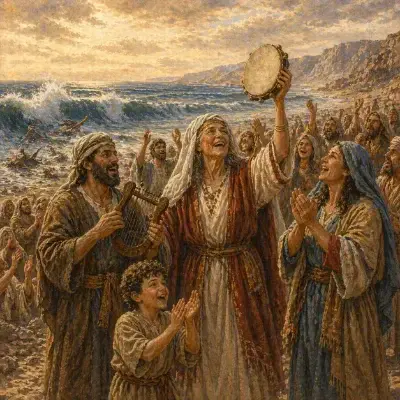
Exodus 15 records Israel’s response after Yahweh brings them through the sea and destroys the army of Egypt. Before law is given, before instruction for the wilderness, Yahweh gives His people words. Deliverance comes first, and praise follows.
Exodus 15 Explained: Yahweh Saves, Judges, and Reigns Forever
Exodus 15 explains the exodus by putting it into song.
What chapter 14 narrates in action, chapter 15 declares in praise.
Before Israel receives instruction for the wilderness, Yahweh gives His people words.
Yahweh delivers His people and puts praise in their mouths.
“Then Moses and the sons of Israel sang this song to Yahweh.”
Yahweh is highly exalted.
He has hurled horse and rider into the sea.
The song speaks plainly about judgment.
The overthrow of Egypt’s power is the reason for praise.
Yahweh’s glory is displayed in judgment.
Yahweh is named as strength, song, and salvation.
He has not merely provided salvation.
He has become salvation for His people.
Yahweh is then named a warrior.
This defines the exodus.
It was not escape by negotiation or chance.
Yahweh went to war against Egypt and its false gods.
Yahweh Himself entered the conflict.
Yahweh Himself won it.
Yahweh is declared as the One who reigns forever and ever.
The song then slows and lingers over Egypt’s defeat.
Pharaoh’s chariots are cast into the sea and the waters cover them.
This recalls the judgment of Yahweh in Genesis, when He brought the flood upon the world.
In the days of Noah, Yahweh judged the wicked through water and saved Noah and his family through the same act.
Now Yahweh judges Egypt through the sea and saves His people by bringing them safely through it.
The enemy that inspired terror only moments earlier is destroyed.
Israel contributes nothing to their own salvation.
Yahweh’s right hand alone brings deliverance.
Yahweh’s exaltation stands in direct contrast to human pride.
Those who oppose Him are destroyed.
His burning anger devours like chaff.
Yahweh has full control over nature.
At the blast of Yahweh’s nostrils the waters were piled up.
Pharaoh’s intention is stated clearly. ‘I will pursue, I will overtake, I will divide the spoil;
My desire shall be fulfilled against them; I will draw out my sword, my hand will dispossess them.’
This is the high point of human pride.
It is immediately undone.
Yahweh blows with His wind.
The sea covers them.
They sink like lead in mighty waters.
One act answers every boast.
At this point the song stops recounting and speaks theology.
“Who is like You among the gods, O Yahweh?”
This is the center of the song.
Egypt’s defeat reveals Yahweh’s incomparability.
Who is like You among the gods, O Yahweh?
Who is like You, majestic in holiness,
Fearsome in praises, working wonders?
It is Yahweh’s utter uniqueness as the God who judges, inspires fear, receives praise, and works wonders.
The gods of Egypt have been exposed. Only Yahweh is powerful to save. The gods of Egypt have been revealed as false gods.
The song presses Israel to confess what the plagues and the sea have proven.
Yahweh is the true God without rival.
From this confession the song turns forward.
The same right hand that shattered Egypt now guides Israel.
Redemption language enters explicitly.
Yahweh has redeemed a people.
He leads them in His lovingkindness.
Deliverance establishes ownership.
Israel has not been released into independence.
They have been purchased.
Yahweh leads them toward His holy habitation.
The destination is defined by His presence, not merely by territory.
The horizon expands beyond Israel.
The nations hear and tremble.
Anguish has seized the inhabitants of Philistia.
Then the chiefs of Edom were dismayed;
The leaders of Moab, trembling seizes them;
All the inhabitants of Canaan have melted away.
Yahweh’s act at the sea will be remembered and His reputation will move ahead of His people.
Before Israel ever meets these nations, Yahweh has already subdued them.
Their future does not rest on Israel’s strength.
It rests on Yahweh’s arm.
The song concludes with a declaration of kingship.
“Yahweh shall reign forever and ever.”
Pharaoh’s reign ends at the sea.
Yahweh’s reign has no end.
The exodus reveals who truly reigns.
Yahweh saves.
Yahweh judges.
Yahweh reigns.
Yahweh parted the waters of the sea, and Israel walked through on dry land.
Pharaoh’s horses and chariots followed Israel into the sea, and the waters returned.
These were real acts of judgment and deliverance.
Miriam then appears.
She is named as a prophetess and is identified as Aaron’s sister.
She takes a tambourine and leads the women in worship.
They repeat the song’s opening confession.
Her role is not to introduce new revelation.
Her role is to confirm what Yahweh has done.
The praise of Yahweh belongs to all Israel.
Prophecy here consists in rightly declaring His saving act.
After the song of praise, the chapter quickly shifts to the scene at Marah.
Three days into the wilderness the people find no water.
And when water appears it is bitter.
In contrast to the earlier song of praise, the people grumble against Moses.
They ask what they will drink.
The people who sang of Yahweh’s power now question His provision.
Their faith proves fragile when tested
They know what Yahweh has done.
However, they do not yet trust Him enough to interpret present hardship in light of past deliverance.
Moses cries out to Yahweh.
Yahweh shows him a tree and Moses throws it into the water.
The water becomes sweet.
Yahweh provides and he also instructs.
He sets for Israel a statute and a judgment.
He tests them.
The issue is framed in terms of listening.
Obedience flows from hearing Yahweh’s voice.
The promise given ties Israel’s future to Egypt’s past.
The diseases placed on Egypt were judgments.
Israel will not experience them if they walk in obedience.
Yahweh names Himself here as healer.
The God who judges is also the God who preserves His redeemed people.
The chapter closes at Elim.
There are twelve springs of water and there are seventy date palms.
Provision follows testing and abundance follows bitterness.
Exodus 15 therefore marks the true end of Egypt.
It also marks the beginning of testing in the wilderness.
Yahweh has revealed His name through salvation and judgment.
Israel must now learn whether they will live as a people who trust the God they have sung about.
Or will they be a people who forget His deeds when their faith is tested?