
Psalm 27
Psalm 27 begins with David's fearless confession that Yahweh is his light, salvation, and strong defence, then unfolds into a prayer for the presence, guidance, and protection of God. Surrounded by enemies and false witnesses, David seeks one thing above every earthly deliverance: to dwell in Yahweh's house, behold His beauty, and seek His face. The psalm moves from confidence, through urgent petition, and back to patient hope, teaching God's people to interpret every danger through His covenant faithfulness and to wait for the goodness fulfilled in Jesus Christ.
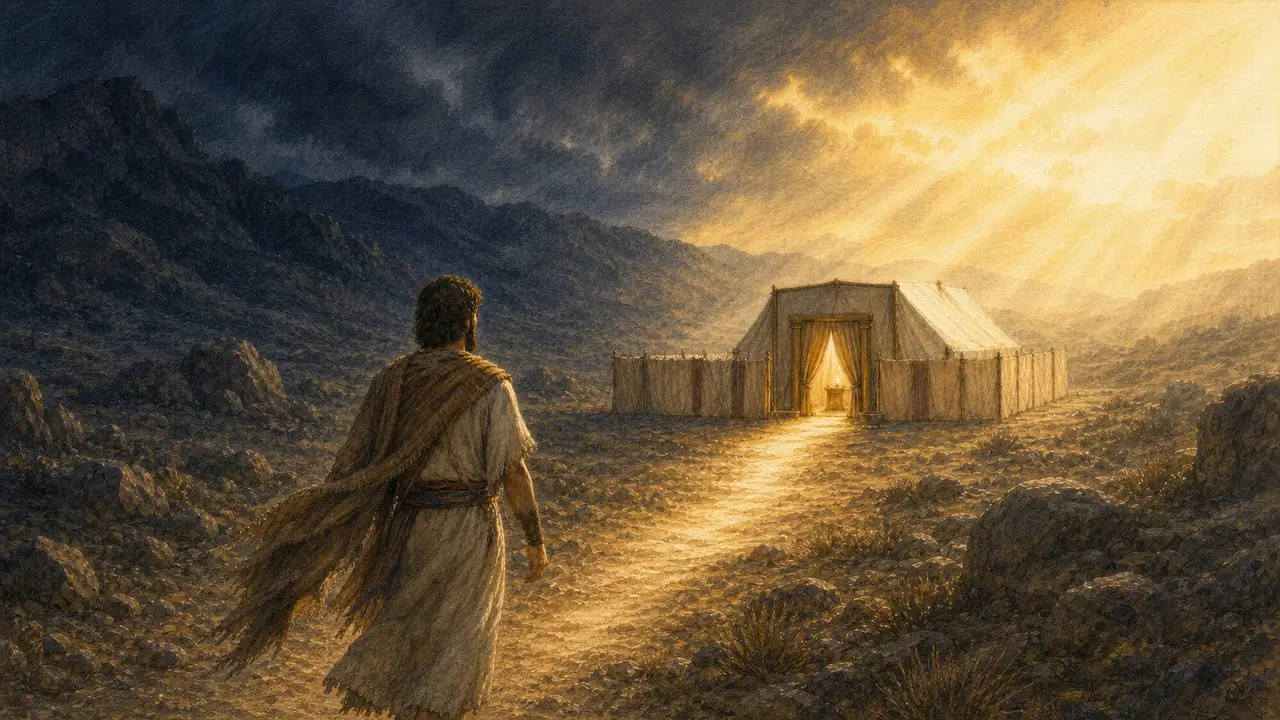
Psalm 27 Explained: Yahweh Is My Light and My Salvation.
Psalm 27 is identified simply as “Of David,” and its language fits a man who knew warfare, political hostility, false accusation, betrayal, and repeated threats against his life. David had stood before Goliath, fought in Israel’s armies, fled from Saul, faced the Philistines, and endured rebellion within his own kingdom. When he speaks of armies encamping against him and war rising against him, he is drawing from experience. Even so, the psalm does not begin with the danger. It begins with Yahweh, because David interprets every threat through what he knows about his covenant God.
The psalm has a broad thematic symmetry. Verses 1 to 3 express confidence in Yahweh’s presence and protection. Verses 4 to 6 turn towards David’s desire to remain in that presence. Verses 7 to 12 continue the same theme as direct petition, asking Yahweh to hear, receive, instruct, and preserve him. Verses 13 and 14 return to confidence, now expressed as hope. The psalm therefore moves from confidence in Yahweh’s presence, to prayer for Yahweh’s presence, and back to confidence in Yahweh’s presence.
The covenant name “Yahweh” appears thirteen times throughout this psalm. David begins with Yahweh, repeatedly addresses Yahweh by name, and closes by commanding himself and the congregation twice to “Hope in Yahweh.” The name of God binds the psalm together. David is calling upon the God who revealed Himself to Moses, redeemed Israel from slavery, made covenant with His people, and caused His presence to dwell among them. Every part of the psalm depends on who Yahweh is.
“Yahweh is my light and my salvation; whom shall I fear? Yahweh is the strong defense of my life; whom shall I dread?” David gives three descriptions of Yahweh, and each one answers the danger before it is even named. Light drives back darkness and makes the way clear. Salvation means rescue from a threat that David cannot overcome by his own strength. A strong defence is a secure place where the enemy cannot finally reach him. David speaks personally: “my light,” “my salvation,” and “the strong defence of my life.” The covenant God who saved Israel is also the God who saves His servant.
The joining of light and salvation naturally recalls the Exodus. Yahweh appeared to Moses in fire at the burning bush, revealed His covenant name, brought Israel out of slavery, and led His people through the wilderness by a pillar of fire during the night. At the sea, Yahweh saved Israel from Pharaoh and destroyed the army that pursued them. Moses and the people then sang, “Yah is my strength and song, and He has become my salvation” in Exodus 15:2. David takes God’s saving work that defined Israel’s history and applies it to his own life. Yahweh was Israel’s light in the wilderness and salvation at the sea, and He remains David’s light and salvation in the presence of his own enemies.
Because Yahweh is the strong defence of his life, David asks, “Whom shall I fear?” and “Whom shall I dread?” The questions expect the answer, “No one.” David is not claiming that his enemies are weak. He immediately describes them as evildoers who came upon him “to devour my flesh.” Their intent was violent and personal. They were his adversaries and enemies, and they wanted his destruction.
The attack belongs to the past: “they stumbled and fell.” David has already seen Yahweh overthrow those who rose against him. His present confidence rests on remembered deliverance. He does not reason from favourable circumstances. He reasons from the proven faithfulness of Yahweh.
Verse 3 then looks towards whatever danger may come next: “Though a host encamp against me, my heart will not fear; though war arise against me, in this I trust.” A host is an army. David imagines military forces surrounding him and war rising against him, circumstances he understood well. The future remains uncertain at the level of events, but David’s trust is already settled because Yahweh’s character does not change.
The language of an encamped army also recalls Israel’s life in the wilderness. Israel camped around the tabernacle, with Yahweh’s dwelling at the centre, while hostile nations threatened them from outside. Their security came from the presence of Yahweh among them. At the sea Moses had said, “Yahweh will fight for you while you keep silent.” David understands that same covenant reality personally. The enemy may surround him, but Yahweh is closer than the enemy and stronger than the army.
Having declared what he does not fear, David now states what he desires: “One thing I have asked from Yahweh, that I shall seek: that I may dwell in the house of Yahweh all the days of my life, to behold the beauty of Yahweh and to inquire in His temple.” David has many obvious needs. He needs protection, guidance, and deliverance. But his greatest desire is this: to remain in the presence of Yahweh.
The words “one thing” give the request its weight. David’s life contains many pressures, but his heart is directed towards one central pursuit. He wants to dwell in Yahweh’s house, behold Yahweh’s beauty, and inquire in Yahweh’s temple. The repeated name gives the request its covenant character. He seeks the God who has bound Himself to His people and chosen to dwell among them.
The permanent temple in Jerusalem had not been built during David’s life, but temple language could still refer to Yahweh’s sanctuary. The place matters because Yahweh caused His name and presence to dwell there. Exodus 25:8 states the purpose of the tabernacle: “Let them make a sanctuary for Me, that I may dwell among them.” David’s desire grows out of that purpose. He longs to remain before the God who dwells with His people.
“To behold the beauty of Yahweh” reaches beyond the appearance of the sanctuary. David wants to contemplate the character, holiness, majesty, goodness, and glory of Yahweh Himself. He also wants “to inquire in His temple,” which carries the sense of seeking direction and understanding. David seeks a presence that governs his life. He wants to behold Yahweh and receive instruction from Yahweh.
Verse 5 explains why the house of Yahweh gives him confidence: “For in the day of calamity He will conceal me in His shelter; in the secret place of His tent He will hide me; He will lift me up on a rock.” David expects calamity, but he also expects Yahweh to keep him. The shelter, secret place, and tent continue the sanctuary imagery. Yahweh’s dwelling becomes the place of protection for His servant.
The repetition of conceal and hide strengthens the assurance that David’s life remains under God’s care. His enemies may search for him, surround him, and accuse him, but Yahweh can place him beyond their reach. The security comes from Yahweh’s decision to preserve him.
The final line changes the image from concealment to elevation: “He will lift me up on a rock.” A rock provides stability, height, and safety. Throughout the Old Testament, Yahweh is called the Rock of His people. Moses says in Deuteronomy 32:4, “The Rock! His work is perfect,” and David later sings in 2 Samuel 22:47, “Blessed be my rock; and exalted be God, the rock of my salvation.” Psalm 27 does not directly call Yahweh the rock in this verse, but the image belongs to the same theology. Yahweh places His servant where the enemy cannot overthrow him.
The lifting in verse 5 leads directly into verse 6: “And now my head will be lifted up above my enemies around me.” David does not claim that he will raise himself through military ability or royal authority. Instead, Yahweh will lift him up. David has been surrounded, but Yahweh will vindicate him and raise his head above those who seek his fall.
That expected deliverance leads into worship: “And I will offer in His tent sacrifices with loud shouts of joy; I will sing, and I will sing praises to Yahweh.” The movement of verses 4 to 6 begins with seeking Yahweh’s presence, continues through protection and vindication, and ends in public praise. Yahweh’s saving work returns to Him in sacrifice, worship, and song.
Verse 7 marks a clear turn: “Hear, O Yahweh, when I call with my voice, and be gracious to me and answer me.” David moves from speaking about Yahweh to speaking directly to Yahweh. The confidence of the opening does not remove the need for petition. It gives David grounds to call upon God. Since Yahweh is his light and salvation, David asks Him to hear and answer.
David’s appeal for grace is significant. He does not treat Yahweh’s help as something owed to him. He asks Yahweh to be gracious. His confidence rests on the mercy and covenant faithfulness of God.
Verse 8 brings the central desire of the psalm into sharper focus: “On Your behalf my heart says, ‘Seek My face,’ ‘Your face, O Yahweh, I shall seek.’” Yahweh calls David to seek His face, and David answers that call. To seek Yahweh’s face is to seek His favourable presence, fellowship, direction, and blessing.
The language recalls the priestly blessing in Numbers 6:25 to 26: “Yahweh make His face shine on you, and be gracious to you; Yahweh lift up His face on you, and give you peace.” David prays for that blessing. He wants Yahweh’s face turned towards him in grace and peace.
This also recalls Moses in Exodus 33. After Israel sinned with the golden calf, Moses refused to go forward without Yahweh’s presence. He said, “If Your presence does not go with us, do not lead us up from here.” Moses then asked to see Yahweh’s glory. David expresses the same covenant concern. Deliverance, land, and victory mean little without the presence of Yahweh.
Because David seeks Yahweh’s face, he immediately prays, “Do not hide Your face from me.” The opposite of Yahweh’s shining face is the withdrawal of His favour. David then adds, “Do not turn Your slave away in anger.” He knows that he approaches a holy God and that Yahweh’s anger against sin is righteous.
The psalm does not identify a particular sin, so David is not making a specific confession here. He is recognising his dependence on grace. Confidence in Yahweh does not become presumption before Yahweh. David belongs to God as His slave and relies entirely on God’s favour.
“You have been my help” looks backwards again. David knows from experience that Yahweh has helped him. Past mercy becomes the ground of present prayer: “Do not abandon me and do not forsake me, O God of my salvation!” The opening declaration returns in direct address. Yahweh is David’s salvation, so David asks Him to continue acting according to that saving character.
The language of abandonment prepares for verse 10: “For my father and my mother have forsaken me, but Yahweh will take me up.” David names the strongest earthly relationships possible. Even those relationships may fail through death, weakness, rejection, or inability to help. Yahweh will receive His servant and take him into His care.
The verse does not require us to imagine a particular event in which David’s parents rejected him. Its force lies in the comparison. The closest human bonds cannot equal the covenant faithfulness of Yahweh. Those who should naturally take up their child may fail, but Yahweh will take up His servant.
Because Yahweh receives him, David asks for instruction: “Instruct me in Your way, O Yahweh, and lead me in a level path because of my foes.” David needs protection from his enemies, and he also needs to walk rightly in their presence. His foes watch for failure and seek an opportunity to accuse him. David therefore asks Yahweh to lead him along a straight and secure path.
The wording recalls the commission of Joshua. Moses told Joshua in Deuteronomy 31:7 to “be strong and courageous,” and Yahweh repeated the command in Joshua 1. Joshua’s courage rested on Yahweh’s presence and his obedience to Yahweh’s instruction. He was told not to turn aside to the right or to the left. David asks for the same kind of direction. He wants a life ordered by Yahweh while opposition surrounds him.
The danger becomes more specific in verse 12: “Do not give me over to the desire of my adversaries, for false witnesses have risen against me, and such as breathe out violence.” David’s enemies seek his destruction through lies and force. False witnesses create the appearance of guilt, while violent men stand ready to act on that falsehood.
The expression “breathe out violence” presents violence as something that fills their speech and intentions. Their words serve death. David asks Yahweh not to hand him over to what they desire.
Verse 13 then gathers the tension of the psalm into one unfinished sentence: “I would have despaired unless I had believed that I would see the goodness of Yahweh in the land of the living.” The Hebrew begins with the sense, “Unless I had believed that I would see the goodness of Yahweh in the land of the living,” and leaves the consequence unspoken. The LSB supplies “I would have despaired” because that is the evident implication.
The sentence reveals how David survives the interval between danger and deliverance. He believes before he sees. Yahweh is presently his light and salvation, while the full display of Yahweh’s goodness remains future. Faith holds him while he waits.
The psalm moves repeatedly through past, present, and future. David remembers that his enemies came against him and fell. He confesses that Yahweh is his light and salvation. He expects that Yahweh will conceal him, hide him, lift him, and take him up. What Yahweh has done supports what David believes now, and what David believes now gives him confidence about what Yahweh will do.
“The land of the living” ordinarily refers to life on earth in contrast with death, the grave, or Sheol. Psalm 52:5 speaks of being uprooted “from the land of the living.” Psalm 142:5 calls Yahweh the psalmist’s portion “in the land of the living.” Isaiah 38:11 contrasts seeing Yahweh in the land of the living with going down to death. Isaiah 53:8 says that the Servant was “cut off out of the land of the living,” meaning that He was put to death. Ezekiel uses the same expression when describing nations brought down to the pit.
At the immediate level, David believes that Yahweh will preserve him from his enemies so that he continues to live and see God’s goodness on earth. His adversaries want his death, and David expects Yahweh to deliver him.
The expression also carries the theology of the land. Yahweh brought Israel out of Egypt so that they might live before Him in the land He promised. Life in the land meant life under covenant blessing, under the rule and presence of Yahweh. David therefore expects more than bare survival. He expects to continue experiencing the goodness of Yahweh among the living.
The psalm nevertheless reaches beyond one earthly deliverance. Many faithful servants of God have died without escaping their persecutors. Hebrews 11 speaks of some who escaped the sword and others who were tortured, imprisoned, stoned, and killed. Their faith did not fail. They looked for “a better resurrection.”
David’s longing also exceeds temporary survival. He wants to dwell in Yahweh’s house, behold Yahweh’s beauty, seek Yahweh’s face, and see Yahweh’s goodness in the land of the living. Earthly deliverance gives him another season in which to experience those blessings, but death eventually comes to every man. The desires expressed in this psalm require a greater fulfilment.
Other psalms open that expectation further. Psalm 16 says, “In Your presence is fullness of joy; in Your right hand there are pleasures forever.” Psalm 17 says, “As for me, I shall behold Your face in righteousness; I will be satisfied with Your likeness when I awake.” These words carry the hope of life with God beyond death.
Verse 14 therefore concludes with confident waiting: “Hope in Yahweh; be strong and let your heart take courage; hope in Yahweh.” The answer has not yet appeared in full, so hope remains necessary. David knows who Yahweh is, and that knowledge gives him courage while he waits.
The command again recalls Moses and Joshua. Moses told Joshua to be strong and courageous because Yahweh would go with him and would neither fail nor forsake him. Yahweh repeated the same promise in Joshua 1. David draws on that covenant assurance. He can be strong because Yahweh is present, and he can hope because Yahweh remains faithful.
The repeated “Hope in Yahweh” forms a fitting conclusion to a psalm that began, “Yahweh is my light and my salvation.” The psalm starts with the character of Yahweh and ends with the response that character demands. David has enemies, unanswered petitions, and an uncertain future, but his hope rests on the covenant name of the God who has saved before and will save again.
After following the psalm through David’s own historical and covenant setting can we see clearly how its themes reach their fulfilment in Christ. Jesus is the Son of David who faced adversaries, false witnesses, violence, rejection, and death. What David experienced in part, Christ endured in full.
The opening declaration finds its clearest expression in Him. Jesus says, “I am the Light of the world,” and His name means “Yahweh saves.” The angel explained, “You shall call His name Jesus, for He will save His people from their sins.” Yahweh’s light and salvation stand before us in the person of the Son.
David longed to dwell in Yahweh’s house and behold His beauty. John says that the Word became flesh and dwelt among us, using language associated with the tabernacle, and that “we beheld His glory.” Jesus is the true dwelling place of God among mankind. The presence David sought in the sanctuary appears bodily in Christ.
David prayed, “Do not hide Your face from me,” and “Do not abandon me and do not forsake me.” At the cross, Jesus entered the judgement signified by that abandonment and cried, “My God, My God, why have You forsaken Me?” He bore the wrath due to sinners so that those joined to Him would never be cast away.
David feared false witnesses and men who breathed out violence. False witnesses rose against Jesus, and violent men handed Him over to death. Isaiah 53:8 says that the Servant was “cut off out of the land of the living.” Jesus entered death and was laid in the grave.
The Father then raised Him. Christ passed through death into indestructible life and entered the true land of the living. In Him, David’s confidence becomes larger than escape from one army or survival through one crisis. Jesus has conquered sin and death, and all who belong to Him will share His resurrection.
The land of the living therefore reaches its final fulfilment in the renewed creation. Revelation says that God will dwell with His people and that “they will see His face.” The house, tent, face, beauty, goodness, and life of Psalm 27 all meet there. What David sought in the sanctuary and expected in earthly life will be given without interruption to everyone redeemed by Christ.
Believers already possess eternal life through Him, and they still wait for the resurrection of the body. They live in the same pattern expressed in verse 13: believing before seeing. The fulfilment is certain because Christ has already risen.
Psalm 27 therefore teaches the people of God to interpret fear, suffering, and death through the covenant character of Yahweh and the finished work of Christ. Yahweh has revealed Himself as light and salvation. He has come to dwell with His people in the Son. He has conquered death through the resurrection. Those who trust in Christ will behold the beauty of God, see His face, and live forever in His presence.
That is why the final command carries such certainty: “Hope in Yahweh; be strong and let your heart take courage; hope in Yahweh.” The God who was David’s light and salvation has completed His saving work in Jesus Christ, and everyone who belongs to Him will see the goodness of Yahweh in the true land of the living.