
Genesis 11
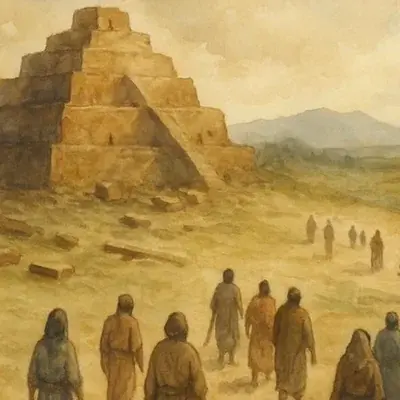
Genesis 11 brings the first section of the Bible to a close. What begins as human unity turns into rebellion, as the people build a city and a tower to make their name great. But Yahweh comes down, confuses their language, and scatters them over the face of the earth. Even so, the line of promise is preserved.
Babel, Scattered Nations, and a Barren Woman
We start off Genesis 11 with some critical information that will move the story forward. The opening verses describe a united world, one language, one people, moving together. But what looks like unity quickly turns into something else.
As the people move eastward, they find a plain in the land of Shinar and settle there. The direction east is something we have seen before. Adam and Eve went east from the garden of Eden, and Cain went east from the presence of God. Once again, mankind is drifting further from Yahweh.
The aim of the city builders is clear. They say, “Come, let us build for ourselves a city and a tower with its top in the heavens, and let us make a name for ourselves, lest we be scattered over the face of the whole earth.” Their fear is dispersion. Their solution is to build something that will hold them together and make them great.
They are likely building a ziggurat, a stepped structure common in Mesopotamia, designed not to reach up to God but to bring the gods down to earth.
What they construct is a man-made temple, an attempt to draw down divine power while keeping control in their own hands. The name they seek is not just a reputation on earth, but recognition among the gods.
Yahweh comes down to see the city and the tower the people had built. It is an ironic moment. They had tried to reach heaven, but fall miserably short. Yahweh must come down just to inspect their work.
Yahweh’s name appears five times in this short section. This is not the distant Creator, but the covenant God who gave mankind a calling. He had said, “Be fruitful and multiply, and fill the earth.”
But here, mankind resists Yahweh’s command. They stay together, build upward, and try to make a name for themselves. Their actions are not just proud, they are a direct rejection of Yahweh’s covenant purpose for the world.
Yahweh says, “Behold, they are one people, and they all have the same language. And this is only the beginning of what they will do.” Left unchecked, their pride will grow without limit. So He confuses their language.
The unity they used to exalt themselves is broken. What they feared, being scattered across the earth, becomes their future. No weapon or disaster is needed. Just confusion. The project unravels, and the city stops.
The place is called Babel, because there Yahweh confused the language of the whole earth. The name sounds like the Hebrew word for confusion.
What they feared is exactly what takes place. Their unity is undone, and the very thing they tried to avoid becomes their legacy. From here, the focus narrows. The nations are scattered, but one line will be traced.
Verses 10–26 trace the descendants of Shem down to Abram. This genealogy follows the same pattern as Genesis 5, recording the father’s age at the birth of his son, the years he lived afterward, and the passing on of life.
It may seem like just another list, but it quietly continues the story of the promise. Back in Genesis 3, after sin entered the world, God declared that the seed of the woman would crush the serpent’s head.
That promise was passed down through the righteous line, from Adam to Seth, through Noah, and now through Shem. Each generation brings us one step closer.
The names may be unfamiliar, and no events are recorded, but the line is preserved. God is still at work, moving the story forward.
From Arpachshad to Terah, nearly 400 years pass. It is a long stretch of silence in the biblical narrative. No stories are told. No events are recorded.
People are fruitful, having many sons and daughters, echoing the divine blessing, but beyond that, the text remains silent.
This will not be the only time we see God working quietly through the centuries. When we get to the book of Exodus, Israel will spend around 400 years in Egypt before God raises up Moses.
And again, after the final prophet speaks at the end of the Old Testament, there will be another long silence before John the Baptist appears in the wilderness. In each case, Yahweh is not absent. He is preserving, preparing, and positioning His people for what comes next. The line continues, even when nothing seems to be happening.
Another thing worth noticing is the sharp decline in lifespans. Before the flood, men commonly lived more than 800 years. But now, one generation after another lives less and less, dropping below 200 years by the time we reach Nahor.
The effects of the fall continue to play out in the human condition. And yet, fruitfulness remains. Each man in this line has other sons and daughters. This pattern is not just historical, it is theological. It echoes the blessing given at creation in Genesis 1, and again after the flood in Genesis 9: “Be fruitful and multiply.” Even as life shortens, God’s purpose moves forward.
In verses 27–32, the focus narrows to Terah and his family. We are introduced to Abram, Nahor, and Haran.
Haran dies in the presence of Terah, and at the end of the section, Terah dies in Haran. The repetition is not accidental, it forms a chiasm, a framing device that draws attention to what lies at the centre.
And at the centre is verse 30: “Sarai was barren; she had no child.” This is the theological turning point. After generations marked by fruitfulness, the line comes to a halt. Sarai does not bear children. She cannot multiply. She appears to be a genetic dead end.
And she and her husband are powerless to change it.
But this is fertile soil for Yahweh to act. The promise will not move forward by human strength, but by divine intervention.
Genesis 11 closes one chapter of the Bible’s story and opens the way for the next. Human pride is scattered, but the line of promise remains. From Shem to Abram, the family is preserved. Now the focus will narrow. The nations fill the earth, and into that world, Yahweh will speak again.