
Galatians 4
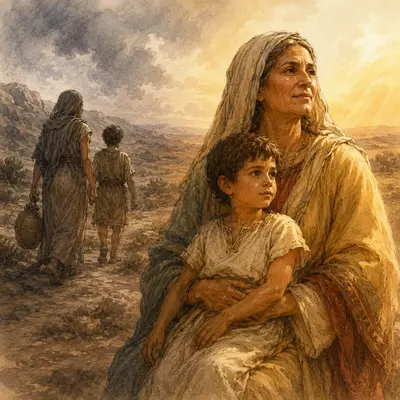
Galatians 4 moves from inheritance to sonship. In Christ, believers are not slaves under a guardian but sons who cry "Abba, Father" by the Spirit. Paul warns the Galatians against trading adoption for bondage, and proves from Abraham's own household that the inheritance belongs to the child of promise, not the child of the flesh.

Galatians 4 Explained: Sons of Promise, Not Slaves of the Law
Galatians 4 continues the argument from chapter 3 by moving from inheritance to sonship. Paul has already said, “And if you belong to Christ, then you are Abraham’s seed, heirs according to promise.” Now he explains what that inheritance means, and why returning to the Law for righteousness takes them back into slavery.
The Galatians are being tempted to think that coming under the Law will give them a fuller place among the people of God. Paul says the opposite. In Christ they are already sons and heirs. To go back under the Law is to go back under guardianship, bondage, and fear.
Paul begins with an illustration from household life: “Now I say, as long as the heir is a child, he does not differ at all from a slave although he is lord of all.” The heir owns everything by promise, but while he is still a child, he does not exercise the freedom of mature sonship. He is under guardians and stewards until the date set by his father. That helps us understand Paul’s use of the word “slave” in this passage.
In the ancient household, a slave could be entrusted with serious responsibility. A slave could manage property, supervise children, and carry authority on behalf of the master.
Paul is not saying the child has no place in the household. He is saying that the child, before the appointed time, does not live in the freedom of mature inheritance. He is under supervision. He is governed by others. He belongs to the household, but he is not living in the full liberty of sonship.
Paul applies the illustration: “So also we, while we were children, were enslaved under the elemental things of the world.” Before Christ came, God’s people lived under a guarded order. The Law had a real place in God’s purpose, but it belonged to the time of childhood, supervision, and custody. This reaches back to the end of chapter 3, where Paul said the Law was a tutor unto Christ. It restrained, exposed, guarded, and prepared. It did not give the inheritance. It did not make sinners righteous. It held the people under custody until the promised Seed came.
Then Paul explains: “But when the fullness of time came, God sent forth His Son, born of a woman, born under the Law, so that He might redeem those who were under the Law, that we might receive the adoption as sons.”
God acted when the fullness of time came. The Father sent forth His Son. The Son entered real mankind, born of a woman. He entered Israel’s covenant condition, born under the Law. He did not stand outside the burden He came to redeem. He came under the Law so that He might redeem those under the Law.
That is why the incarnation matters for Paul’s argument. The Son of God became man, not as a distant observer, but as the obedient Redeemer. He was born under the Law and fulfilled righteousness where sinners had failed. He bore the curse of the Law on the tree, as Paul has already said in chapter 3.
He redeemed those under the Law so that they might receive adoption as sons. Redemption is release from bondage by the payment of a price. Adoption is the granting of sonship and inheritance. Christ does not only rescue His people from slavery. He brings them into the household as sons.
Paul then says, “And because you are sons, God sent forth the Spirit of His Son into our hearts, crying, ‘Abba! Father!’” The Father sends the Son to redeem, and the Father sends the Spirit of His Son into our hearts. Paul is not blurring the Persons of the Trinity. He is showing the unity of God’s saving work. The Father sends. The Son redeems. The Spirit confirms sonship in the hearts of believers.
The Spirit is called the Spirit of His Son because He brings believers into the Son’s own relation to the Father. We do not become sons in the same way Christ is the eternal Son. He is Son by nature. We are sons by adoption. But in Christ, by the Spirit, we truly call upon God as Father.
The word “Abba” is often explained as though it means “daddy,” but that is too soft for the passage. “Abba” means “Father.” It is intimate, but it is not childish or casual. Jesus Himself uses “Abba! Father!” in Gethsemane when He prays, “Abba! Father! All things are possible for You; remove this cup from Me; yet not what I will, but what You will.”
That is the cry of the Son in reverent submission to the Father. Paul says the Spirit of God’s Son brings that cry into the hearts of believers. Adopted sons do not approach God as strangers, hired workers, or terrified slaves. They call upon Him as Father because Christ has redeemed them and the Spirit has been sent into their hearts.
Paul then draws the conclusion: “Therefore you are no longer a slave, but a son; and if a son, then an heir through God.” This answers the whole temptation facing the Galatians. The Judaisers are offering them a higher religious status through circumcision and Law-observance.
Paul says they already have the status that matters. They are no longer slaves. They are sons. And if sons, then heirs through God. Sonship is not earned by taking on the Law. It is given through Christ, confirmed by the Spirit, and grounded in the Father’s saving purpose.
Paul then turns from what they are in Christ to what they are in danger of becoming again. He says, “However at that time, when you did not know God, you were slaves to those which by nature are no gods.” Before they knew God, the Galatians were enslaved to idols. They served things that were not gods at all. Their former paganism was not religious innocence. It was slavery. They did not know the true God, and they were bound to false gods.
But then Paul corrects the way he speaks about their conversion: “But now, having known God, or rather having been known by God.” That correction is powerful. Their knowledge of God is real, but it rests on something deeper: God knew them. He set His saving knowledge upon them. He claimed them. He brought them out of slavery and into sonship. Salvation begins with God’s gracious initiative. The Galatians did come to know God, but only because God first knew them.
That makes their present danger all the more serious. Paul asks, “How is it that you turn back again to the weak and worthless elemental things, to which you desire to be enslaved all over again?” The language is shocking because the Galatians are not returning to pagan idols in the exact same form. They are being tempted into Jewish Law-observance as necessary for covenant standing.
But Paul says that if they use those observances as the ground of righteousness, they are returning to slavery. The form has changed, but the bondage is the same. Anything that pulls confidence away from Christ and places it in religious performance is slavery.
Paul then gives the evidence: “You observe days and months and seasons and years.” In context, this is not harmless attention to a calendar. The issue is religious observance treated as necessary for standing before God. The Galatians are being drawn into a system where sonship must be secured through days, months, seasons, and years. But Paul has just said sonship comes through Christ and is confirmed by the Spirit.
To make these observances the basis of covenant standing is to act as though adoption must still be earned. That is why Paul says, “I fear for you, that perhaps I have labored over you for nothing.” He fears that his gospel labour among them may prove fruitless if they continue down this road. They began by the Spirit, but now they are willingly turning back toward slavery.
Paul then makes a personal appeal: “I beg of you, brothers, become as I am, for I also have become as you are. You have done me no wrong.” Paul was born a Jew under the Law, but in Christ he no longer lives under the Law as the basis of righteousness or covenant status. He wants the Galatians to become as he is, free from the Law in Christ.
And when he says, “for I also have become as you are,” he is reminding them that when he came among them, he did not require Gentile believers to live as Jews. He became like them in that sense. He preached Christ to them without placing them under circumcision and the works of the Law. Now he pleads with them to stand with him in that freedom.
The words “You have done me no wrong” show that Paul is not writing out of personal bitterness. He is not defending his pride. He is not nursing an offence. He is pleading with them because they are in danger. His rebuke is not personal resentment. It is pastoral urgency.
Paul reminds them of how they first received him: “But you know that it was because of a bodily illness that I proclaimed the gospel to you the first time.” Paul came to them in weakness, not in outward impressiveness. His physical condition could have tempted them to despise him, but they did not. He says, “And that which was a trial to you in my flesh, you did not despise or loathe, but you received me as an angel of God, as Christ Jesus Himself.”
He then asks, “Where then is that sense of blessing you had?” Their former affection for Paul had been real and deep. He says, “For I bear witness to you that, if possible, you would have gouged out your eyes and given them to me.” That may be connected to his illness, but it may also be a vivid way of saying they would have helped him with anything if they could.
The precise detail is not the main point. The point is their change. They once received Paul with joy and honour because he brought them Christ. Now they are being turned against him by people who are drawing them away from the truth.
That is why Paul asks, “So have I become your enemy by telling you the truth?” This line explains the whole section. The Galatians once received Paul as Christ’s messenger. Now, because he tells them the truth, they are treating him as though he were their enemy.
This is what false teaching often does. It changes how people hear correction. The truth they once received with joy begins to feel like hostility. The messenger who first brought them Christ begins to seem like a threat because others have made error sound attractive.
Paul then exposes the method of the false teachers: “They eagerly seek you, not commendably, but they wish to shut you out so that you will eagerly seek them.” The Judaisers are zealous, but their zeal is corrupt. They are not seeking the Galatians for their good. They want to cut them off from Paul, from gospel freedom, and from confidence in Christ, so that the Galatians will become dependent on them. It makes believers feel incomplete in Christ, then offers Law-observance as the missing piece.
Paul is not against zeal itself. He says, “But it is good always to be eagerly sought in a commendable manner, and not only when I am present with you.” Godly zeal is good when it seeks people for the truth and for Christ. But the zeal of the Judaisers is not commendable. They are not labouring for Christ to be formed in the Galatians. They are labouring to form the Galatians around themselves.
Paul then opens his heart: “My children, with whom I am again in labor until Christ is formed in you.” Paul compares his pastoral labour to birth pains. He had already laboured among them when the gospel first came to them. Now he is in labour again because they are being led astray by false teaching. His goal is not that they become loyal to Paul as a party leader. His goal is that Christ be formed in them. He wants Christ to shape their faith, their confidence, their identity, and their life before God.
He says, “But I could wish to be present with you now and to change my tone, because I am perplexed about you.” Paul’s tone is severe because the situation requires severity. If he were with them, he might speak differently as he saw their condition more directly. But from a distance, knowing the danger, he writes with force. He is perplexed because their present course is leading them away from the gospel. They have received the Spirit. They have been known by God. They have been adopted as sons. And now they are turning back to slavery.
Paul then turns to the Law itself and says, “Tell me, you who want to be under law, do you not listen to the Law?” The Galatians want to be under the Law, but Paul says they are not listening to what the Law actually says. He takes them back to Abraham’s household, because the issue is inheritance. They want to become true sons of Abraham through the Law. Paul shows them that the Law itself tells a different story.
He writes, “For it is written that Abraham had two sons, one by the servant-woman and one by the free woman.” The servant-woman is Hagar, and her son is Ishmael. The free woman is Sarah, and her son is Isaac. Both sons are connected to Abraham, but they do not represent the same line of inheritance. Paul explains the difference: “But the son by the servant-woman had been born according to the flesh, while the son by the free woman through the promise.”
This is the contrast: Ishmael was born according to the flesh. Ishmael came through human effort to secure the promise apart from waiting on God to fulfil what He had spoken. Isaac was born through promise. His birth depended on God’s power and faithfulness. Sarah was barren and Abraham was old. The promised son came because God kept His word. The Galatians are being tempted to pursue inheritance through the flesh, through circumcision and Law-observance, rather than through promise, by faith in Christ.
Paul then says, “This is spoken with another meaning, for these women are two covenants: one from Mount Sinai bearing children into slavery; she is Hagar.” This would have been shocking to those who boasted in the Law. Paul connects Hagar with Mount Sinai. The covenant from Sinai, when treated as the basis of inheritance, bears children into slavery. The Judaisers would have expected Sinai to support their argument. Paul says Sinai, in their use of it, places them with Hagar, not Sarah. It produces slavery, not freedom.
He continues, “Now this Hagar is Mount Sinai in Arabia and corresponds to the present Jerusalem, for she is in slavery with her children.” The present Jerusalem refers to unbelieving Judaism centred on the earthly Jerusalem of Paul’s day.
It remains in slavery because it remains under the Law and outside the freedom of Christ. The Galatians think that aligning themselves with that order will make them full heirs. Paul says it will make them children of slavery.
Then Paul gives the contrast: “But the Jerusalem above is free; she is our mother.” The mother of believers is not Hagar, Sinai, or the present Jerusalem in slavery. Their mother is the Jerusalem above, the free city belonging to God’s promise. Our identity comes from God’s promise and from the freedom Christ gives, not from the earthly order that rejects Christ and clings to the Law as the ground of righteousness.
Paul proves this from Isaiah: “For it is written, ‘Rejoice, barren woman who does not bear; break forth and shout, you who are not in labor; for more numerous are the children of the desolate than of the one who has a husband.’” This quotation comes from Isaiah 54:1, immediately after the suffering servant passage in Isaiah 53.
After the servant bears sin, the barren woman is told to rejoice because God will give her many children. Paul sees the Galatians within that promise. The children of promise are multiplying through the work of Christ, not through the flesh. God is bringing many sons into freedom by the gospel.
Paul applies the point directly: “And you brothers, like Isaac, are children of promise.” This is what the Galatians must understand. They are not Ishmael. They are Isaac. They are not children of the slave woman. They are children of promise. Their place in Abraham’s family does not come through flesh, circumcision, or Law-observance. It comes through God’s promise fulfilled in Christ and received by faith.
But promise-born children are persecuted by flesh-born religion. Paul says, “But as at that time he who was born according to the flesh was persecuting him who was born according to the Spirit, so it is now also.” In Genesis, Ishmael mocked Isaac. Paul sees the same pattern in his own day.
Those born according to the flesh persecute those born according to the Spirit. The Judaisers are acting like Ishmael toward Isaac. They are pressuring the children of promise to come under the line of slavery. The Galatians are being persecuted by the very people they are tempted to imitate.
Then Paul asks, “But what does the Scripture say?” That is the decisive question. The Judaisers do not have the final word. Religious appearance does not have the final word. Scripture has the final word. Paul quotes Genesis 21:10: “Cast out the servant-woman and her son, for the son of the servant-woman shall not be an heir with the son of the free woman.”
The son of the slave woman will not share the inheritance with the son of the free woman. Applied to the Galatians, this means that those who seek inheritance according to the flesh will be cast out. They will not inherit with the children of promise.
In chapter 3, Paul said that those who are of the works of the Law are under a curse. Here he says the son of the slave woman will not be an heir. To seek righteousness and inheritance through the Law is not a harmless addition to faith. It is to stand on the wrong side of the promise.
The chapter ends with Paul’s conclusion: “So then, brothers, we are not children of a servant-woman, but of the free woman.” That is the identity he wants the Galatians to recover. They are not slaves. They are sons. They are not children of Hagar. They are children of Sarah. They are not born according to the flesh. They are born according to promise. Sonship is not earned. They have received adoption through Christ, and God has sent the Spirit of His Son into their hearts, crying, “Abba! Father!”
Galatians 4 teaches that Christ came in the fullness of time, born of a woman and born under the Law, to redeem those under the Law so that they might receive adoption as sons. The Spirit confirms that sonship in the heart, teaching believers to cry to God as Father. To return to Law-observance as the ground of standing before God is to return to slavery after receiving sonship.
The Judaisers are not leading the Galatians to salvation. They are drawing them away from Christ and making them depend on Law-observance for their standing before God. And the Law itself testifies against them, because Abraham’s household shows that the inheritance belongs to the child of promise, not the child of slavery.
Therefore the Galatians must not live as though they belong to Hagar when God has made them children of Sarah. They must not trade adoption for bondage, promise for flesh, or inheritance for exclusion. In Christ they are sons, and if sons, then heirs through God.