
Luke 3
John the Baptist appears in the wilderness, fulfilling Isaiah's promise of a voice preparing the way for Yahweh, and calls Israel to a repentance that bears visible fruit rather than resting on descent from Abraham. He warns that the coming Messiah brings both salvation and judgment, then points beyond himself to the One who will baptise with the Holy Spirit and fire. When Jesus is baptised, heaven opens: the Spirit descends like a dove and the Father declares Him His beloved Son, joining together the royal Messiah of Psalm 2 and the Servant of Isaiah 42. Luke then traces Jesus' genealogy back through David and Abraham all the way to Adam, setting up the obedient Son who is about to succeed where the first son of God failed.
The ministry of John the Baptist
As with the previous two chapters, Luke 3 begins by placing John’s ministry in history. “Now in the fifteenth year of the reign of Tiberius Caesar”, he names Pontius Pilate as governor of Judea, Herod as tetrarch of Galilee, a Roman-appointed ruler over part of a region rather than a king in his own right, Philip as tetrarch over Ituraea and Trachonitis, Lysanias over Abilene, and Annas and Caiaphas in the high priesthood. The Gospel takes place in real history, under identifiable rulers, in known regions, and within the political and religious structures of the first century.
The majority of Luke 3 concerns the ministry of John the Baptist: “the word of God came to John, the son of Zechariah, in the wilderness.” That phrase places John unmistakably in the line of the Old Testament prophets. Jeremiah 1:2 speaks of the time “when the word of Yahweh came” to Jeremiah. Ezekiel 1:3 says that “the word of Yahweh came expressly to Ezekiel”. Hosea, Joel, Jonah, Micah, Zephaniah, Haggai and Zechariah all begin with similar language. Luke presents John as a prophet in the same biblical pattern as those who came before him. God speaks, His word comes to the man He has appointed, and that man faithfully declares it.
John goes throughout the district around the Jordan “preaching a baptism of repentance for the forgiveness of sins”. Baptism involved washing with water, something Jewish society already knew through ritual washings. Later Jewish sources also associate immersion with Gentiles entering Judaism, although it is difficult to know how widespread that practice had become before John. John calls Israelites to repent, be baptised and seek forgiveness for their sins. John’s point is that Israelites cannot assume that physical descent from Abraham places them automatically in God’s favour. They too must repent.
John’s baptism is distinct from Christian baptism. Acts chapter 19 makes this explicit. Paul meets men who had received “John’s baptism” and explains that John baptised with “the baptism of repentance”, telling people to believe in the One coming after him, that is, Jesus. They are then baptised “in the name of the Lord Jesus”. John’s baptism belongs to his preparatory ministry. It marks those responding to his call to turn from sin and prepare for the coming Lord. Christian baptism belongs to the Christ who has come, died and risen.
Repentance means turning away from sin and returning to God. It includes a changed mind, but John immediately shows that true repentance produces a changed life. That becomes the point of verses 7–14.
Luke then explains John’s ministry through the lens of Isaiah chapter 40 which reads:
“Prepare the way for Yahweh in the wilderness;
Make smooth in the desert a highway for our God.”
Isaiah chapter 40 announced comfort to God’s people and the coming of Yahweh. A voice cries out that a road must be prepared for Yahweh in the wilderness, and Luke identifies John as that voice. This is very important: John prepares the way for Jesus, and Isaiah 40 is a passage that unmistakably describes Yahweh’s own coming. John’s role is therefore greater than simply calling people to personal reform. He prepares Israel for the arrival of Yahweh Himself.
The imagery of ravines being filled, mountains and hills brought low, crooked paths straightened and rough roads smoothed comes from preparing a road for the arrival of a king. John’s preaching prepares the people for the One who is coming.
Luke quotes further into Isaiah than Matthew and Mark do here:
“And all flesh will see the salvation of God.”
That line fits the direction Luke has already established. Simeon said in Luke 2, “For my eyes have seen Your salvation”, which God prepared “in the presence of all peoples”, and he called Jesus “a Light for revelation to the Gentiles”. Now Isaiah says that “all flesh will see the salvation of God”. The salvation coming through Jesus reaches beyond Israel to the nations.
John’s preaching is very severe: “You brood of vipers, who warned you to flee from the wrath to come?” He does not speak gently to the crowds who have come for baptism. Baptism does not prove repentance.
The prophets repeatedly confronted Israel over the same problem. Isaiah 1 condemns sacrifices, assemblies and prayers while the people continue in violence and injustice. Amos 5 rejects Israel’s festivals and songs while justice is absent. Joel 2:13 says, “And tear your heart and not your garments.” Zechariah 7 confronts people who ask whether they should continue fasting, and Yahweh answers by reminding them to “judge with true justice and show lovingkindness and compassion each to his brother”, refusing to oppress the widow, orphan, sojourner or afflicted.
John demands evidence that the heart has genuinely turned towards God. He immediately attacks one of the assumptions that could prevent that repentance: “do not begin to say to yourselves, ‘We have Abraham for our father.’”
Physical descent from Abraham gives no protection from the coming judgment. God certainly made covenant promises to Abraham and his seed, but those promises never gave unrepentant descendants permission to despise God while relying on ancestry. John says, “from these stones God is able to raise up children to Abraham.” God does not depend upon the people standing before John in order to fulfil His promises.
Paul later makes the same distinction in Romans 9:6–8: “For they are not all Israel who are descended from Israel”, and “the children of the promise are considered as seed”.
Then comes the warning: “the axe is already laid at the root of the trees”. Judgment is near. John does not describe an axe that will arrive sometime later. It is already laid at the root, ready to strike. “Every tree that does not bear good fruit is cut down and thrown into the fire.”
That makes the crowds’ question the right one: “Then what should we do?” John answers with ordinary acts that reveal whether repentance is real. The person with two tunics should share with the one who has none. The person with food should do the same. Repentance changes how a person treats those in need.
Tax collectors ask the same question. John does not tell them that collecting taxes is itself sinful. He tells them, “Collect no more than what you have been ordered to.” Their repentance must reach into the way they handle money and authority. They must stop using their position to enrich themselves through exploitation.
Soldiers also ask what they should do. John tells them, “Do not take money from anyone by force, or extort anyone, and be content with your wages.” Again the issue is abuse of power. Genuine repentance changes the way a person uses authority.
These actions do not earn forgiveness. They are the fruit of repentance. Where repentance is real, the person’s life will change.
The people then begin wondering whether John himself might be the Christ. Luke has presented him as an extraordinary prophet, filled with the Holy Spirit from the womb, fulfilling Malachi’s promise that Yahweh would send Elijah before “the great and awesome day of Yahweh” (Malachi 4:5), and preparing the way of Yahweh. John refuses every attempt to make him the centre.
“As for me, I baptize you with water, but One is coming who is mightier than I, and I am not fit to untie the strap of His sandals.”
Untying sandals belonged to the work of the lowest servant. John says that he is unworthy even to perform that task for the One who is coming. The prophet, messenger and herald points beyond himself to Jesus.
John’s witness continues:
“He will baptize you with the Holy Spirit and fire.”
The promise of the Holy Spirit draws on the prophetic hope of the new covenant, the promise that Yahweh would write His law on His people’s hearts and put His own Spirit within them. Joel 2:28 says that Yahweh will pour out His Spirit on all flesh. Ezekiel 36:27 joins cleansing with the promise, “I will put My Spirit within you and cause you to walk in My statutes.” John announces that Jesus will be the One who gives the promised Holy Spirit.
The reference to fire must be read with the next verse. John says that the coming One already has His winnowing fork in His hand. He will clear His threshing floor, gather the wheat into His barn, “but He will burn up the chaff with unquenchable fire.”
The coming Messiah will divide mankind. He gathers the wheat and burns the chaff. Jesus brings the promised Spirit to His people and judgment upon the unrepentant. The Messiah comes to save and to judge.
John therefore speaks of the coming Christ with both hope and warning. The people must repent because the Lord is coming. His coming brings forgiveness, the Holy Spirit and salvation, and it also brings the axe, the winnowing fork and unquenchable fire.
Luke then says that “so with many other exhortations he proclaimed the gospel to the people.” Luke calls this severe preaching “the gospel”. The good news includes warning about wrath, judgment and repentance because the promised King and Saviour is coming. The approaching judgment makes the coming Saviour good news to those who repent.
John also confronts the rulers. He reproves Herod because of Herodias, his brother’s wife, and because of “all the wicked things which Herod had done”. John’s message remains the same for rulers and ordinary people alike.
Herod responds to John’s preaching by locking John in prison. John again stands in the pattern of the prophets. Elijah confronted Ahab and Jezebel and suffered because of it. John, who came “in the spirit and power of Elijah”, confronts Herod and Herodias and is imprisoned.
The baptism of Jesus
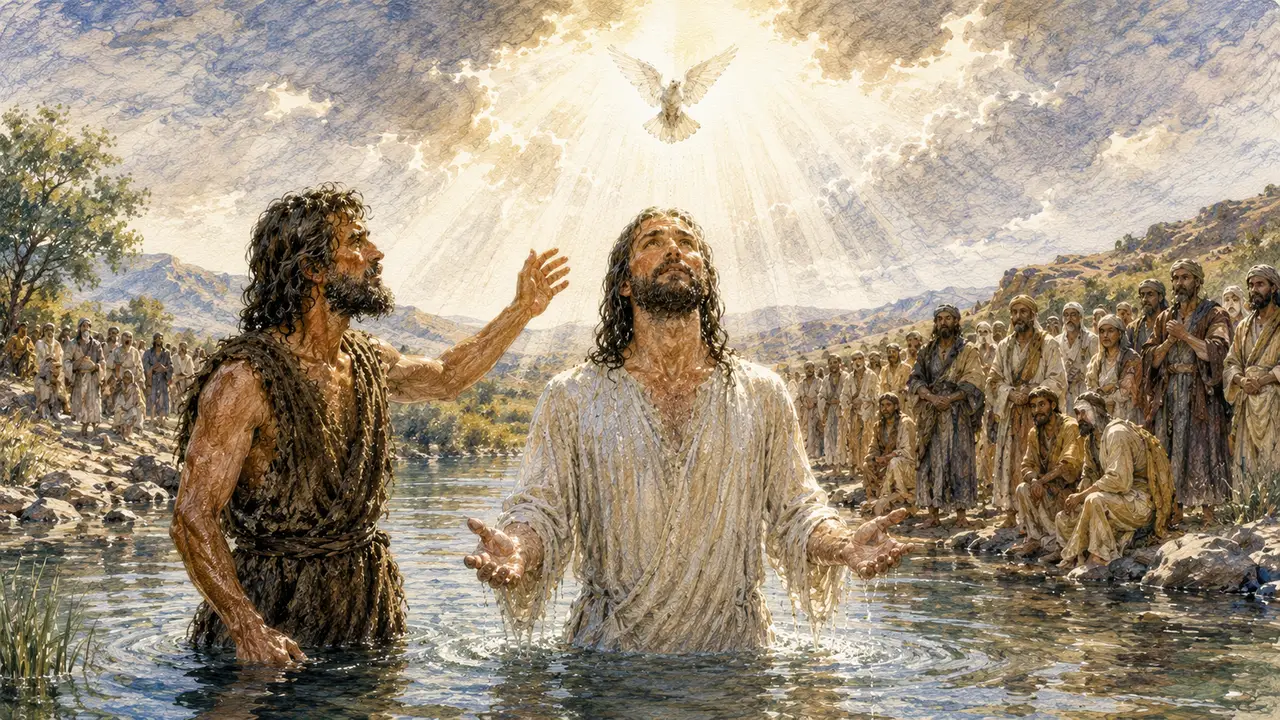
Luke then moves from John’s witness to the baptism of Jesus. Jesus joins the people being baptised, and while He is praying heaven opens. Luke does not suggest that Jesus needs repentance or forgiveness. Rather, His baptism identifies Him with Israel, marks the beginning of His public ministry, and becomes the setting in which God Himself bears witness to who He is.
The Holy Spirit descends upon Jesus “in bodily form like a dove”, and the Father speaks from heaven:
“You are My beloved Son, in You I am well-pleased.”
This is the highest witness in the chapter. John has testified that One greater than himself is coming. Now God Himself identifies Him.
The Father’s words bring together two major Old Testament passages. “You are My… Son” recalls Psalm 2:7:
“You are My Son,
Today I have begotten You.”
Psalm 2 concerns Yahweh’s Anointed King, the Messiah who receives the nations as His inheritance.
“In You I am well-pleased” recalls Isaiah 42:1:
“Behold, My Servant, whom I uphold;
My chosen one in whom My soul is well-pleased.”
Isaiah 42 introduces Yahweh’s Servant, upon whom He puts His Spirit and through whom justice will go out to the nations. Simeon has already drawn on this same passage in Luke 2, naming the infant Jesus a light for the Gentiles’ own revelation. Now the Father joins the royal Son of Psalm 2 with the Servant of Isaiah.
Jesus is therefore identified as the Messiah-King and Yahweh’s Servant. Those two lines shape Luke’s entire Gospel.
The baptism scene also places Father, Son and Holy Spirit together. Jesus the Son stands in the water. The Holy Spirit descends upon Him. The Father speaks from heaven. Luke distinguishes all three while showing them acting together at the beginning of Jesus’ ministry.
The genealogy of Jesus
Luke then turns immediately to the genealogy. Its placement after the baptism gives it theological importance. The Father has just said, “You are My beloved Son”, and Luke traces Jesus’ ancestry backwards until he reaches “the son of Adam, the son of God”.
Luke introduces the genealogy carefully. Jesus was “being, as was supposed, the son of Joseph”. The wording preserves what Luke has already established concerning the virgin conception. People regarded Jesus as Joseph’s son, and Joseph gave Him His legal place within the Davidic line, but Joseph was not His biological father.
The genealogy passes through David, confirming again Jesus’ royal identity. It passes through Abraham, placing Him within the covenant promises made to Abraham and his seed. Then Luke keeps going.
Matthew begins his genealogy with Abraham because he emphasises Jesus as Israel’s Messiah and Son of David. Luke traces the line all the way through Noah, Seth and Adam. Jesus belongs to Israel, but His relation to mankind extends beyond Israel to the father of all mankind.
That fits Luke’s earlier emphasis. Simeon had already declared that Jesus would bring light to the Gentiles as well as glory to Israel, and Isaiah said that all flesh would see the salvation of God. Now the genealogy reaches beyond Abraham to Adam. The Saviour stands within the history of all mankind.
Adam also gives the genealogy a deeper theological significance. Scripture identifies Adam as the man through whom sin entered the world. Romans 5 says that through one man sin entered the world, and death through sin. First Corinthians 15 sets Adam and Christ beside one another: “For as in Adam all die, so also in Christ all will be made alive.”
Adam, the first son of God, failed and brought sin and death into the world. Jesus, the beloved Son of God, now stands at the beginning of His ministry, ready to enter the wilderness and succeed where Adam fell. The salvation that “all flesh” will see has come in the obedient Son.