
Exodus 25
Exodus 25 marks a decisive shift from covenant law to covenant dwelling. Yahweh commands the construction of a sanctuary so that He may dwell among Israel, according to a pattern He reveals. Every detail, from the ark to the lampstand, shows that His presence is holy, ordered, and centred on atonement. The chapter reveals that redemption leads to nearness, but that nearness is defined entirely by Yahweh’s word and maintained through His appointed means.
Exodus 25 Explained: Yahweh Commands the Construction of His Dwelling
Exodus 25 takes place on top of Mount Sinai. At the end of chapter 24 Moses had entered the cloud, and we are told he spent forty days on the mountain. The covenant has been declared and sealed with blood, and Israel has pledged obedience. Now Yahweh commands that a sanctuary be built, because He intends to dwell among His people, just as He promised.
The chapter begins with contributions. Yahweh tells Moses to take a contribution from the sons of Israel, but only from every man whose heart is willing. The contributions are voluntary. Yahweh seeks a people who respond to Him from the heart. Most of the materials listed, gold, silver, bronze, fine yarns, skins, wood, oil, spices, and precious stones, are the very things Israel received from the Egyptians when they left Egypt. Yahweh had given them favour, and Egypt’s wealth left with them. Now He asks for a portion of what He Himself provided to build His sanctuary.
Verse 8 gives the purpose: “Let them make a sanctuary for Me, that I may dwell among them.” This is the goal of redemption. Yahweh did not bring Israel out simply to free them from Pharaoh. He brought them out so that He might draw near to them. However, His dwelling must follow a revealed pattern. Twice He says that everything must be made according to what was shown on the mountain. Yahweh gives strict instructions on how He is to be worshipped, because He determines how He will dwell among His people.
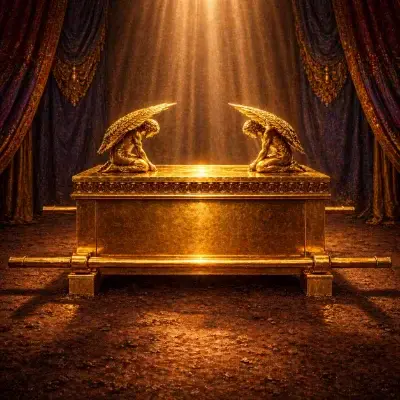
The ark is described first. The tablets of the testimony are placed inside it. The ark is made of acacia wood and overlaid inside and out with pure gold. Gold speaks of glory and kingship. Later Scripture will speak of Yahweh as enthroned between the cherubim. That imagery begins here. The ark functions as God’s throne as well as the chest of the covenant. Rings and poles remain attached so that it may be carried. Yahweh’s throne moves with His people.
Above the ark is the cover, called the mercy seat or atonement cover. It is pure gold and matches the dimensions of the ark. The tablets remain inside, and above them is the cover, with the cherubim standing over it. Yahweh says, “There I will meet with you… from above the mercy seat, from between the two cherubim.” He chooses to speak from that place.
Later, Leviticus 16 shows that blood is sprinkled on this cover on the Day of Atonement, and that the Most Holy Place is entered only with blood. The arrangement teaches that the covenant law remains at the centre, and the place where Yahweh meets His servant is the place where atoning blood is applied.
The cherubim recall Genesis 3. After Adam and Eve were driven from Eden, Yahweh placed cherubim east of the garden to guard the way to the tree of life. Here they stand over the mercy seat where Yahweh promises to speak. The guarded place becomes a meeting place. Access is restored, yet still defined by holiness. The sanctuary forms a holy enclosure in the middle of the camp.
The table comes next. It is made of acacia wood overlaid with gold and fitted with poles for carrying. Upon it is placed the bread of the Presence, set before Yahweh continually. Exodus 25 does not yet state the number of loaves, but Leviticus 24:5–9 makes clear that there are twelve, one for each tribe, arranged in two rows and replaced every Sabbath. The previous week’s bread is eaten by the priests in a holy place. The arrangement is called an everlasting covenant.
The twelve loaves correspond to the twelve tribes and stand continually before Yahweh. This is not food for Him. The text never suggests that He consumes it. Instead, the bread remains before His face and is later eaten by the priests He appoints. The arrangement teaches that the tribes live continually in His presence and that their sustenance comes from Him. The bread is set before Yahweh, yet it is He who provides it for His people.
The lampstand is then described in detail. It is fashioned from one piece of pure gold, hammered into shape. It has a central shaft and six branches, three on each side. Its cups are shaped like almond blossoms, with bulbs and flowers. The design is tree-like. A golden tree stands within the holy place.
Its purpose is to give light. Inside the tabernacle no natural light enters, because the coverings shut out the sun. The only illumination comes from the lamps Yahweh commands to burn. This recalls Genesis 1, where the first word spoken into the darkness was, “Let there be light.” The light in Yahweh’s dwelling exists because He ordains it.
The lampstand has seven lamps. This reflects the seven days of creation, when Yahweh ordered the world over six days and rested on the seventh. The seven lamps reinforce that this dwelling reflects that same ordered pattern.
The tree design recalls the tree of life. In Eden there was a tree at the centre of the garden. Here, in the sanctuary, there is a new tree giving light to the entire room. The elements of Eden reappear in a guarded holy space within the camp. Yahweh teaches Israel that His dwelling among them restores light and ordered life in the darkness. It is not the full return to Eden, but it is a real sign that He is reversing what sin disrupted.
Gold dominates the chapter. The closer one moves to the centre, the more prominent the gold becomes. The mercy seat is pure gold. The lampstand is entirely gold. Even the utensils are gold. Nearness to Yahweh is weighty and glorious. His presence is not casual.
Exodus 25 teaches more than layout and measurement. Yahweh reveals Himself as the holy King enthroned above His covenant word. He provides atonement so that communion can continue. He restores light and ordered life in the midst of darkness. He keeps His people continually before His face. He dwells among them according to His revealed order.
Yahweh, who descended on Sinai in fire, now commands a dwelling place in the midst of the camp. He will live among Israel, but He will do so according to His word, under His law, and at the place of atonement. His presence is real, but it is ordered and defined by His holiness.