
Genesis 12
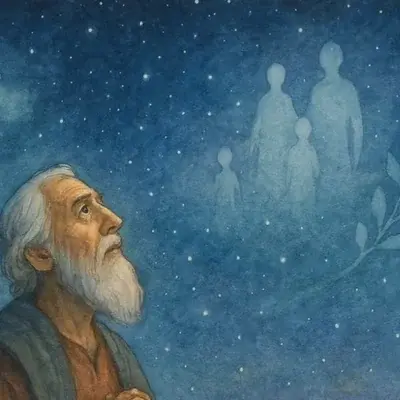
Genesis 12 is the beginning of something new. Yahweh calls Abram out of his land and makes staggering promises: a new homeland, a great nation, and blessing for all the families of the earth. Abram believes and obeys. His faith soon gives way to fear in Egypt. But Yahweh remains faithful.
Abram’s Faith, His Failure, and God’s Promise
Genesis 12 opens with the voice of Yahweh calling Abram. In the previous chapter, the builders of Babel had attempted to make their name great through their own strength. But here, Yahweh speaks. He does not command Abram to build or reach upward, He simply calls him, and promises to make his name great.
With this call, God begins a plan that will stretch across generations and bring blessing to the nations scattered in the previous chapter.
Abram is summoned from the east, from the land of dispersion, and called toward the land Yahweh will show him. It is a quiet reversal, a return from exile.
The command Yahweh gives is costly. “Go forth from your land, and from your kin, and from your father’s house, to the land which I will show you.” These are not easy things to leave behind. Abram is called to leave his homeland, his people, and his family. But what Abram is told to leave, Yahweh promises to provide: a land, a kin, a household, this time not built by human hands, but supplied by God.
Yahweh makes Abram a sevenfold promise. “I will make you a great nation,” this is an amazing promise considering we learned at the end of the previous chapter Sarai is barren. “I will bless you,” a word that answers the repeated curses of earlier chapters.
“I will make your name great.”
Here God freely gives what the people of Babel tried to do for themselves.
Then, “You shall be a blessing.”
Abram is not only to receive blessing, but to become the channel of it. “I will bless those who bless you, and the one who curses you I will curse.” And finally, “In you all the families of the earth will be blessed.”
We can actually tie this promise back to Eden. As we have been tracing the promise made in Genesis 3:15 for the seed of the woman that will crush the serpent’s head, this seed, we now learn, will come through Abram. Through him, all the nations of the earth will be blessed.
Though the promise is given in seven parts, it is often summarised under three headings: land, offspring, and blessing. In verse 1, Abram is called to leave his land and promised another. In verse 2, he is promised descendants, a great nation, despite Sarai’s barrenness. And in verses 2 and 3, he is promised blessing, not just for himself, but for all the families of the earth. These three themes, land, seed, and blessing, will echo through the rest of Genesis, and through the covenant that Yahweh will soon confirm.
The families dispersed by judgment in chapter 11 are the very ones Yahweh now intends to bless through Abram.
“So Abram went forth as Yahweh had spoken to him.”
Abram obeys in faith. Sarai goes with him, and so does Lot, the son of his deceased brother. He takes all his possessions and the people acquired in Haran. Abram has no intention of going back to Haran, so he takes everything with him. He stakes his entire future on Yahweh’s promise.
They enter the land of Canaan. Abram passes through to Shechem, to the oak of Moreh. Then we are told, “Now the Canaanite was then in the land.” The land is not empty. It is occupied. The descendants of Canaan are there, those who stand under the curse declared in Genesis 9.
The promise has brought Abram into a place already filled with others. He arrives, but cannot yet take hold of what has been promised. The tension between promise and reality appears immediately. Yahweh has said, “I will show you the land,” but what He shows is a land inhabited. How will this be resolved? Yahweh has made a promise, but there is now a visible obstacle.
Then Yahweh appears to Abram. This is the first time in the chapter that Yahweh makes a personal, visible appearance. Abram has arrived in the land, and now Yahweh speaks again, building on the promise already given. “To your seed I will give this land.” The blessing is being narrowed and confirmed. The land is not yet his, but it will belong to his offspring. Yahweh’s promise still looks forward. The fulfilment will come, but not yet.
In response, Abram builds an altar and worships Yahweh. Then he moves on to the hill country between Bethel and Ai, builds another altar, and calls on the name of Yahweh.
This phrase, last heard in Genesis 4:26, marks Abram as the type of person found in the righteous line of Seth. In a land filled with pagan idolatry, Abram proclaims the name of the covenant God.
A pattern begins to form: Yahweh speaks, Abram obeys, and worship follows. But as we will see, the road ahead will not remain so steady.
Abram’s arrival in the land is not followed by rest. He dwells in a temporary dwelling, a tent near Bethel. He is still a sojourner in the very land Yahweh has promised him. Then a famine strikes, a severe one. As we read on, Yahweh’s name is conspicuously absent. Abram does not pray for guidance. He simply goes down to Egypt.
The structure of the following section is precise, a tight chiasm centred on Yahweh’s intervention:
A. Abram enters Egypt, fears for his life, and deceives. B. Sarai is taken into Pharaoh’s house. C. Abram receives wealth because of Sarai. D. Yahweh strikes Pharaoh’s house with a plague. C′. Pharaoh rebukes Abram for deception. B′. Sarai is returned. A′. Abram leaves Egypt with all he has.
By highlighting the structure, we see where the weight of the passage truly falls. Yahweh is not mentioned elsewhere in this section, but His hand is unmistakably present. At the very centre, He acts decisively and alone to ensure His promises stand.
This section begins with fear. As they approach Egypt, Abram is afraid for his life. He believes the Egyptians will kill him in order to take Sarai, so he asks her to lie. His concern is not unfounded, but his response is not faith. It is self-preservation. Rather than praying and trusting in the God who promised to bless and protect him, Abram chooses a scheme of his own making.
Following Abram’s deception, Sarai is taken. Pharaoh’s officials see her and report her beauty. She is brought into Pharaoh’s house, and Abram benefits. He receives wealth, livestock, servants, camels, all because Abram places his wife, the woman through whom the promise must continue, in jeopardy.
At the centre of the structure, Yahweh acts. He strikes Pharaoh’s house with great plagues because of Sarai. This is the only time Yahweh’s name appears in this section. He does not speak to Abram. He speaks through judgment. The crisis turns not because Abram repents, but because Yahweh intervenes. The promise is not upheld by human strength.
And it is not held up because of Abram’s righteous actions.
It is upheld by divine faithfulness.
There is a tragic irony in these verses. Abram was supposed to be a blessing to the nations. So far, all he has done is lie to Pharaoh, put his wife in danger, and bring a plague on the Egyptians.
Because of the plague Yahweh sends, Sarai is returned to Abram. Pharaoh summons Abram and demands an explanation: “What is this you have done to me?” The pagan king shows more moral clarity than the man of promise. The one who should have protected Sarai has put her at risk. The outsider sees the truth more clearly than the one who carries the promise.
It is worth noting that Pharaoh’s words, “What is this you have done?” are the same words Yahweh spoke to Eve after she took the fruit. In both cases, sin has been committed, and the question exposes the weight of what has happened. But here, it is not Yahweh who speaks, His words come from the mouth of a pagan king.
But even here, Yahweh’s mercy is evident. Pharaoh returns Sarai and sends Abram away with everything he gained. There is no retaliation. The man who endangered the promise leaves with it preserved. He departs Egypt with his wife, with his possessions, and with nothing lost that Yahweh had given.
This episode lays bare the tension in Abram’s character. He answers Yahweh’s call with remarkable trust, but when danger arises, he moves ahead without seeking the One who called him.
Abram leaves the land Yahweh had shown him. In Egypt, he builds no altar. He does not call on the name of Yahweh. The man who had walked by faith now acts in fear, and in doing so, he appears to put the promise at risk.
But even here, Yahweh is not hindered. Abram’s failure does not unravel Yahweh’s plan.
Genesis 12 ends with failure and grace held side by side. Abram started out in faith. He received a great promise, and he responded in obedience. But when testing came, he did not rely on Yahweh. His fear placed the promise at risk. Yet despite Abram’s failure, Yahweh remained faithful.
He preserved Sarai, protected the seed, and brought Abram safely out of Egypt. The promise does not depend on Abram’s obedience, but on Yahweh’s faithfulness.
And that will be the pattern running through the entire Bible.