
Exodus 40
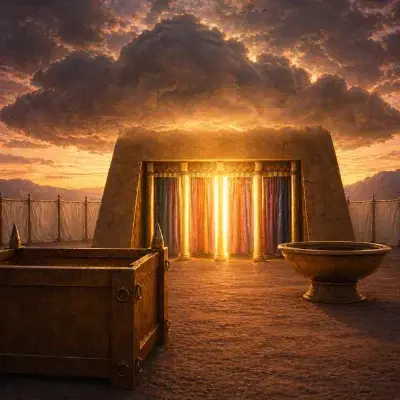
Exodus 40 concludes the book with the tabernacle set up according to Yahweh’s command and His glory filling it. Everything is arranged exactly as He instructed, and His presence comes to dwell in the midst of Israel, leading them by the cloud and the fire. Yet even as Yahweh draws near, the veil remains and access is restricted, showing that while He now dwells among His people, the full way into His presence is not yet open.
Exodus 40 Explained: The Tabernacle is Erected and Yahweh Dwells Among His People
Exodus 40 brings the book to its conclusion with the setting up of the tabernacle and Yahweh coming to dwell among His people. The chapter begins with Yahweh speaking to Moses and commanding him to set up the tabernacle on the first day of the first month. The tabernacle has been built, but it is not erected until Yahweh commands it. The dwelling place of God is established by the word of God.
Yahweh commands Moses to place the ark inside the tabernacle and to hang the veil to separate the holy place from the most holy place. He is told to arrange the table, set up the lampstand and light its lamps, place the altar of incense before the veil, and set the screen at the entrance of the tabernacle. The altar of burnt offering is placed at the entrance to the tent of meeting, and the basin is set between the tent and the altar with water in it. Yahweh commands Moses to anoint the tabernacle and everything in it so that it will be holy. Aaron and his sons are to be brought near, washed, and clothed in the priestly garments so that they may serve as priests. They are to be anointed as Yahweh commanded for their perpetual priesthood. The tabernacle, its furnishings, and the priesthood all belong to Yahweh. They are established by His command.
Moses then does everything exactly as Yahweh commanded him. He sets up the tabernacle, lays its sockets, erects its frames, places the crossbars, and raises up the pillars. He spreads the tent over the tabernacle and puts the covering on it, just as Yahweh commanded him. He places the ark inside and hangs the veil. He arranges the table and sets the bread in order. He places the lampstand and lights the lamps before Yahweh. He sets the golden altar in the tent and burns fragrant incense on it. He sets up the screen for the doorway. He places the altar of burnt offering at the entrance and offers the burnt offering and the grain offering, just as Yahweh commanded him. He sets the basin between the tent of meeting and the altar and puts water in it for washing. Moses, Aaron, and his sons must wash their hands and their feet when they enter the tent of meeting or approach the altar, just as Yahweh commanded Moses. Finally, Moses erects the courtyard around the tabernacle and the altar and sets up the screen of the court gate. So Moses finishes the work.
Then one of the great climactic moments of the book takes place. The cloud covers the tent of meeting, and the glory of Yahweh fills the tabernacle. From Exodus 25 onward, Yahweh had commanded Israel to build a sanctuary so that He might dwell among them. Now the tabernacle is erected according to His word, and Yahweh comes and fills it with His glory. The instructions were not empty ritual. The design was not merely symbolic. The tabernacle truly becomes the dwelling place of Yahweh in the midst of His people. Everything was done as Yahweh commanded, and Yahweh comes to dwell among them.
This answers what Yahweh said after the golden calf. Yahweh had said, “I will not go up in your midst, because you are a stiff-necked people.” But Moses interceded, and Yahweh said, “My presence shall go with you.” Now, at the end of the book, Yahweh’s presence does go with them. The glory of Yahweh fills the tabernacle, and the cloud rests upon it. Yahweh is now dwelling among His people.
Yet the chapter also makes something else clear. When the glory of Yahweh fills the tabernacle, Moses is not able to enter the tent of meeting. Even Moses cannot enter. Yahweh dwells among His people, but He is still behind the veil. He is near, but He is still holy. Access to Him is still restricted. The priesthood, the sacrifices, and the system of mediation are still necessary.
The final verses describe the cloud of Yahweh resting on the tabernacle by day and the fire in it by night, in the sight of all Israel. Whenever the cloud was taken up from over the tabernacle, the sons of Israel set out on their journeys. But if the cloud was not taken up, they did not set out. Yahweh not only dwells among them. He leads them. The God who brought them out of Egypt is now in the midst of their camp, guiding their journey.
At the beginning of the book, Israel was in slavery in Egypt under Pharaoh. Now Yahweh dwells in the centre of their camp. They have gone from slavery under Pharaoh to living as a people among whom Yahweh dwells.
However, despite the glory of Yahweh entering the tabernacle, this is not the final solution. Israel is still a stiff-necked people, and Yahweh is still behind the veil. The tabernacle shows that Yahweh dwells among His people, but it also shows that there is still a barrier between a holy God and a sinful people. The tabernacle has worked. Yahweh now dwells in Israel’s camp. But the barrier remains. And the way into His full presence is not yet open.