
Exodus 26
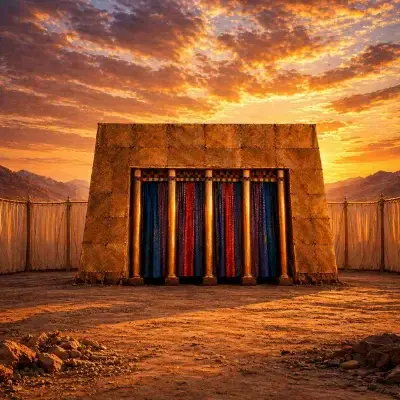
Exodus 26 sets out the structure of the tabernacle, defining how Yahweh’s dwelling is formed, layered, and guarded. Every curtain, covering, and board follows a pattern revealed by Yahweh, showing that His presence is not approached casually. The outer simplicity hides inner glory, while the veil establishes a clear separation between the holy place and the Most Holy Place. The chapter teaches that Yahweh dwells among His people, yet remains set apart, with access carefully defined by His holiness.
Exodus 26 Explained: The Structure and Veiling of Yahweh’s Dwelling
Exodus 26 continues from chapter 25, with the focus moving from the furniture inside the sanctuary to the structure that surrounds it. The word “tabernacle” means a dwelling place. Yahweh is building His own tent in the midst of the camp of Israel. He supplies the design, and the dwelling must match the pattern shown on the mountain.
The inner layer of the tabernacle consists of ten curtains of fine twisted linen, woven with blue and purple and scarlet material, with cherubim worked into them by a skilled designer. These curtains form the inside ceiling and walls of the sanctuary space. The colours are costly, and the cherubim mark the space as guarded and holy, recalling Genesis 3 where cherubim guarded the way to the tree of life.
Each inner curtain measures twenty-eight cubits long and four cubits wide. A cubit is roughly forty-five centimetres, so each curtain is about twelve and a half metres long and just under two metres wide. Five curtains are joined together, and another five are joined together. Fifty gold clasps fasten the two sets into one unit, so that the tabernacle is unified. The dwelling is ordered, not loosely assembled.
Very few Israelites would ever see this beauty. These linen curtains with woven cherubim are hidden inside the structure. The priests would see the Holy Place regularly, but only the high priest would pass beyond the inner veil into the Most Holy Place.
Over this inner layer comes a second covering: eleven curtains of goats’ hair forming a tent over the tabernacle. These are slightly larger, each thirty cubits long and four cubits wide. The extra length allows them to overhang, protect, and completely conceal what lies underneath. The design is practical and deliberate. The clasps here are bronze rather than gold. As one moves outward from the centre, the materials change. Gold belongs nearer the innermost space. Bronze appears further away. The closer one comes to the centre, the more costly the materials become.
Above the goats’ hair come rams’ skins dyed red, and above that a final covering translated here as porpoise skins. The exact animal the Hebrew word refers to is uncertain, but it points to a tough, durable leather suitable for weatherproofing in a desert environment. The outermost layer provides protection from sun, wind, and rain.
From the outside, the tabernacle would not appear impressive. It would look like a sturdy, well-constructed tent. Beneath those skins, however, lay gold, fine linen, and intricate craftsmanship. The ark overlaid with gold, the mercy seat of pure gold, and the golden lampstand all stood within layers of ordinary coverings. The glory of the tabernacle was veiled behind plain materials.
The frame of the structure reinforces stability. The boards are made of acacia wood overlaid with gold. Each board is ten cubits high, about four and a half metres, and one and a half cubits wide. Each has two tenons at the base that fit into silver bases.
There are twenty boards on the south side, twenty on the north, and six at the west, with two additional corner boards. In total there are forty-eight boards and ninety-six silver bases. Bars of acacia wood run horizontally along the sides, including a central bar that passes from end to end. Like the boards, the bars are overlaid with gold.
This is not a fragile shelter. It is structured and strong. It can be dismantled and carried, yet when assembled it stands firm on a foundation of silver, with wooden panels covered in gold. Yahweh dwells in a movable house that is designed to endure.
Verse 30 summarises the chapter: “Then you shall erect the tabernacle according to its plan which you have been shown in the mountain.” The design comes from Yahweh Himself.
The next part described is the veil. It is made of fine linen and coloured threads, again with cherubim. It hangs on four pillars overlaid with gold and set in silver bases. Its purpose is explicit: it separates the holy place from the Most Holy Place.
The ark and the mercy seat belong within the Most Holy Place. The table and lampstand stand outside the veil in the Holy Place. The closer one moves toward the centre, the more restricted the access. Yahweh dwells in the midst of Israel, yet He remains holy and set apart. Israel’s redemption brings nearness, but that nearness is defined by holiness.
The orientation of the structure is also significant. The rear of the tabernacle is to the west, which means the entrance faces east. After Adam and Eve were driven from Eden, cherubim were placed east of the garden to guard the way to the tree of life. To enter Yahweh’s dwelling, the priest moves from east toward the west, toward the place where Yahweh’s throne stands above the ark. The layout echoes exile and symbolises guarded return.
The chapter devotes careful detail to the tabernacle because every element teaches that Yahweh is holy and His dwelling place is holy. He chooses to live among His people, and He defines the terms of that nearness.
Exodus 26 shows that Yahweh does not simply place a throne in the camp. He establishes a layered, guarded dwelling at its centre. Its outward appearance is practical, but inwardly it is filled with gold and woven glory. His presence is truly near, yet veiled. He dwells among Israel according to His word, and His dwelling reflects His holiness.