
Genesis 49
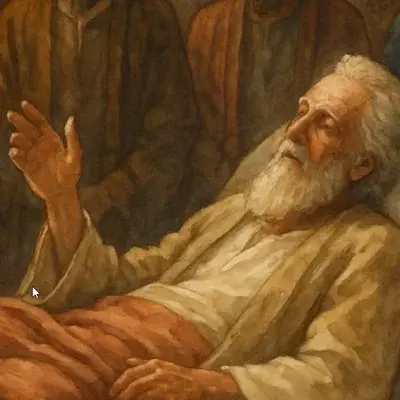
Genesis 49 records Jacob’s final words to his sons, a prophetic poem that reveals the future of Israel’s tribes.
Jacob’s Prophetic Blessing of the Twelve Tribes
Genesis 49 opens with Jacob summoning his sons to gather before him so that he may declare what will befall them in the last days. What follows is a prophetic word from God declaring the future of Israel’s tribes and revealing His purposes in history. The language is poetry, interpreting both past actions and future outcomes, binding the character of each son to the history of his tribe.
Reuben, the firstborn, is recalled as Jacob’s might and the beginning of his strength, but also as uncontrolled as water. His preeminence is lost, for he defiled his father’s bed in taking Bilhah, as recorded earlier in Genesis 35. This means he forfeits the privileges of the firstborn. He remains among the tribes of Israel, but stripped of his inheritance.
Simeon and Levi are paired together, their violence at Shechem still defining them. As the two next oldest, each might have wondered whether the blessing and inheritance of the firstborn would pass to them, since Reuben was disqualified. But Jacob’s words make clear that they too are set aside. Their anger was cruel and their swords instruments of violence, and Jacob refuses to be joined with their council. Their inheritance will not be united, but scattered in Israel.
This is fulfilled when Simeon’s territory is swallowed up by Judah and Levi receives no land of his own, but only cities throughout Israel. Yet, in God’s providence, Levi’s scattering is redeemed into priestly service, showing that even judgment can become a channel of blessing when God appoints it.
The next in line, Judah, now receives the first of the long and climactic blessings, inheriting the blessing of the firstborn. His brothers will praise him. His hand will be on the neck of his enemies, and his father’s sons will bow down before him. Judah is a lion’s whelp, rising in strength, resting in majesty, untouchable in power. The imagery builds toward verse 10, the centrepiece of his blessing.
“The scepter shall not depart from Judah, nor the ruler’s staff from between his feet, until Shiloh comes, and to him shall be the obedience of the peoples.”
The word Shiloh functions here as a noun, most likely a messianic title, not unlike “Prince of Peace” in Isaiah 9:6. Some take it as “the one to whom it belongs,” as echoed in Ezekiel 21:27: “Until he comes whose right it is, and I will give it to him.” Another, far less common view, takes the word as “tribute,” meaning “until tribute comes to him,” but this seems unlikely in context, since the blessing speaks of kingship and messianic rule, not taxation.
The most fitting sense is that Shiloh is tied to the same root as shalom, pointing forward to the one who brings peace. Judah’s line will continue until the rightful ruler comes, the king who both brings peace and claims the sceptre by divine right, and to him shall be the obedience of the peoples.
Here the promise of Genesis 3:15 is narrowed again, from the seed of the woman to the seed of Abraham, then to the line of Jacob, and now to the tribe of Judah. The serpent crusher will come from Judah’s line.
The imagery of verses 11 and 12 is one of superabundance. Vines so plentiful that they may be used as tethering posts, garments so soaked in wine that it runs like water, eyes dark from wine, and teeth white from milk. This is a poetic picture of abundance and shalom under Judah’s king and foreshadows the messianic banquet that later prophets will describe.
Later Scripture will take up these images, where wine, blood, and red-stained robes converge, and in the Messiah they find paradoxical depth. Abundance comes through suffering, and blessing is poured out through blood.
From Judah, the poem moves quickly through the other sons. Zebulun is oriented to the sea, his territory later giving access to trade routes toward Sidon, as seen in Joshua 19:10–16. Issachar is likened to a strong donkey, content with a good land, but submitting to forced labour, a portrait of compromise for comfort, later seen in their vulnerability to Canaanite oppression, as seen in Judges 5:15.
Dan is said to judge his people, but also to be serpent-like, cunning and dangerous, a prophecy borne out in the tribe’s idolatry and violent migration north, as seen in Judges 18. Here, at the very centre of the poem, Jacob breaks into prayer: “For Your salvation I hope, O Yahweh.”
His hope rises beyond every blessing and curse, fixed on God alone as the source of salvation.
From this centre, the blessings move outward again. Gad will be raided, but he will press back, a pattern fulfilled in the frequent conflicts east of the Jordan, where Gad’s warriors became renowned for their valour, as seen in 1 Chronicles 12:8.
Asher will enjoy fertile land and rich food, delicacies fit for kings, reflected in the tribe’s later inheritance along the fertile northern coast, as seen in Deuteronomy 33:24–25. Naphtali is a doe let loose, graceful and free, associated with beautiful words, which may foreshadow the song of Deborah and Barak’s victory in Naphtali’s region, in Judges 5.
Joseph receives the second of the great blessings, balancing the blessing given to Judah at the other side of the chiasm. He is a fruitful bough by a spring, his branches running over the wall. Though attacked, he was upheld by the Mighty One of Jacob, strengthened by the Shepherd, the Stone of Israel, helped by the God of his father, and blessed by the Almighty.
The language piles blessing upon blessing, from above, from below, from the womb, surpassing the blessings of Jacob’s ancestors, reaching to the everlasting hills. Joseph is distinguished among his brothers, a man of suffering and exaltation, abundantly blessed and a source of blessing. Judah holds the sceptre, but Joseph overflows with fruitfulness. Kingship and abundance together define the covenant future.
Benjamin closes the sequence, described as a ravenous wolf, fierce in battle and dividing the spoil, a picture fitting the tribe’s later history of warlike ferocity, as seen in Judges 19–21 and 1 Samuel 9.
The narrative pauses to summarise: “All these are the twelve tribes of Israel, and this is what their father spoke to them, so he blessed them, everyone with the blessing appropriate to him.” This confirms the tribal scope of the prophecy. The sons before Jacob are now the twelve tribes, named and addressed in their fullness. The covenant family has become the covenant nation.
Jacob then commands his burial, anchoring his prophetic words in covenant faith. He insists on being gathered to his people in the cave of Machpelah, the tomb of Abraham and Sarah, Isaac and Rebekah, and Leah.
His eyes remain fixed on the land of promise even as he dies in Egypt. By commanding his sons to bury him in Canaan, Jacob testifies that Egypt is not their home and that God will restore them to the land He swore to their fathers. His last act is an act of faith, trusting God to bring about restoration to the promised land.
Jacob draws his feet into the bed, breathes his last, and is gathered to his people, dying in faith that God would fulfil His covenant promises.
Genesis 49 is not simply a farewell, but the prophetic centre of Israel’s story. Its poetry is carefully structured, with the blessings of Judah and Joseph balancing one another, and Jacob’s cry in verse 18 standing at the very centre.
All the tribes’ futures, whether fruitfulness or fading, greatness or scattering, are held within that cry of hope. Jacob dies in faith, but his words live on, pointing forward to the king from Judah who will reign, the fruitful one who will bless, and the God who alone saves His people.