
1 Corinthians 15
1 Corinthians 15 returns the church to the gospel Paul preached, where Christ died for sins, was buried, was raised, and will raise those who belong to Him.
Paul opens 1 Corinthians 15 by returning the Corinthians to the gospel he had already proclaimed to them. He is not introducing something new in the second-to-last chapter of his letter, as though the gospel had somehow been absent from everything that came before. He reminds his readers of the message they had already received, the message in which they now stand, and the message by which they are saved.
The reason for returning to it here becomes clear in verse 12. Some among them were saying that there is no resurrection of the dead, and Paul intends to show that this teaching strikes at the heart of the gospel itself. The resurrection of the dead cannot be separated from the good news they first believed.
That is why Paul begins by reminding them where they stand. He says: “the gospel which I proclaimed as good news to you, which also you received, in which also you stand, by which also you are saved, if you hold fast the word which I proclaimed to you as good news, unless you believed for nothing.” The gospel is something proclaimed, received, believed, and held fast.
Paul is warning that abandoning the gospel exposes the emptiness of a profession of faith that does not endure. He is not saying that salvation rests upon human effort or the Corinthians’ own determination to preserve themselves. If they finally reject the resurrection that belongs to the gospel they received, then their earlier profession has proved to be for nothing.
That word “nothing”, or “vain”, is an important theme in the chapter. The Corinthians must not believe for nothing. God’s grace toward Paul did not prove vain. If Christ has not been raised, apostolic preaching is vain and Christian faith is vain. And at the very end of the chapter Paul assures believers that their labour in the Lord is “not in vain”. The resurrection is what separates empty faith, empty preaching, and empty labour from faith, preaching, and labour that have eternal substance.
Paul summarises the gospel he had delivered to them “as of first importance”: “that Christ died for our sins according to the Scriptures, and that He was buried, and that He was raised on the third day according to the Scriptures.” Each of these is essential to the gospel Paul preaches. Christ died, and He died “for our sins”. His death was substitutionary. He died because of sins that were not His own, bearing what sinners deserved.
Paul says this happened “according to the Scriptures”, because the death of Christ was never an unexpected failure in God’s plan. The Old Testament had already prepared the way for it. Isaiah 53 speaks of Yahweh’s Servant being pierced for our transgressions, crushed for our iniquities, and bearing the sin of many. Christ’s death fulfils what God had spoken beforehand.
Paul also says Christ “was buried”. That brief statement confirms the reality of His death. His body was laid in the grave. Then Paul says He “was raised on the third day according to the Scriptures”. The precise Old Testament passage Paul has in mind is difficult to identify with certainty. Hosea chapter 6 may form part of the background when it speaks of being raised up on the third day.
Moreover, the Old Testament contains a broader pattern in which the third day becomes a day of decisive divine action and deliverance. For example, we see this with Jonah in the belly of the great fish, and also Abraham lifting his eyes on the third day, when he received Isaac back from the dead. So while we might not know Paul’s allusion with certainty, what matters for Paul’s argument is that Christ’s resurrection, including its appointed timing, belongs within the Scriptural purposes of God. The same Scriptures that anticipated His death also anticipated His victory over death.
Paul grounds the resurrection in eyewitness testimony. Christ appeared to Cephas, then to the twelve, then to more than five hundred brothers at one time, then to James, then to all the apostles, and finally to Paul. The resurrection belongs to recent history for Paul’s readers. Many of those who had seen the risen Christ were still alive. Some had “fallen asleep”. This is Paul’s resurrection-shaped way of speaking about believers who had died. But most were still alive. He is writing while eyewitnesses of the risen Christ are still living, not appealing to a story that developed generations after the fact.
Jesus’ appearance to Paul came in a different manner from those earlier appearances. He says Christ appeared to him “as to one untimely born”. The Greek word is unusually strong and can describe an untimely or abnormal birth. Some translations render it in ways that sound extremely graphic in English, but Paul’s point is best understood from his own circumstances. His entrance into the company of the apostles came at an untimely moment, in an extraordinary manner. He had not followed Jesus through His earthly ministry and then seen Him after the resurrection alongside the others. He encountered the risen Christ later, while actively persecuting the church.
That explains Paul’s immediate humility: “For I am the least of the apostles, and not worthy to be called an apostle, because I persecuted the church of God.” Paul never forgets what he had been doing when Christ appeared to him. He had tried to destroy the very church he was later commissioned to serve. His apostleship is therefore a display of God’s grace: “But by the grace of God I am what I am.”
That grace did not make Paul passive. God’s grace toward him did not prove vain, because he laboured even more than the other apostles. Paul can acknowledge the reality of his labour without treating it as independent of God’s work. Grace produced the labour. The persecutor became an apostle because of grace, and the apostle then laboured because that same grace was active in him.
Paul, Cephas, James, and the other apostles all proclaimed the same risen Christ the Corinthians believed. That common apostolic proclamation creates the problem Paul now addresses: “Now if Christ is preached, that He has been raised from the dead, how do some among you say that there is no resurrection of the dead?”
This is the central issue of the chapter. Some Corinthians apparently wanted to affirm that Christ had been raised while denying the future bodily resurrection of the dead. Paul will not allow those two claims to be separated. If resurrection is impossible, then Christ has not been raised. If Christ has not been raised, apostolic preaching is empty and Christian faith is empty.
He drives the consequences further. The apostles would be false witnesses about God because they testified that God raised Christ when He did not. The Corinthians would still be in their sins because the resurrection confirms the victory accomplished through Christ’s death. Those who had died trusting in Christ would have perished. Christian hope would extend no further than this present life.
Then Paul delivers one of the strongest statements in the chapter: “If we have hoped in Christ in this life only, we are of all men most to be pitied.” Christianity does not survive if it is only good moral teaching, community, personal improvement, or spiritual comfort. If Christ is dead, the gospel is false. Paul has risked everything for a lie. The martyrs died for nothing. Those who trusted Christ and then died have simply perished. Without the resurrection, Christianity collapses.
Paul answers all of this in verse 20. “But now Christ has been raised from the dead, the first fruits of those who have fallen asleep.” Christ is genuinely resurrected, and that overturns everything Paul has just described as the consequence of a dead Christ. He is the “first fruits”, the beginning of a harvest that must follow. The resurrection of Christ guarantees the resurrection of those who belong to Him.
Paul traces death and resurrection through two men: “For since by a man came death, by a man also came the resurrection of the dead. For as in Adam all die, so also in Christ all will be made alive.” Adam stands at the head of fallen mankind. Through his sin came death. Christ stands at the head of a redeemed people, and through Him comes resurrection. All who are in Adam die; all who are in Christ will be made alive. The contrast concerns two representative heads and those who belong to them.
Paul moves from physical resurrection to kingdom and dominion: “Then comes the end, when He hands over the kingdom to the God and Father, when He has abolished all rule and all authority and power. For He must reign until He has put all His enemies under His feet.”
Here, Paul is drawing on Psalm 110: “Yahweh says to my Lord: ‘Sit at My right hand until I put Your enemies as a footstool for Your feet.’” The risen Christ reigns while His enemies still exist. His reign does not begin after they are defeated. He reigns until they are defeated. Psalm 110 presents the Messiah enthroned at Yahweh’s right hand, ruling in the midst of His enemies while Yahweh brings them beneath His feet.
When Paul says, “For He has put all things in subjection under His feet,” he turns to Psalm 8, where Yahweh says of man, “You make him to rule over the works of Your hands; You have put all things under his feet.” Paul brings Psalm 110 and Psalm 8 together in Christ. Psalm 110 speaks of the Messiah’s victorious reign, and Psalm 8 speaks of the dominion Yahweh gave to mankind at creation. Jesus is both the promised King and the true Man in whom mankind’s original calling is fulfilled.
Psalm 8 had looked back to Genesis 1, where God made mankind in His image and gave him dominion over the created order. That mandate was never revoked, even though sin corrupted mankind’s exercise of it. Hebrews 2 takes Psalm 8 and acknowledges the tension created by the fall: we presently see disorder under fallen mankind, while Jesus stands as the true Man crowned with glory. Paul now takes that same line of thought to its ultimate conclusion. The true Man is risen and reigning, and every enemy will be placed beneath His feet.
Paul identifies the last enemy: death. This is where Paul’s teaching reaches back to Adam. Death entered through man, and now the Man Christ Jesus reigns until death itself is abolished. The first Adam received dominion and brought death through sin. The last Adam rises from death and exercises a dominion that ends with death’s destruction. The creation mandate, the kingdom of Psalm 110, and the resurrection all converge in Christ.
When Paul says that all things are subjected to Christ, he clarifies that God the Father, the One who subjected all things to Him, is not included among the things subjected. Then, when all things have been brought beneath Christ’s rule, “the Son Himself also will be subjected to the One who subjected all things to Him, so that God may be all in all.”
Paul is speaking about the completion of Christ’s kingdom, His reign as the Messiah who has accomplished redemption and defeated every enemy. Throughout Scripture the Son shares the divine identity and glory with the Father, while also willingly carrying out the work given to Him by the Father; this is not a statement that the Son is inferior in divine nature to the Father. Here Paul looks to the final completion of that mission, when every enemy has been abolished and the purpose of the kingdom has reached its goal.
In verse 29 Paul introduces one of the strangest statements in the chapter: “Otherwise, what will those do who are baptized for the dead? If the dead are not raised at all, why then are they baptized for them?”
We cannot know with certainty what this practice involved. One plausible possibility is that some of the Corinthians were baptised on behalf of believers who had died before they had the opportunity to be baptised themselves. Paul does not explain the practice, probably because the Corinthians already knew exactly what he was referring to.
More importantly, Paul does not endorse it. His wording creates some distance: “what will those do who are baptized for the dead?” He does not say that this is something he himself practises or commands. He simply uses the Corinthians’ own behaviour to expose a contradiction. Whatever they thought baptism for the dead accomplished, the practice assumed that the dead still had a future. If the dead are never raised, why perform any act on their behalf at all?
Paul moves from what “they” do to what “we” do: “Why are we also in danger every hour?” His own life becomes another argument for resurrection. Why would Paul repeatedly risk death for the gospel if death ends everything? He says, “I die daily,” describing the constant danger and self-denial that marked his ministry.
He asks, “If from human motives I fought with wild beasts at Ephesus, what does it profit me?” Whether Paul is describing literal beasts or using the expression for savage human opposition is difficult to determine. His point is unchanged either way. He has endured danger severe enough to threaten his life. If the dead do not rise, what has any of that gained him?
Paul quotes the attitude of Isaiah 22: “Let us eat and drink, for tomorrow we die.” In Isaiah, people facing judgment refuse the response God requires and instead turn to feasting and drinking. Paul takes that statement and applies its logic to resurrection denial. If death is final, then why endure suffering for Christ? Why sacrifice? Why refuse sinful pleasure? Why order your present life around a future kingdom that will never come?
The denial of resurrection therefore inevitably affects the way people live. That explains Paul’s next warning: “Do not be deceived: ‘Bad company corrupts good morals.’ Become righteously sober-minded, and stop sinning; for some have no knowledge of God. I speak this to your shame.”
False teaching about resurrection produces moral consequences. If tomorrow we simply die, then to live for today is all that matters. Paul therefore tells the Corinthians to wake up, think rightly, and stop sinning. Their theology and their conduct cannot be separated. A church that loses the reality of resurrection will eventually lose the reason for obedience altogether.
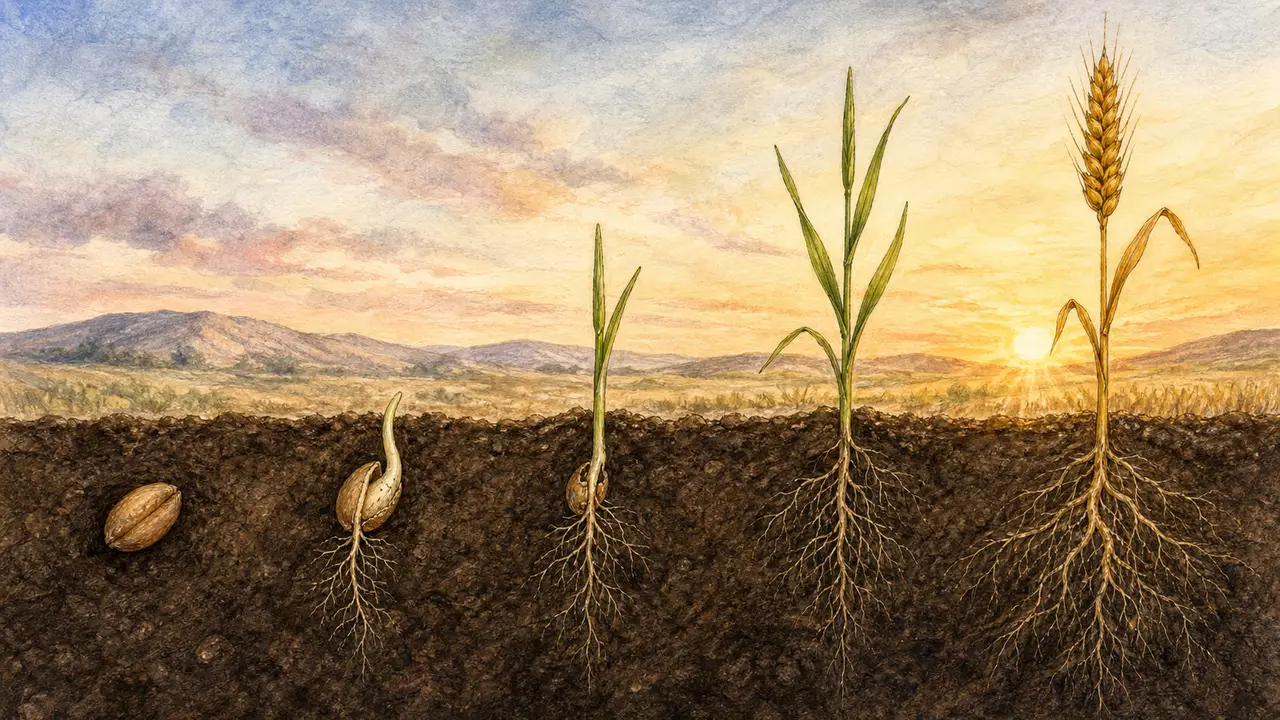
Paul turns to the question of the resurrection body: “How are the dead raised? And with what kind of body do they come?” His answer begins with something ordinary: a seed. What is sown does not come to life unless it dies. The seed placed in the ground is not the final form of what will emerge, though there is continuity between what is sown and what grows.
Paul’s point is that resurrection involves both continuity and transformation. God raises the body that dies, but He raises it in a form suited to resurrection life. God transforms what is corruptible into something incorruptible.
Paul points again to creation. God gives different bodies to different creatures: men, beasts, birds, and fish. There are heavenly bodies and earthly bodies. The sun has one glory, the moon another, and the stars another. Paul is drawing attention to the immense variety already present in what God has made. The Creator who gives each creature a body suited to its place in creation is fully able to give His people bodies suited to resurrection life.
This section of Paul’s letter again carries strong echoes of Genesis 1. Men, animals, birds, fish, sun, moon, and stars all appear in Paul’s argument. He is reasoning from creation to resurrection. The God who created bodies of many kinds is the God who raises the dead.
“So also is the resurrection of the dead.” The body is sown corruptible and raised incorruptible. It is sown in dishonour and raised in glory. It is sown in weakness and raised in power. It is sown a natural body and raised a spiritual body.
Paul is arguing for bodily resurrection throughout the chapter, and “spiritual body” does not mean a body that has ceased to be physical. The contrast is between the body as we presently experience it under mortality and corruption, and the body as it will be transformed for resurrection life. The resurrection body is fully bodily, but no longer governed by the weakness and decay that mark our present condition. It is fitted for life in the age to come.
Paul returns directly to Adam: “The first man, Adam, became a living soul.” He quotes Genesis chapter 2, where God forms man from the dust of the ground and breathes into him the breath of life. Then Paul says, “The last Adam became a life-giving spirit.”
Adam received life. Christ gives life. The first man is “from the earth, earthy”; the second man is “from heaven”. Those who belong to Adam bear the condition of the earthy man, subject to corruption and death. Those who belong to Christ will bear the image of the heavenly Man.
Paul says, “Just as we have borne the image of the earthy, we will also bear the image of the heavenly.” The language of image takes us back once again to creation. Mankind was made in the image of God, but through Adam we now bear the marks of fallen, mortal existence. In resurrection, those who belong to Christ will be conformed to Him. The creation purpose for mankind reaches its perfected expression in the risen Christ and in those united to Him.
Paul explains why transformation is necessary: “flesh and blood cannot inherit the kingdom of God, nor does the corruptible inherit the incorruptible.” His point is that our present mortal and corruptible condition cannot inherit an incorruptible kingdom unchanged, not that physical bodies have no place in God’s kingdom; that would contradict everything he has just said about bodily resurrection.
Therefore, some believers will still be alive when Christ comes, and all believers must be changed. At the last trumpet, the dead will be raised incorruptible and the living will be changed “in a moment, in the twinkling of an eye”. The corruptible must put on incorruption. The mortal must put on immortality. God brings His people into a state beyond the condition we know now, one where corruption and death no longer have any claim upon them.
Paul reaches the climax of the chapter by returning to the enemy he identified earlier: death. “When this corruptible puts on the incorruptible, and this mortal puts on immortality, then will come about the word that is written, ‘Death is swallowed up in victory. O death, where is your victory? O death, where is your sting?’”
Paul draws together Isaiah and Hosea and turns their words into a taunt against death. Death has ruled over mankind since Adam, but it does not have the final word. The enemy that entered through sin will itself be defeated.
Paul explains, “The sting of death is sin, and the power of sin is the law.” Death wounds because mankind is sinful. Sin brings guilt and condemnation, and the Law exposes sin and pronounces God’s righteous judgment upon it. The problem therefore runs deeper than physical mortality. Death reigns in a world of sinners who stand guilty before a holy God.
Paul’s final word is thanksgiving: “Thanks be to God, who gives us the victory through our Lord Jesus Christ!” We have the victory, but we did not win it. It is our victory because Christ won it for us.
Paul ends with one word that draws everything into one final command: “Therefore.” “Therefore, my beloved brothers, be steadfast, immovable, always abounding in the work of the Lord, knowing that your labor is not in vain in the Lord.”
The resurrection gives present obedience eternal significance. Paul has already shown what follows if the dead are not raised: preaching is vain, faith is vain, suffering is pointless, and the logical conclusion is to eat and drink because tomorrow we die. Since Christ has been raised, believers can remain steadfast, refuse to be moved by false teaching, abound in the work of the Lord, suffer without concluding that suffering is wasted, labour without seeing immediate results, and face death knowing that death is an enemy already sentenced to destruction.
The chapter began with the gospel the Corinthians had received and by which they were being saved if they held fast to it. It ends by showing why holding fast matters: Christ is alive, the body that dies will be raised, and the work done in the Lord belongs to an eternal kingdom.