
Deuteronomy 31
Deuteronomy 31 records Moses' final address to Israel as Yahweh commissions Joshua to lead the people into the promised land. Moses assures Israel that Yahweh Himself will cross ahead of them, installs Joshua publicly before the whole nation, and commands that the Law be written down, entrusted to the priests and elders, and read publicly every seven years. Yahweh then tells Moses that after his death Israel will forsake the covenant and turn to foreign gods, and commands a song be written as a witness against the nation's coming unfaithfulness. The chapter holds Yahweh's unfailing presence and Israel's coming rebellion together, closing with the Law, the ark, and the Song of Moses all set as witnesses against the people.
Deuteronomy 31 Explained: Yahweh Will Go Ahead of You
Deuteronomy 31 brings Moses to the edge of his death and Israel to the edge of the land. Moses speaks “to all Israel.” This is his final public address. The man who stood before Pharaoh, led Israel through the sea, received the Law at Sinai, interceded for the people after their sin, and carried the burden of the wilderness generation now says, “I am 120 years old today; I am no longer able to come and go.”
This is not physical decline. Deuteronomy 34 later says his eye was not dim and his vigour had not fled. It means his time of public leadership is ending. He can no longer stand before the people as their covenant mediator and leader, because Yahweh has spoken: “You shall not cross this Jordan.”
These words would have carried real weight for Israel. Everyone standing there had lived under Moses’ leadership. They had known the wilderness through him. They had heard Yahweh’s commandments through him. None of them had passed through the Red Sea or stood at Sinai, except Joshua and Caleb. Now Moses tells them he can no longer go with them.
Moses directs their eyes away from himself and toward Yahweh: “It is Yahweh your God who will cross ahead of you.” Israel is losing Moses, but they are not losing Yahweh. The God who brought them out of Egypt, carried them through the wilderness, fed them with manna, gave them water from the rock, judged their enemies, and preserved them to this point will cross ahead of them.
This is the theological centre of the first section. Israel’s future rests on the presence, promise, and power of Yahweh. Moses says, “He will destroy these nations before you, and you shall dispossess them.” Joshua will also cross ahead of them, “just as Yahweh has spoken,” and his leadership is grounded in Yahweh’s word. Joshua is the appointed servant through whom Yahweh will continue to lead His people.
The covenant name of God appears nineteen times in this chapter. This frequency signals a covenant moment. Yahweh is the God who swore to the fathers, who commands His people, who gives the land, who warns of rebellion, who will judge covenant unfaithfulness, and who will preserve His own purposes even through Israel’s failure.
Moses strengthens Israel by reminding them of what Yahweh has already done. “Yahweh will do to them just as He did to Sihon and Og, the kings of the Amorites.” We read about this in Numbers chapter 21, and again in Deuteronomy chapters 2 and 3. Those victories east of the Jordan were given to Israel as evidence that Yahweh goes before His people and delivers their enemies into their hands.
The command to be strong and courageous rests on Yahweh’s presence. Israel is not being asked to manufacture confidence from within themselves. Moses says, “Be strong and courageous. Do not be afraid or be in dread of them, for Yahweh your God is the one who goes with you. He will not fail you or forsake you.” Courage in this chapter is covenant courage. It rests on Yahweh’s presence and promise.
The same command is then spoken directly to Joshua in the sight of all Israel. Moses calls him publicly because the transition of leadership must be recognised by the whole people. Joshua will go with this people into the land Yahweh swore to their fathers to give them, and Joshua will give it to them as an inheritance.
The land is the inheritance sworn by Yahweh to Abraham, Isaac, and Jacob. Israel will possess it because Yahweh has promised it. Joshua must therefore be strong and courageous, because his leadership rests on the same assurance given to the people. Yahweh goes ahead of him, Yahweh will be with him, and Yahweh will not fail or forsake him.
This same language echoes through Scripture. It stands behind the opening of Joshua, where Yahweh again commands Joshua to be strong and courageous. It also stands behind David’s confidence in Psalm 27, where he says, “Yahweh is my light and my salvation; whom shall I fear?” David’s confidence in the face of enemies is the same covenant confidence Moses now presses upon Israel and Joshua. The enemies are real, but Yahweh is with His people, goes before them, and does not abandon His covenant purpose.
Moses then writes the Law and gives it to the priests, the sons of Levi who carried the ark of the covenant of Yahweh, and to the elders of Israel. Israel’s life in the land must be ordered by Yahweh’s revealed word. The ark carries Yahweh’s covenant presence, and the Law is placed under the care of the same priests and elders, not left to memory or convenience. Israel’s future depends on hearing, learning, fearing, and obeying the word of Yahweh.
Every seven years, during the year of remission, when debts among Israel were released, and at the Feast of Booths, when Israel remembered Yahweh’s wilderness provision, the Law was to be read publicly before all Israel. The number seven carries weight here. Israel’s entire calendar ran on cycles of seven: a seventh day of rest each week, and a seventh year in which the land rested and debts were released, as commanded in Leviticus chapter 25. Reading the Law in that seventh year set Yahweh’s word at the centre of the very rhythm by which Israel measured time, the same rhythm that began when Yahweh rested on the seventh day of creation.
The men, the women, the children, and the sojourner within their gates must all be assembled. No part of the covenant community is excluded from hearing. The purpose is clear: “so that they may hear and so that they may learn and fear Yahweh your God and be careful to do all the words of this law.”
The fear of Yahweh is reverent covenant submission to the God who speaks, saves, commands, judges, and dwells among His people. The Law is read so that Israel may learn to fear Yahweh and obey Him. Their children, who have not known, must hear and learn to fear Yahweh all the days Israel lives on the land they are about to possess.
This ties possession of the land to covenant instruction and faithfulness. The land is a gift, and life in the land must be shaped by obedience. The next generation must be taught because covenant faithfulness cannot be assumed. They must hear. They must learn. They must fear Yahweh.
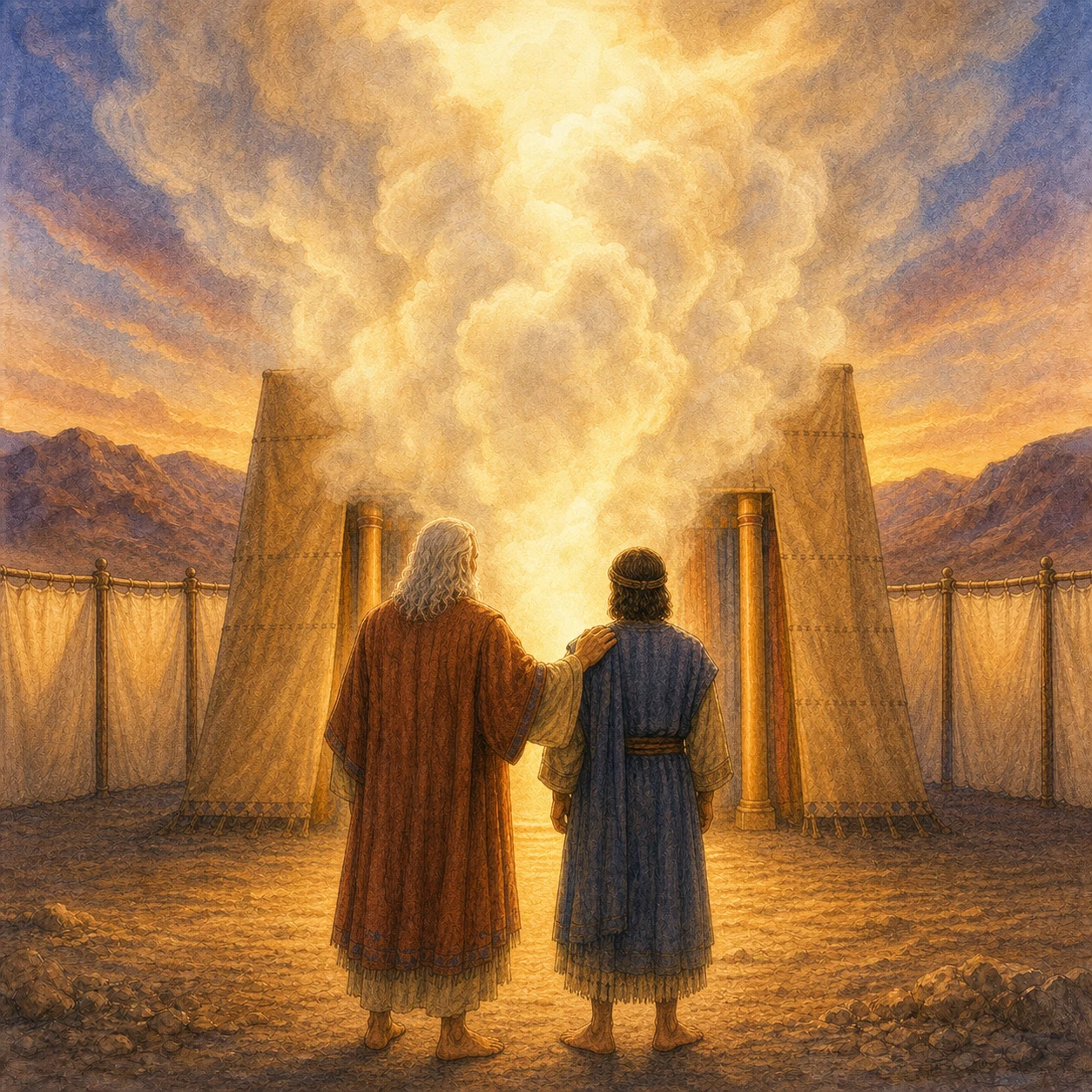
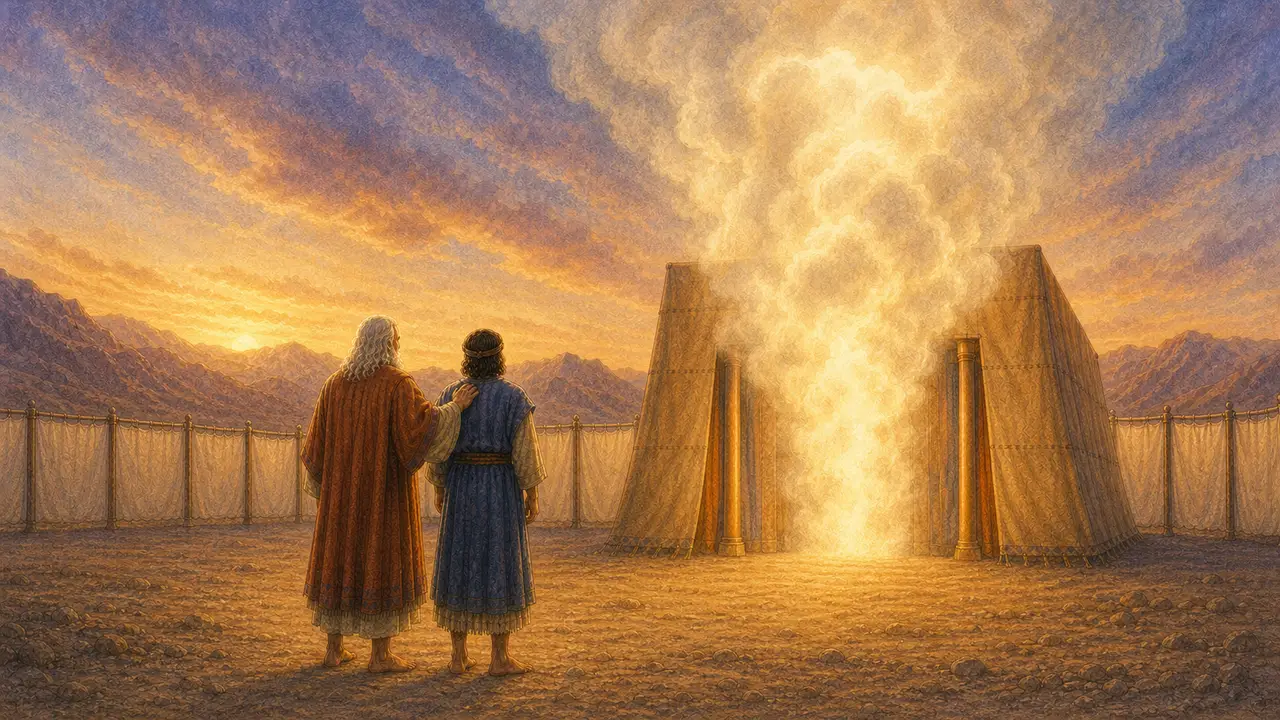
Then the chapter moves from Moses’ public address to Yahweh’s direct instruction. Yahweh tells Moses, “Behold, the time for you to die is near; call Joshua and present yourselves at the tent of meeting, that I may commission him.” Moses and Joshua go to the tent, and Yahweh appears in the pillar of cloud at the doorway.
The pillar of cloud is the familiar sign of Yahweh’s presence that guided Israel through the wilderness and stood over the tabernacle. At this critical moment, Yahweh makes clear that the transition from Moses to Joshua takes place under His own presence and authority.
Moses is about to lie down with his fathers, and Israel will “arise and play the harlot with the foreign gods of the land.” The language is covenantal and marital. Idolatry is spiritual adultery. Israel will forsake Yahweh and break the covenant He cut with them.
Yahweh is bringing them into the land He swore to their fathers, a land flowing with milk and honey, and once they have eaten, become satisfied, and grown fat, they will turn to other gods, serve them, spurn Yahweh, and break His covenant.
Israel’s danger will come through hardship and through fullness. In the wilderness, they grumbled because they lacked. In the land, they will rebel after being satisfied. Yahweh knows the intent already developing in them before they enter the land.
Their future sin is not hidden from God. Moses understands that Yahweh’s word will come to pass, both the gift of the land and the later corruption of the people. The same God who knows their rebellion still brings them into the inheritance He swore to their fathers.
Yahweh says His anger will be kindled against them, and He will forsake them and hide His face from them. This is the covenant consequence of their rebellion. Earlier Moses had told Joshua and Israel that Yahweh would not fail them or forsake them. Now Yahweh says that when Israel forsakes Him and breaks His covenant, He will forsake them and hide His face. Yahweh will not abandon His promise, but He will judge the people when they turn away from Him.
Yahweh hiding His face means the loss of His favourable presence. The people will be consumed, and many evils and troubles will find them. They will say, “Is it not because our God is not among us that these evils have found us?”
For the covenant people, the face of Yahweh is life, mercy, help, and fellowship. When Yahweh hides His face, the people experience the consequences of their own evil. In Deuteronomy 31, Yahweh says, “I will surely hide My face in that day because of all the evil which they will do, for they will turn to other gods.”
Because Israel will rebel, Yahweh commands Moses to write a song. The song will be taught to Israel and placed in their mouths “so that this song may be a witness for Me against the sons of Israel.” This is mercy and judgment at once.
Yahweh gives Israel a song that will testify against them when they turn aside. They will sing their own indictment. The song will remain in the mouths of their seed, and when many evils and troubles find them, it will answer them as a witness. Yahweh is giving them words that will interpret their future suffering truthfully.
This witness function continues when Moses finishes writing the words of the Law in a book and commands the Levites who carry the ark of the covenant of Yahweh to place it beside the ark. The book of the Law is to remain there “as a witness against you.”
Israel will not be able to say they were not warned. They will not be able to interpret exile, trouble, and judgment as though Yahweh failed them. The witnesses will say that Yahweh spoke beforehand, Israel rebelled, and the covenant curses came because of their idolatry and corruption.
Moses speaks plainly: “For I know your rebellion and your stiff-neck.” This is not a flattering farewell speech. While Moses is still alive, they have been rebellious against Yahweh; how much more after his death? That question exposes the depth of Israel’s problem.
Their faithfulness cannot finally rest on Moses’ presence, Joshua’s leadership, public reading, national memory, or possession of the land. All of those are good gifts, but Israel’s stiff neck remains. Moses knows that after his death they will act corruptly and turn away from the way he has commanded them.
The language of corruption reaches back into earlier biblical judgment. Before the flood, the earth was corrupt before God. Sodom was marked by grievous wickedness. The nations in the land are being judged for their evil. Now Moses says Israel itself will act corruptly. Israel will share the same moral category as the nations Yahweh judges.
They will do what is evil in the sight of Yahweh, provoking Him to anger “with the work of your hands.” That phrase likely points especially to idols, the gods they will make and serve. The hands Yahweh gave them for obedience, worship, service, and covenant life will be used to fashion objects of rebellion.
The chapter ends by leading directly into the Song of Moses: “Then Moses spoke in the hearing of all the assembly of Israel the words of this song, until they were complete.” Deuteronomy 31 therefore prepares us for Deuteronomy 32.
Israel stands on the edge of the land, Moses stands on the edge of death, Joshua stands ready to lead, and Yahweh gives a song that will explain Israel’s future. The song will teach them that Yahweh is faithful, Israel is corrupt, and covenant judgment is not divine failure.
Deuteronomy 31 teaches us that the people of God live by Yahweh’s presence, Yahweh’s promise, and Yahweh’s word. Moses dies, but Yahweh goes ahead. Leadership passes to Joshua, but Yahweh remains the true leader of His people.
The land is given as inheritance, but life in the land must be shaped by hearing, fearing, and obeying Yahweh. At the same time, the chapter forces us to face the depth of human rebellion. Israel can receive promise, law, leadership, worship, warning, song, and witness, and still turn aside to idols.
This chapter gives both assurance and warning. Yahweh will not fail His covenant purpose. He will bring His people into the land He swore to their fathers. But Israel will fail, forsake Him, and provoke Him to anger with the work of their hands.
That tension prepares us for the larger story of Scripture. The people need more than a new leader after Moses. They need hearts changed by God. They need a covenant mercy deeper than their rebellion.