
Exodus 4
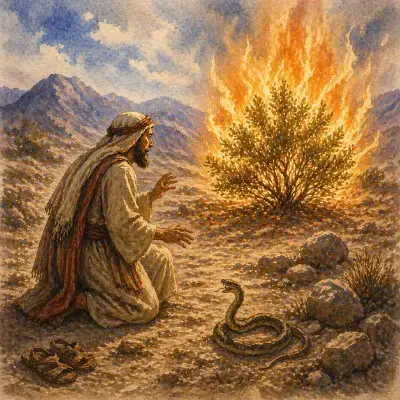
Exodus 4 continues Moses’ encounter with Yahweh at the burning bush. The revelation that began in chapter 3 now becomes a commission. God commands, and Moses resists. What unfolds is a contest between divine sovereignty and human reluctance. Yahweh will deliver His people—not because His servant is willing, but because His purpose cannot fail.
God’s Sovereign Plan to Rescue His People and the Reluctance of Moses
Exodus chapter 4 continues where chapter 3 ended, giving us the second half of Moses’ encounter with Yahweh at the burning bush.
In chapter 3, Yahweh revealed Himself as the living God who sees the suffering of His people and has come down to deliver them.
Now He reveals how that deliverance will unfold through the servant He has chosen.
This is the same conversation, not a new one, and here the focus shifts from divine revelation to divine commissioning.
Yahweh’s command is clear, but Moses starts looking for excuses why he shouldn’t go.
Most of the chapter traces Moses’ escalating objections and Yahweh’s answers.
Moses begins with doubt.
“What if they will not believe me or listen to my voice?” he asks in verse one.
It is not confusion—it is unbelief, because Yahweh has already promised, “They will listen.”
Yahweh answers Moses’ objection.
He asks, “What is that in your hand?”
Moses replies, “A staff.”
Yahweh commands him to throw it down, and it becomes a serpent.
Moses runs from it, terrified.
Then Yahweh commands him to grasp it by the tail, and when he obeys, it becomes a staff again in his hand.
This is the first sign, given “that they may believe that Yahweh, the God of their fathers, has appeared to you.”
In verse six Yahweh gives a second sign.
He tells Moses, “Put your hand into your bosom.”
When Moses does, he pulls it out and sees that his hand is leprous—white as snow.
Yahweh tells him to put it back, and when he draws it out again, it is restored.
The God who sends him has control over both disease and healing.
Then Yahweh describes a third sign. Moses has to take this particular sign on faith, since this one can only be performed in Egypt.
If the people still will not believe, Moses must pour out water from the Nile, and it will turn to blood on the dry ground.
The text does not explain why these signs were chosen, but together they show Yahweh’s control over creation, life, and judgment.
They confirm that the messenger carries the authority of the One who sends him.
Still Moses hesitates.
In verse ten he protests, “Please, Lord, I have never been a man of words… I am slow of mouth and slow of tongue.”
His fear now becomes self-distrust.
He no longer questions the people’s faith but his own ability.
Yahweh replies. “Who has made man’s mouth? Or who makes him mute or deaf, or seeing or blind? Is it not I, Yahweh? So now, go, and I, even I, will be with your mouth and will instruct you what you shall speak.”
This moment sits at the centre of the entire encounter.
The Creator who formed man from dust rules every faculty of speech, sight, and hearing.
Therefore, Moses can’t use the excuse that he is inarticulate.
Yahweh’s response is not to remove Moses’ weakness; He chooses to work through it, so that His strength will be seen in what Moses lacks.
The same God who made the mouth will give the words, and at this point Yahweh presses the command with urgency—He has heard enough hesitation and tells Moses, in effect, “Get going.”
But Moses refuses and escalates again. He says, “Please, Lord, send someone else.”
The tone is polite, but he is now directly defying God.
Yahweh’s anger burns, because he has answered all Moses’ objections. Moses has run out of excuses and his heart is revealed: He just doesn’t want to go!
Yet God still deals graciously with His servant.
He appoints Aaron, Moses’ brother, to speak on his behalf.
“I know that he can certainly speak,” Yahweh says.
He commands Moses to put the words in Aaron’s mouth and promises, “I will be with your mouth and with his mouth.”
The arrangement itself becomes a living parable of divine mediation.
God speaks to Moses; Moses speaks to Aaron; Aaron speaks to the people.
Yahweh remains in control of every word.
He commands Moses to take “the staff of God” in his hand, the same staff through which He will perform the signs.
Though Yahweh is angry, He still provides everything Moses needs to obey.
In verse eighteen Moses finally departs.
He goes to Jethro, his father-in-law, and says, “Let me go, that I may return to my brothers in Egypt and see if they are still alive.”
He does not tell Jethro about the burning bush, the divine name, or the call itself.
His omission of the whole story shows that, at this point, Moses still does not trust God’s plan enough to speak of it openly.
Jethro replies, “Go in peace.”
Then Yahweh speaks again to Moses. “Go, return to Egypt, for all the men who sought your life are dead.” So, Moses takes his wife and sons, mounts them on a donkey, and sets out, with the staff of God in his hand, finally doing what God commanded.
In verse twenty-one Yahweh reveals the next stage of His plan.
“When you go to return to Egypt, see that you perform all the wonders that I have put in your hand before Pharaoh. But I will harden his heart so that he will not let the people go.”
Yahweh does not merely foresee Pharaoh’s defiance—He determines it.
He will strengthen Pharaoh’s heart in stubbornness so that the full weight of His power and judgment can be revealed.
The outcome of Israel’s deliverance is not uncertain; God Himself will bring it about exactly as He intends.
Pharaoh will resist, Israel will go free, and the nations will know that Yahweh alone is God.
Then, in verses twenty-two and twenty-three, Yahweh explains why.
“Israel is My son, My firstborn. Let My son go that he may serve Me; but you have refused to let him go. Behold, I will kill your son, your firstborn.”
Here Yahweh discloses both His purpose and His justice. He will redeem His own firstborn by striking Egypt’s firstborn.
This speech stands as the foundation of everything that will follow—the plagues, the Passover, and the exodus itself. It also ties back to the sign Yahweh gave Moses earlier in verse nine, when He said that water from the Nile poured on the ground would become blood.
That sign foreshadows the first of the coming plagues, when Yahweh will strike the Nile and turn it to blood. Now He announces the last plague—the death of the firstborn. The first and the last judgments stand like bookends around all the others.
Yahweh knows every event before it happens because He Himself will bring it to pass.
He directs the outcome, governs the opposition, and ensures that His plan unfolds exactly as He has spoken.
Nothing in Egypt—neither Pharaoh’s will nor Israel’s fear—will alter what God has decreed.
But before Moses can confront Pharaoh, Yahweh confronts him!
In verse twenty-four, at the lodging place on the way, Yahweh meets him and seeks to put him to death.
The text gives little detail, but the cause is clear: Moses has not circumcised his son.
He has ignored the sign of the covenant given to Abraham. The messenger of the covenant stands guilty of breaking it.
Yahweh acts in judgment, showing that holiness cannot be compromised, even in His chosen servant.
Then Zipporah, Moses’ Midianite wife, steps forward in faith and obedience. This is another case where a foreigner shows greater faith than the chosen servant of God.
She recognises what Moses has ignored—that the covenant sign cannot be neglected without sinning against God.
This moment recalls the moment in Genesis when Abraham’s deception endangered Abimelech, and the pagan king showed more righteousness than Abraham.
Zipporah’s obedience restores Moses and re-establishes his household under the covenant.
In verse twenty-seven Yahweh brings the chapter to its fulfilment.
He commands Aaron, “Go to meet Moses in the wilderness.” And Aaron obeys. He meets Moses at the mountain of God, the same place where this call began.
Moses tells Aaron everything Yahweh has said and shown him and together they return to Egypt.
They gather the elders of Israel. Aaron speaks the words Yahweh has given, Moses performs the signs, and the people believe.
The promise of chapter 3 is fulfilled exactly as spoken: “They will listen to your voice.”
When they hear that Yahweh has seen their affliction and cares for them, they bow down and worship.
Exodus 4 shows that Yahweh’s plan to redeem His people does not depend on the strength or willingness of His servant.
Moses resists at every step—doubting, excusing, refusing, and finally disobeying—but Yahweh answers each objection with power and patience.
He gives signs to confirm His word, provides Aaron to share the task, and even spares Moses’ life through Zipporah’s faithful intervention.
The chapter reveals a single truth that governs all that follows: the success of God’s purpose rests entirely on His sovereignty and grace.