
Exodus 33
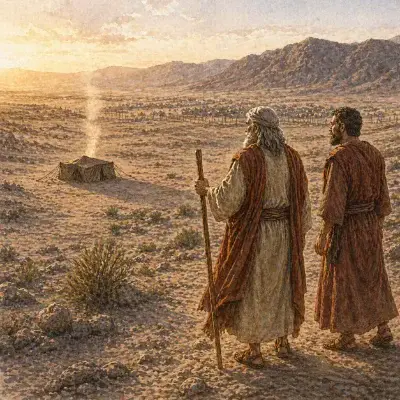
Exodus 33 confronts the central problem created by the golden calf: Yahweh has promised to dwell among Israel, yet His holiness threatens to consume them. The chapter shows the tension between His presence and their sin, as the tent is set outside the camp and access is limited. Moses stands as mediator and refuses to go forward without Yahweh with the people. Yahweh agrees to go with them, not because of their worth, but because He is gracious.
Exodus 33 Explained: Yahweh’s Presence, Israel’s Sin, and the Need for a Mediator
Exodus 33 continues directly from the sin of the golden calf and addresses the central problem identified in the previous chapter. Yahweh has promised to dwell in the midst of Israel, but Israel has shown that they are a stiff-necked people who break His covenant. The question now is whether Yahweh Himself will go with them. The chapter focuses on the presence of Yahweh, the danger of His holiness, and the role of the mediator.
The chapter opens with Yahweh commanding Moses to lead the people to the land He swore to Abraham, Isaac, and Jacob. He repeats the promise that He will give the land to their seed and drive out the nations before them. The covenant promise remains in place. But Yahweh then says that He will send an angel before them and that He Himself will not go up in their midst, because they are a stiff-necked people and He would consume them on the way.
The problem is not whether the promise will be fulfilled, but whether the people can survive Yahweh’s presence. A holy God in the midst of a sinful people is a danger to them.
When the people hear this word, they mourn and none of them puts on his ornaments. These ornaments are connected to the gold used for the calf. By removing them, the people come before Yahweh without outward display or self-glory. They present themselves as a guilty people who depend on His mercy.
The text says that the sons of Israel stripped themselves of their ornaments from Mount Horeb onward. This shows an ongoing posture of mourning and repentance. Sin has visibly altered their appearance and their approach to God.
The narrative then describes Moses pitching the tent of meeting outside the camp, a good distance away. This is a visible picture of what sin has done. Yahweh is not dwelling in the midst of the camp. He is outside it. Anyone who seeks Yahweh must go out to the tent.
Whenever Moses goes out to the tent, the people rise and stand at the entrances of their tents and watch him. When Moses enters the tent, the pillar of cloud descends and stands at the entrance, and Yahweh speaks with Moses. The people see the cloud and rise and worship, each at the entrance of his tent.
Yahweh speaks with Moses face to face, as a man speaks to his friend. Then Moses returns to the camp, but Joshua remains at the tent. The people stay at a distance, Moses is brought near as mediator, and Joshua remains near the place of Yahweh’s presence.
The chapter shows that access to Yahweh is not casual. Sin has created distance, and nearness now takes place through the mediator and at the place where Yahweh chooses to meet.
The centre of the chapter is the conversation between Moses and Yahweh. Moses reminds Yahweh that He has told him to lead the people but has not said whom He will send with him. Moses appeals to what Yahweh has already said, that Moses has found favour in His sight and is known by name.
Moses then asks to know Yahweh’s ways so that he may know Him, and he insists that this nation is Yahweh’s people. Yahweh responds, “My presence shall go with you, and I will give you rest.”
Moses presses further. He refuses to go forward if Yahweh will go only with him personally. He says, “If Your presence does not go with us, do not lead us up from here.” Moses binds himself to the people and will not be separated from them.
He then explains why this matters. What distinguishes Israel from all other nations is Yahweh’s presence with them. Yahweh agrees and says He will go with the people because Moses has found favour before Him and has interceded for them.
Moses then asks, “Show me Your glory.” Yahweh responds that He will make all His goodness pass before Moses and proclaim His name. He declares, “I will be gracious to whom I will be gracious, and I will show compassion on whom I will show compassion.”
This explains why Israel still exists after the golden calf. It is not because they deserve mercy, but because Yahweh chooses to show mercy. His grace comes from His own will.
Yahweh then says, “You cannot see My face, for no man can see Me and live.” He places Moses in the cleft of the rock and covers him while His glory passes by. Moses sees only His back, not His face.
The chapter ends with both nearness and limitation. Yahweh speaks with Moses as a man speaks with his friend, yet His full glory would destroy a man.
Exodus 33 teaches that the defining reality of God’s people is the presence of Yahweh in their midst. The land and the promises are not enough without Him. But a holy God cannot dwell among a sinful people without mediation and mercy. Yahweh remains with Israel because He is gracious, and the people live because a mediator stands before Him on their behalf.