
Exodus 7
Exodus 7 begins the direct confrontation between Yahweh and Pharaoh. Moses is sent to speak with authority, signs are performed in Pharaoh’s court, and the first plague strikes the Nile. The chapter shows how Yahweh reveals His power in judgment and how an unbelieving heart responds even when confronted with clear acts of God.
Exodus 7 Explained: Yahweh Confronts Pharaoh and Reveals His Power
Exodus 7 begins by taking up Moses’ unresolved objection at the end of chapter 6, where Moses says, “I am of uncircumcised lips; how then will Pharaoh listen to me?”
Yahweh answers, but he does not address this objection. He does not correct it, and He does not cleanse Moses’ lips.
Instead, He answers with a new declaration: “I have made you like God to Pharaoh, and your brother Aaron shall be your prophet.”
Yahweh shows that Moses’ lack of holiness is not the issue; His own authority is.
He establishes a hierarchy for the confrontation: He stands over Moses, and when Moses approaches Pharaoh, Aaron shall speak Moses’ words as a prophet speaks the words of God.
This mirrors the pattern of Pharaoh’s own court, where Pharaoh stands above his magicians and wise men.
Yahweh confronts Pharaoh on grounds Pharaoh will recognise, and Moses stands before him as the representative of the God who rules all kings.
Yahweh then declares the pattern that will govern everything that follows: He will harden Pharaoh’s heart, Pharaoh will not listen, and His signs and wonders will multiply in Egypt.
Pharaoh’s resistance will not stop God’s deliverance. Instead it will provide the stage on which Yahweh reveals His name.
Moses and Aaron obey exactly as Yahweh commands, and their obedience forms the steady contrast to Pharaoh’s refusal.
Before Yahweh sends the first plague, He gives Moses and Aaron a sign to perform in Pharaoh’s court.
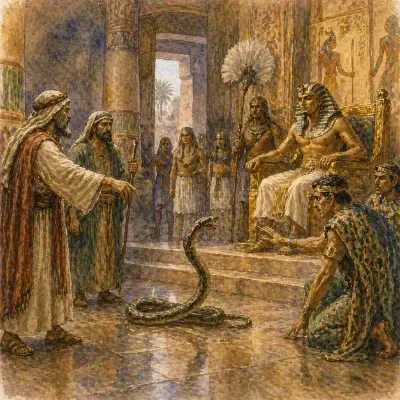
Aaron is to cast down his staff and it will become a serpent, repeating the sign Yahweh first gave to Moses at the bush.
The difference is that Moses’ staff was to be a sign to the Israelites, whereas Aaron’s staff is to be a sign to Pharaoh.
Moses and Aaron go to Pharaoh, doing just as Yahweh commanded them. Aaron throws down his staff and it becomes a serpent.
In response, Pharaoh summons his magicians, and they imitate the sign with their secret arts.
The line of conflict is now clearly drawn: Moses and his prophet on one side, Pharaoh and his magicians on the other.
Pharaoh’s magicians are able to imitate Aaron’s sign.
However, Aaron’s serpent swallows the serpents of Egypt’s magicians, a decisive display of Yahweh’s supremacy.
The magicians’ imitation is shown to be inferior. Moreover it does not reverse Yahweh’s act; it only strengthens Pharaoh’s blindness.
Pharaoh sees the false wonders of his own magicians and uses them as the reason to remain defiant.
Yahweh then sends Moses to confront Pharaoh at the Nile, the river that sustains Egypt and stands at the centre of its worship.
Moses announces that by the judgment that follows, Egypt will know Yahweh.
The Nile is struck first because it is the heart of Egypt’s life and the symbol of its gods’ claimed power.
Aaron stretches out his hand, and Yahweh sends His plague.
The Nile turns to blood, the fish die, the river stinks, and the water becomes undrinkable.
The word “blood” can refer to literal blood or to something blood-red in appearance, but either way the result is the same: the water is undrinkable and poisonous, and all the fish die.
The comprehensiveness of the sign makes every natural explanation impossible, for the rivers, canals, ponds, reservoirs, and even water already stored in vessels of wood and stone all turn to blood.
Therefore, it is not possible that this miracle is a seasonal reddening or the result of upstream silt; it is Yahweh’s direct act affecting all the drinking water of Egypt, turning the Egyptians’ source of life into a river of death.
The magicians imitate this sign also, producing nothing that could help Egypt and relieving none of the suffering.
Miracles can be dismissed by an unbelieving heart, and their imitation strengthens Pharaoh’s overconfidence and gives him another excuse to ignore Yahweh’s word.
Pharaoh turns and goes into his house without setting his heart on what he has seen.
The Egyptians are forced to dig along the Nile for water.
The judgment exposes the fragility of the nation’s life when Yahweh strikes down the Egyptians’ god: the river of Egypt.
Seven days pass after Yahweh strikes the river, marking the completeness of the first plague.
Exodus 7 teaches that Yahweh’s purpose stands firm whether His servant feels unworthy or His enemy refuses to listen.
It shows that miracles can be dismissed by an unbelieving heart, that counterfeit signs deepen blindness, and that Pharaoh’s refusal to listen stands as a warning of how easily the truth can be resisted.
It shows Yahweh striking the heart of a nation’s strength to reveal that He alone commands creation and rules the nations, while Moses and Aaron act in obedience and Pharaoh answers with defiance.
And it shows that Yahweh’s authority extends over every nation, every ruler, and every power that sets itself against Him.