
Exodus 8
Exodus 8 continues the plagues as Yahweh strikes Egypt with frogs, gnats, and flies. The pressure on Pharaoh increases, and for the first time a distinction is made between Egypt and Israel. Yet Pharaoh continues to harden his heart, showing that repeated judgments do not produce repentance where there is no willingness to listen to Yahweh.
Exodus 8 Explained: Judgment Intensifies as Pharaoh Hardens His Heart
Exodus 8 continues the confrontation where chapter 7 ended.
The Nile has been struck, Egypt’s source of life has become death, the magicians have imitated the sign, and Pharaoh has hardened his heart.
God’s judgments now move inward, from the river that sustains the nation to the houses, bodies, and land of its people.
Yahweh sends Moses to Pharaoh once more with the demand: “Let My people go, that they may serve Me.”
Pharaoh refuses, so Yahweh announces the second plague: frogs will come up from the Nile and invade every sphere of Egyptian life.
The frog was the sacred emblem of Heqet, goddess of childbirth and fertility, a creature Egypt regarded as a symbol of life itself.
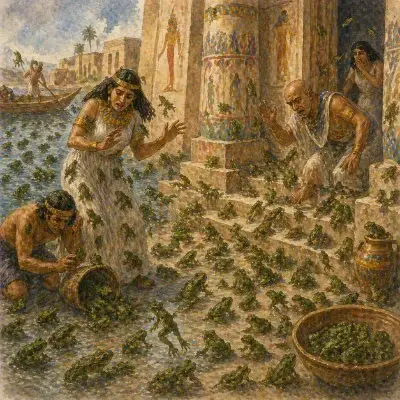
Aaron stretches out the rod over the waters, and frogs cover the land exactly as Yahweh said—into houses, bedrooms, beds, ovens, and kneading bowls.
In response, Pharaoh’s magicians also bring up frogs by their secret arts. Repeating the sign gives Pharaoh grounds to dismiss Moses and Aaron as no different from his own magicians.
Pharaoh summons Moses and Aaron and says, ‘Entreat Yahweh that He may remove the frogs from me and from my people, and I will let the people go to sacrifice to Yahweh.’ For the first time Pharaoh must ask for the plague to end, recognising that only Yahweh can lift it.
Moses allows Pharaoh to name the time. In doing this he shows that Yahweh governs both the beginning and the end of the plague.
Moses cries out to Yahweh, the frogs die everywhere except the river, and the Egyptians heap them into piles; the land stinks.
The creature Egypt honoured as a symbol of life and fertility now lies in rotting heaps, exposing the impotence of Heqet and showing that Yahweh alone governs life and death.
Despite this sign, as soon as Pharaoh sees relief, he hardens his heart and refuses to let the people go, exactly as Yahweh declared.
After Pharaoh commits his deceitful act—promising release and then withdrawing it as soon as the plague ends—the next plague arrives without announcement.
Yahweh commands Aaron to strike the dust of the earth, and when he does, the dust becomes gnats on man and beast throughout Egypt.
“The word commonly translated ‘gnats’ refers to tiny biting insects; the Bible is not identifying a precise species. Different English translations may therefore use words such as mosquitoes or lice.”
The dust was associated with the Egyptian god Geb, their god of the earth, yet the very ground now swarms at Yahweh’s command.
The magicians try to produce gnats but cannot; their arts fail completely for the first time, and they tell Pharaoh, “This is the finger of God.”
Even Pharaoh’s own sorcerers recognise divine action. However, Pharaoh’s heart remains hard.
The fourth plague returns to the same formula as the earlier plagues: Yahweh tells Moses to confront Pharaoh again and to declare that swarms of flies will fill the houses of the Egyptians and cover the ground.
He then declares that He will differentiate the Israelites who dwell in Goshen from the Egyptians.
“I will set apart the land of Goshen, where My people dwell; no swarms will be there, that you may know that I, Yahweh, am in the midst of the land.”
Swarming insects were linked with deities such as Khepri, yet the flies obey Yahweh alone, and their complete absence from Goshen shows that the boundary between judgment and mercy belongs to Him alone.
The flies come and ruin the land of Egypt, while Israel stands untouched, a visible sign that these plagues are not natural events but covenant-directed acts of the God who keeps His word.
Pharaoh summons Moses again, offers compromise within the land, then bargains for a short distance and asks for prayer.
Moses warns him not to act deceitfully again, then prays to Yahweh for the plague to end.
Yahweh removes the flies completely; not one remains.
However, as before, as soon as Pharaoh sees the relief, he hardens his heart again.
Exodus 8 displays deliberate escalation: from the river turned to blood, to homes and bodies invaded by frogs, to the dust of the earth becoming gnats on man and beast, to the land ruined by flies while Goshen is spared.
Each plague increases the pressure on the Egyptians, exposes another Egyptian god as powerless, and reveals that the land is under the authority of Yahweh, the very God whom Pharaoh had confessed he did not know only days earlier.
We begin to see a deliberate pattern in Yahweh’s dealings with Pharaoh: He announces two plagues, Pharaoh continues his pattern of deceit by withdrawing his promise once the plague is lifted, and then Yahweh sends the following plague without warning.
Through all of this Yahweh acts with measured patience.
He repeats the same clear command and gives Pharaoh repeated opportunity to repent.
He answers every prayer Moses offers, even when Pharaoh’s request for relief has no change of heart behind it.
He removes each plague completely and at the precise moment appointed, leaving no room for natural explanation.
And He acts only within the boundaries of the word He spoke in chapter 7 verses 3 to 5: the hardening of Pharaoh, the multiplying signs, the exposure of Egypt’s gods, and the separation of His covenant people all unfold exactly as He declared.
The gods of Egypt stand powerless, the magicians are defeated, and Pharaoh’s continued deceit has been met with sudden judgment.
For the first time the Bible tells us Yahweh separates and protects His chosen people. The distinction was implied earlier but is now stated openly.
Through all this Yahweh shows who He is by the way He acts toward Egypt and toward His chosen people.
Yahweh reveals Himself as the God who answers prayer, gives repeated warnings, shows patience toward the rebellious, and demonstrates His power over every false god.