
Isaiah 52
Isaiah 52 calls captive Zion to awake, rise from the dust, and put on beautiful garments because Yahweh has determined to redeem His people. The chapter announces the good news that God reigns, shows Yahweh returning to Zion and baring His holy arm before the nations, and then unveils the Servant who will be high and lifted up, yet marred beyond recognition. Isaiah 52 prepares the way for Isaiah 53 by showing that Zion's redemption and the salvation of the nations come through Yahweh's exalted and suffering Servant.
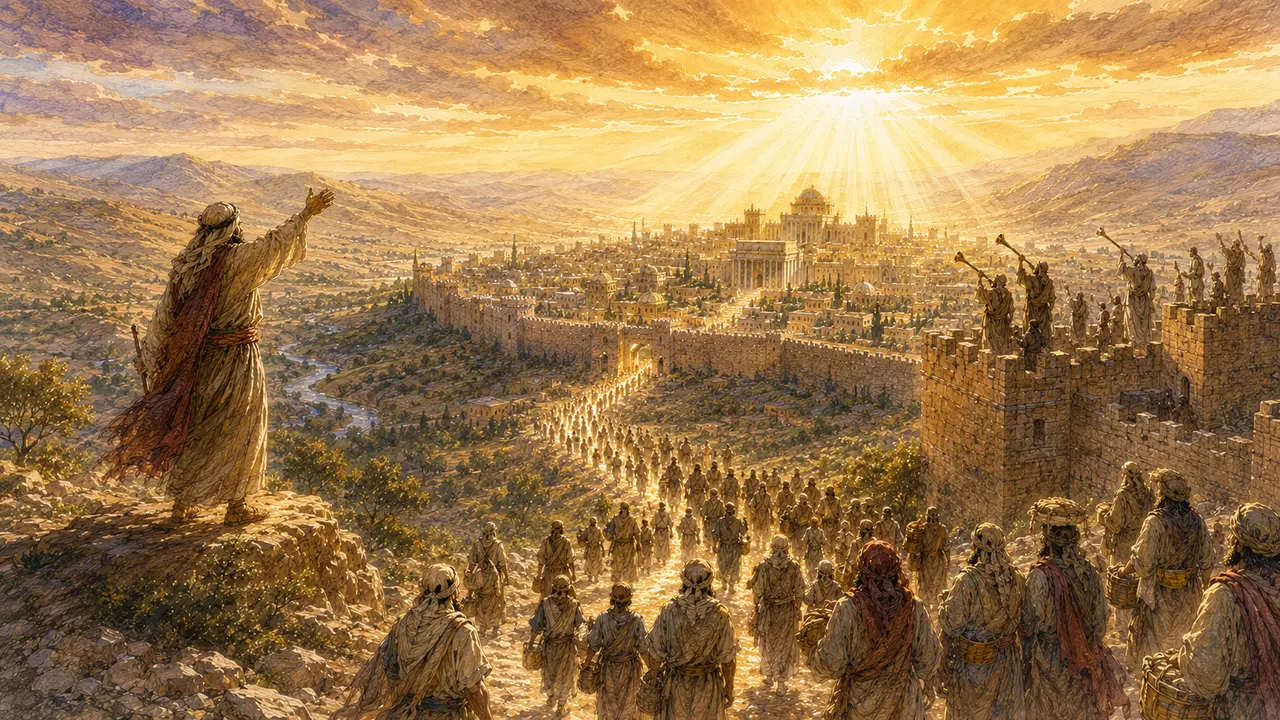
Isaiah 52 Explained: Hope for Captive Zion
Isaiah 52 comes in the middle of Yahweh’s words of comfort to His afflicted people. Zion has been brought low. Jerusalem has been humiliated. The people of God have known exile, oppression, uncleanness, and shame. But this chapter does not begin with Zion’s strength. It begins with Yahweh’s command: “Awake, awake, clothe yourself in your strength, O Zion; clothe yourself in your beautiful garments, O Jerusalem, the holy city.” Zion is told to rise because Yahweh has determined to redeem her. The command does not assume that Jerusalem already has strength in herself. It is the word of God summoning His people out of shame and into the restoration He Himself is bringing.
The language of clothing is important. “Clothe yourself in your beautiful garments” does not mean that Jerusalem is simply being told to dress well. Zion has been sitting in dust, chained, shamed, and treated as captive. Beautiful garments speak of restored dignity, covenant holiness, and the reversal of disgrace. Jerusalem is called “the holy city,” and that holiness shapes the rest of the verse: “for the uncircumcised and the unclean will no longer come into you.” This is restoration language, but it is not mere civic restoration. Yahweh is speaking about a purified Zion, a people no longer trampled by uncleanness, a city restored to covenant honour before God.
Verse 2 continues the same movement: “Shake yourself from the dust, rise up, O captive Jerusalem; loose yourself from the chains around your neck, O captive daughter of Zion.” Dust is the place of mourning, defeat, and humiliation. Chains around the neck are the language of slavery. Zion is not merely discouraged; she is captive. She has been brought low under foreign powers, and Isaiah’s words look ahead to the exile that would come upon Judah because of covenant rebellion. But even as Yahweh names her captivity, He commands her to rise. The same God who judged His people for their sin now speaks the word of release.
Verse 3 explains the nature of that release: “For thus says Yahweh, ‘You were sold for nothing, and you will be redeemed without money.’” Zion did not fall because Babylon, Assyria, Egypt, or any other nation had ultimate ownership over her. Yahweh’s people were not sold because their enemies had purchased them from God. They were handed over under divine judgment, and they will be redeemed by divine mercy. “Without money” means that no human payment will secure their freedom. Yahweh Himself will redeem them. Their restoration will not be purchased by political strength, military bargaining, or human wealth. It will come from Yahweh’s covenant faithfulness.
Yahweh then places Zion’s captivity within the larger history of His people: “My people went down at the first into Egypt to sojourn there; then the Assyrian oppressed them without cause.” Egypt and Assyria are not random examples. Egypt was the house of slavery from which Yahweh redeemed Israel in the first exodus. Assyria was the brutal empire that later crushed the northern kingdom and threatened Judah. The history of Israel had already shown the pattern: God’s people are oppressed, the nations boast, Yahweh’s name is dishonoured, and Yahweh acts for His own name and for His covenant people.
Verse 5 brings the matter into the present crisis: “‘So now, what do I have here,’ declares Yahweh, ‘since My people have been taken away for nothing?’” Yahweh speaks as the covenant Lord whose people have been seized and whose name is being blasphemed. “Those who rule over them howl, and My name is continually blasphemed all day long.” The oppression of God’s people is never only a political matter. When the nations rule over Zion and mock her God, Yahweh’s name is treated with contempt. The captivity of Zion has become the occasion for blasphemy. Yahweh will therefore act so that His people will know His name and His enemies will no longer treat His name as empty.
That is why verse 6 says, “Therefore My people shall know My name; therefore in that day I am the one who is speaking, ‘Here I am.’” This is one of the great covenant statements in the chapter. Yahweh’s purpose is not merely to change His people’s circumstances. He will make His people know His name. In Scripture, knowing Yahweh’s name means knowing Him as He has revealed Himself: the God who is holy, sovereign, faithful, merciful, and true to His covenant. When He says, “Here I am,” He is not giving Israel an idea to consider. He is announcing His personal presence. The God whose name has been blasphemed will speak, act, and make Himself known.
This explains why the next verse breaks into the language of good news: “How lovely on the mountains are the feet of him who proclaims good news, who announces peace and proclaims good news of good things, who announces salvation, and says to Zion, ‘Your God reigns!’” The messenger comes over the mountains to Zion with a royal announcement. The good news is not first a command for Zion to perform, but a declaration of what Yahweh has done and is doing. Peace is announced. Salvation is proclaimed. God’s reign is declared. Zion is not told, “You must rescue yourself.” Zion hears, “Your God reigns.”
This is why the New Testament rightly takes up this verse in relation to the preaching of the gospel. Paul quotes it in Romans 10:15, because the gospel of Christ is the full proclamation that God reigns and saves. Isaiah 52 is already using gospel language. Yahweh is returning to Zion. Yahweh is redeeming His people. Yahweh is announcing peace and salvation. In Christ, that announcement reaches its final clarity: God reigns through His crucified and risen King, and salvation is proclaimed to all who call upon the name of the Lord.
Verse 8 shows the response of Zion’s watchmen: “Listen! Your watchmen lift up their voices, they shout joyfully together; for they will see with their own eyes when Yahweh returns to Zion.” The watchmen stand on the walls, looking for news, danger, armies, and messengers. Here they see the return of Yahweh Himself. That is the centre of the good news. The exiles are returning, but more deeply, Yahweh is returning to Zion. The restoration of the people is grounded in the return of God’s saving presence. Zion’s hope is not only that captives come home, but that Yahweh comes to dwell with His people in mercy.
Verse 9 then calls the ruins of Jerusalem to sing: “Break forth, shout joyfully together, you waste places of Jerusalem; for Yahweh has comforted His people, He has redeemed Jerusalem.” The ruins are addressed as though they can rejoice because Yahweh’s word is so certain that desolation itself must give way to praise. Jerusalem’s comfort is not sentimental. Yahweh comforts His people by redeeming them. The city that had been wasted under judgment is called to rejoice because Yahweh has acted for her restoration.
Verse 10 expands the horizon beyond Jerusalem: “Yahweh has bared His holy arm in the sight of all the nations, that all the ends of the earth may see the salvation of our God.” This deliberately recalls the Exodus. Yahweh’s arm is His saving power, His personal intervention, His strength displayed in redemption. To bare the arm is to act openly and decisively. It is as if Yahweh rolls up His sleeve before the nations, not because He needs effort as man does, but because He is about to reveal His power in public salvation. What He does for Zion will be seen to the ends of the earth.
This also reaches back to the promise to Abraham. Yahweh’s purpose was never limited to Israel as an isolated nation. He promised that in Abraham all the families of the earth would be blessed. Here the salvation of Zion becomes visible before “all the nations” and “all the ends of the earth.” Yahweh redeems His people in such a way that the nations see His salvation. The God of Israel is the God of the whole earth, and His covenant mercy toward Zion becomes the means by which His glory is displayed before the world.
Verses 11 and 12 then call the people to return in holiness: “Depart, depart, go out from there, touch nothing unclean; go out of the midst of her, purify yourselves, you who carry the vessels of Yahweh.” The people must leave the place of captivity and uncleanness. The command to depart does not cancel the larger theme of return; it describes the necessary leaving that belongs to coming home to Zion. They are not to bring Babylon’s uncleanness with them. Those who carry the vessels of Yahweh must be clean, because Yahweh’s redemption calls His people back into holiness.
This is not a panicked escape from captivity. Verse 12 says, “But you will not go out in haste, and you will not go as fugitives; for Yahweh will go before you, and the God of Israel will be your rear guard.” The Exodus background is clear, but Isaiah also shows that this return will surpass the first Exodus in one important respect. Israel left Egypt in haste. Here the redeemed people do not flee like frightened slaves. This is an ordered, protected, triumphant return under divine command. Yahweh goes before His people, and the God of Israel guards them behind. He surrounds the returning remnant with His own presence.
At this point the chapter takes a remarkable turn: “Behold, My Servant will prosper, He will be high and lifted up and greatly exalted.” The shift is sudden, but it is not disconnected. Everything in the chapter has been moving toward Yahweh’s redemption of Zion. Yahweh has announced peace. Yahweh has proclaimed salvation. Yahweh has returned to Zion. Yahweh has bared His holy arm before the nations. Now Yahweh says, “Behold, My Servant.” The Servant is the answer to how this redemption will be accomplished. He is the one through whom Yahweh’s saving work will come.
The exaltation language is extraordinary. The Servant will “prosper,” meaning He will succeed in the work given to Him. He will be “high and lifted up and greatly exalted.” In Isaiah, this language belongs closely to Yahweh Himself. Isaiah 6 speaks of the Lord seated on a throne, “high and lifted up.” Isaiah 57 speaks of the One who is high and lifted up, who dwells forever and whose name is holy. For the Servant to be described in this way places Him far above an ordinary prophet, messenger, or national representative. He is Yahweh’s Servant, but His exaltation bears the weight of divine majesty.
Then verse 14 shocks the reader: “Just as many were appalled at you, My people, so His appearance was marred more than any man and His form more than the sons of men.” The Servant who prospers and is greatly exalted is also the Servant whose appearance is marred beyond ordinary human disfigurement. Isaiah has not yet explained why. At this point we only see the tension. The exalted Servant is also appalling to many. His glory is somehow bound up with humiliation, suffering, and visible ruin.
This means Isaiah 52 closes with a question hanging over the passage. How can the Servant be high and lifted up, and yet marred more than any man? Is He like a returning king whose victory has cost Him dearly? Is He a commander marked by battle? Has He suffered in the act of rescuing the captives? Isaiah 52 does not yet give the full answer. The reader must carry the question into chapter 53. What is clear already is that Yahweh’s salvation will not come through an untouched, distant figure of power. It will come through His Servant, exalted and disfigured, triumphant and appalling.
Verse 15 then shows the effect of the Servant’s work: “Thus He will sprinkle many nations, kings will shut their mouths on account of Him; for what had not been recounted to them they will see, and what they had not heard they will understand.” The word “sprinkle” brings priestly and covenant imagery into the passage. Moses sprinkled the blood of the covenant on the people at Sinai. Priests sprinkled blood in the sacrificial system. Cleansing, consecration, and atonement were bound up with this language. Here the Servant sprinkles not only Israel, but many nations. His work is priestly, cleansing, and international.
The nations that saw Yahweh bare His holy arm in verse 10 are now directly affected by the Servant in verse 15. Kings shut their mouths before Him. Their silence is not indifference. It is astonishment. Those who had not received the report will see. Those who had not heard will understand. The Servant’s humiliation and exaltation will reveal something previously hidden from the rulers of the nations. Yahweh’s salvation will confront them through the marred and exalted Servant.
This final movement also binds the Servant closely to Yahweh’s own saving presence. Earlier Yahweh said, “My people shall know My name,” and “Here I am.” The messenger says, “Your God reigns.” The watchmen see Yahweh returning to Zion. Yahweh bares His holy arm before the nations. Then Yahweh presents His Servant. The Servant does what Yahweh Himself has promised to do. He brings the salvation by which Zion is redeemed and the nations are cleansed. The distinction between Yahweh and His Servant remains, but their work is united. Yahweh saves through His Servant.
Isaiah 52 therefore moves from captive Zion to the exalted Servant. Jerusalem is called to wake, rise, and put on beautiful garments because Yahweh has determined to redeem His people. The good news announces that God reigns and that Yahweh is returning to Zion. The return from captivity is protected by Yahweh before and behind, and the salvation of God is revealed to the ends of the earth. Then, at the climax, Yahweh unveils the Servant, high and lifted up, greatly exalted, and yet marred beyond recognition. Isaiah 52 leaves us standing before the mystery of this Servant. Chapter 53 will explain that His disfigurement is not incidental to His mission. It is the very path by which He bears sin, sprinkles the nations, and brings the salvation of Yahweh to the ends of the earth.