
Psalm 110
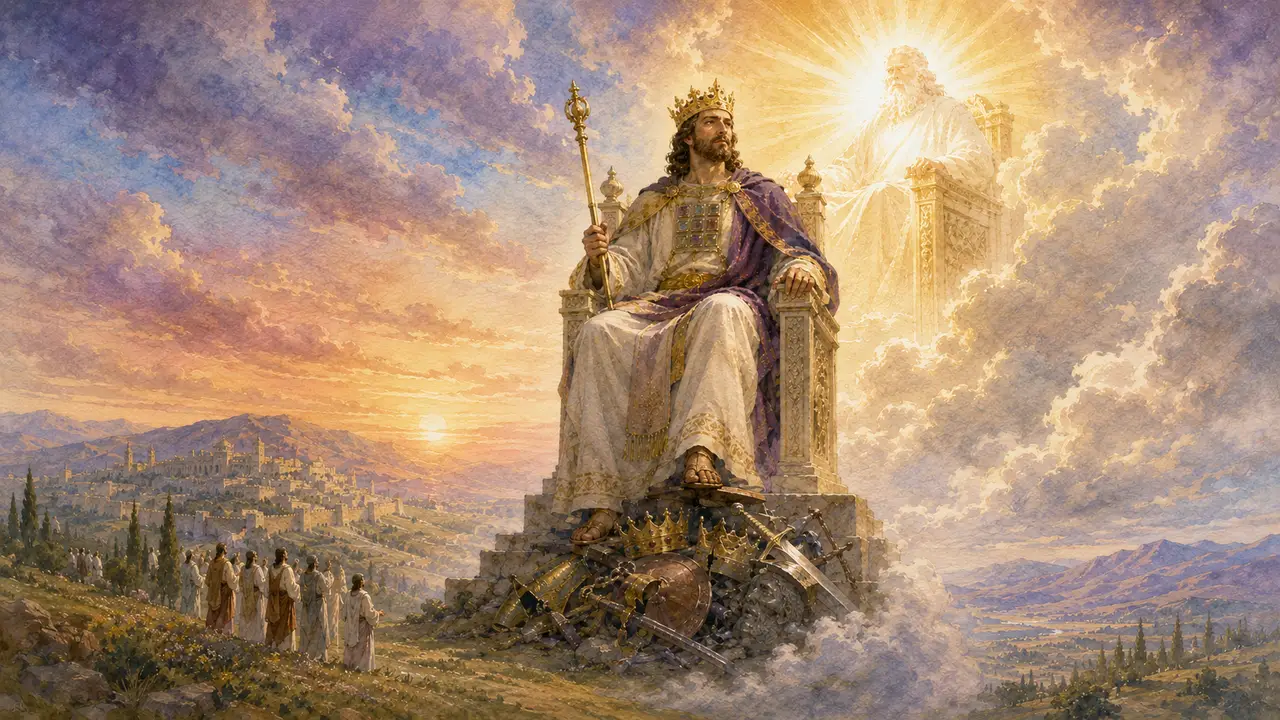
Psalm 110 records David hearing Yahweh speak to someone David calls "my Lord": a king enthroned at God's own right hand and sworn into an eternal priesthood after the order of Melchizedek, centuries before Levi's priesthood even existed. It is the single most quoted Old Testament chapter in the New Testament, and Jesus uses it to press the Pharisees on how David's son can also be David's Lord. This is where kingship and priesthood, David's throne and Melchizedek's order, meet in one enthroned figure whose reign advances in the midst of his enemies until they are made his footstool.
Psalm 110 Explained: You Are a Priest Forever
Psalm 110 is introduced as “Of David. A Psalm.” David is not speaking about his own throne or one of his ordinary descendants. He says, “Yahweh says to my Lord,” which means David hears Yahweh addressing someone greater than David. Because David calls this figure “my Lord,” the psalm immediately points beyond an ordinary royal successor. Psalm 110 therefore opens a window into the identity, enthronement, priesthood, and victory of the Messiah.
The placement of Psalm 110 in Book V of the book of Psalms is important. Book IV has already highlighted the crisis of the Davidic kingdom and the eternal reign of Yahweh. Psalm 89 ended with the apparent collapse of the Davidic throne, asking where Yahweh’s former lovingkindnesses to David had gone. Book IV answers by repeatedly declaring Yahweh’s reign. Book V gathers the hope of restoration, covenant faithfulness, and praise, and Psalm 110 stands in that setting as a direct answer to the question of David’s throne. The Davidic king has not been abandoned. Yahweh speaks to David’s Lord, seats Him at His right hand, extends His scepter, swears Him into eternal priesthood, and brings His enemies under His feet.
The first word of the psalm is the covenant name of God: “Yahweh says to my Lord.” Yahweh, the God who made covenant with Israel and promised David a house, a throne, and a kingdom in 2 Samuel chapter 7, speaks to David’s Lord. The words are royal and heavenly: “Sit at My right hand until I put Your enemies as a footstool for Your feet.”
To sit at the right hand is to sit in the place of supreme honour, authority, and power. In Scripture, the right hand is associated with strength, rule, and saving action. So when Yahweh tells David’s Lord to sit at His right hand, He places Him in the position of royal authority beside Himself.
The footstool imagery also matters. In the ancient world, conquered enemies could be pictured beneath the feet of the victorious king. The image describes public conquest, royal supremacy, and the defeat of enemies. Yahweh Himself promises to place the Messiah’s enemies beneath His feet. The Messiah’s reign is therefore established by Yahweh’s own action. The King is enthroned, and His enemies will be subdued because Yahweh has spoken.
Verse 2 continues: “Yahweh will stretch forth Your strong scepter from Zion, saying, ‘Have dominion in the midst of Your enemies.’” The scepter is kingship imagery. It is the symbol of royal rule. What is striking is the relationship between Yahweh and the Messiah. Yahweh stretches forth the Messiah’s strong scepter from Zion. The scepter belongs to the Messiah, and Yahweh extends it. The Messiah reigns, and Yahweh establishes His reign. The rule of the Messiah is therefore the rule of Yahweh exercised through the King He enthrones.
The Messiah’s rule goes out from Zion. This fits the pattern of the Old Testament, where Zion is the place of Yahweh’s throne, the city of David, and the centre from which God’s reign is announced. But the dominion of this King is not limited to Zion. Yahweh says, “Have dominion in the midst of Your enemies.” The Messiah reigns surrounded by opposition. His kingdom advances into enemy territory. Psalm 110 does not picture a king waiting until all enemies disappear before He reigns. He reigns while enemies remain, and His reign continues until Yahweh places those enemies beneath His feet.
Verse 3 describes the Messiah’s people: “Your people will offer themselves freely in the day of Your power; in the splendor of holiness, from the womb of the dawn, the dew of Your youthfulness will be Yours.” His people are the people who belong to Him and serve under His rule. They offer themselves freely. This is willing allegiance to the King. In the day of His power, His people come to Him as volunteers, giving themselves to His service.
The imagery of dawn and dew gives the verse a sense of freshness, abundance, and renewed strength. Dew appears in the morning and covers the ground in countless drops. In that way, the King’s people appear as a fresh and willing host in the day of His power. The phrase “in the splendor of holiness” gives the scene a priestly and sacred character. These are consecrated people gathered to the Messiah-King. His rule creates a holy people who belong to Him and offer themselves freely.
Then verse 4 gives the great surprise of the psalm: “Yahweh has sworn and will not change His mind, ‘You are a priest forever according to the order of Melchizedek.’” Until this point, the psalm has spoken in royal categories: throne, right hand, enemies, footstool, scepter, and dominion. Now Yahweh swears an oath and declares David’s Lord to be a priest forever. This is startling because the kings of David’s line came from Judah, while the priests came from Levi. Under the Mosaic covenant, kings did not take priestly office for themselves. Saul was judged for unlawful sacrifice. Uzziah was struck with leprosy when he entered the temple to burn incense. King and priest were distinct offices in Israel.
Psalm 110 reveals a priesthood older than Levi and greater than the Levitical order: “according to the order of Melchizedek.” Melchizedek first appears in Genesis 14, where he is called “king of Salem” and “priest of God Most High.” He brings out bread and wine, blesses Abram, and says, “Blessed be Abram of God Most High, possessor of heaven and earth.” Abram then gives him a tenth of everything. That scene is brief, but it is foundational for Psalm 110. Melchizedek is both king and priest before Israel, Levi, Aaron, and the temple priesthood have come into view. He stands outside the later Levitical order, and Abraham tithes to him and receives blessing from him.
That is why the book of Hebrews makes so much of Psalm 110. Jesus is a priest according to the order of Melchizedek. He does not receive His priesthood by descent from Levi. He is from Judah, the tribe of kings. His priesthood rests on something older and greater than the Levitical priesthood: Yahweh’s oath. “Yahweh has sworn and will not change His mind.” The Levitical priests died and had to be replaced. Christ lives forever and holds His priesthood permanently. The sacrifices of the old covenant were repeated again and again. Christ offered Himself once for all and sat down at the right hand of God. Psalm 110 gives Hebrews the language to explain how the Messiah can be both Davidic King and eternal Priest.
Verse 5 then returns to the promise of verse 1: “The Lord is at Your right hand; He will crush kings in the day of His anger.” This line is important because Yahweh had already said to David’s Lord, “Sit at My right hand until I put Your enemies as a footstool for Your feet.” Now “The Lord,” the sovereign King of the universe, stands at the Messiah’s right hand as the divine warrior who acts to fulfil that promise. The Messiah’s enemies are subdued because God Himself rises in judgment on behalf of His enthroned King.
Verse 6 continues with the Lord God as the acting subject: “He will render justice among the nations, He will fill them with corpses, He will crush the head that is over the wide earth.” This is the judgment of the universal King. The nations that oppose Yahweh’s Messiah will be judged by God Almighty. The phrase “crush the head” also reaches back to Genesis 3:15, where the seed of the woman is promised victory over the serpent. Psalm 110 shows that the defeat of God’s enemies comes through Yahweh’s commitment to the Messiah’s reign. Yahweh enthrones the King, stretches forth His scepter, swears Him into priesthood, and crushes His enemies.
This judgment language also connects Psalm 110 with Psalm 2. There the nations rage, the kings of the earth take their stand against Yahweh and against His Anointed, and Yahweh installs His King on Zion. Psalm 110 gives the same royal hope with even greater clarity. The Messiah reigns from Zion. His enemies resist Him. Yahweh Himself ensures their defeat. The kings of the earth may boast for a time, but the enthroned King will not be overthrown.
The final verse returns to the Messiah: “He will drink from the brook by the wayside; therefore He will lift up His head.” The image is brief and vivid. The King pauses by the way, drinks from the brook, and lifts up His head. This is the picture of a warrior-king refreshed and sustained in the course of victory. Yahweh has acted for Him. His enemies are being placed beneath His feet. The Messiah lifts up His head because His triumph is certain.
The New Testament makes extensive use of this psalm. Jesus quotes Psalm 110 when He asks how David can call the Messiah “Lord.” The question exposes the inadequacy of thinking of the Messiah only as a later descendant of David. He is David’s son, but David calls Him Lord. Peter quotes Psalm 110 at Pentecost to explain the resurrection and exaltation of Jesus: David did not ascend into heaven, but Jesus has been raised and seated at God’s right hand. The enthroned Lord of Psalm 110 is the risen Christ.
Jesus also joins Psalm 110 with Daniel 7 when He stands before the high priest. He says they will see “the Son of Man sitting at the right hand of Power, and coming with the clouds of heaven.” That combines the right hand of Psalm 110 with the Son of Man from Daniel 7, who receives dominion, glory, and a kingdom. The Jewish leaders understand the claim. Jesus identifies Himself as David’s Lord, the heavenly Son of Man, the enthroned King who shares in divine authority and receives the everlasting kingdom.
Paul draws from Psalm 110 when he says Christ must reign until He has put all His enemies under His feet. The same psalm stands behind Ephesians 1, where Christ is raised from the dead, seated at God’s right hand in the heavenly places, placed far above every rule and authority and power and dominion, and given as head over all things to the church. Hebrews draws from the same psalm to show that Christ is the eternal Priest whose work is complete. Psalm 110 therefore holds together several central truths about Jesus: His resurrection, exaltation, kingship, priesthood, victory, and final judgment.
The New Testament repeatedly shows that Psalm 110 is fulfilled in Jesus Christ. He is David’s Son and David’s Lord. He is the Messiah enthroned at the right hand of God. He is the King who reigns in the midst of His enemies. He is the Priest forever according to the order of Melchizedek. He is the One who offered Himself for sin, rose from the dead, sat down at the right hand of the Majesty on high, and now reigns until every enemy is placed beneath His feet.
Psalm 110 therefore teaches us to see Christ as both King and Priest. As King, He rules with divine authority and will subdue every enemy. As Priest, He represents His people forever and secures their access to God. His reign is not fragile, and His priesthood does not expire. Yahweh has spoken, Yahweh has sworn, and Yahweh will not change His mind. The enemies of Christ will become His footstool, His people will offer themselves freely, and His dominion will stand forever.