
Exodus 3
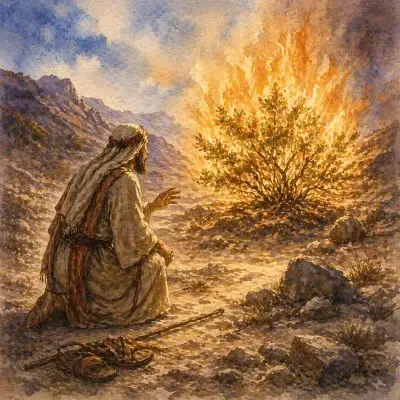
Exodus 3 is where God makes Himself known. Moses, now an exile and shepherd in the wilderness, leads his flock to Horeb—the mountain of God. There, in a bush that burns but is not consumed, the Lord reveals His holiness, His compassion, and His name.
The Burning Bush and the Name of God
Exodus 3 opens with Moses tending the flock of his father-in-law, exiled from his people.
In the 40 years since he fled Egypt, he has become a shepherd; the same occupation the sons of Israel held when they first came to Egypt, the same work the Egyptians considered an abomination.
By taking up this task, Moses stands with his people. Moreover God is using this time to prepare His servant, waiting for the exact right time to intervene.
Moses leads the flock through the wilderness and comes to Horeb, the mountain of God.
There, the angel of Yahweh appears to him in a flame of fire from the midst of a bush.
The word angel simply means “messenger,” but the passage makes it clear that this messenger is no created being.
Verse two calls Him the angel of Yahweh, but verse four says that God called to him from the midst of the bush.
The speaker identifies Himself, not as a servant, but as the God of Abraham, Isaac, and Jacob.
Moses hides his face, afraid to look upon God, because he knows who stands before him.
The same pattern has already appeared in Genesis.
The angel of Yahweh spoke to Hagar in the wilderness, yet she said, “You are the God who sees me.”
He called to Abraham from heaven on Mount Moriah, saying, “You have not withheld your son from Me,” claiming what only God can claim.
Jacob later prayed to “the angel who redeemed me from all evil,” and in the same breath called Him the God of his fathers.
In every one of these encounters, the angel speaks as God, bears the divine name, and receives the honor due only to God.
He is not a separate deity or subordinate spirit but the manifestation of Yahweh Himself.
The invisible God reveals Himself through a visible presence, speaking face to face with His servant.
The fire in the bush is the form that makes this possible.
Moses sees that the bush burns with fire, but the bush is not consumed.
The fact the fire does not need the bush for fuel shows God is self-existent and independent of creation. He doesn’t depend on anything outside Himself.
The scene prepares Moses to understand who is speaking to him and what kind of power is about to act on behalf of Israel.
When Moses goes to investigate, God calls to him from the bush, “Moses, Moses.”
Moses answers, “Here I am.” and God tells Moses to remove his sandals. This command shows that Moses has entered the presence of the living God.
It is a sign of reverence and humility.
Even in ordinary life, a person removes their shoes when entering another’s home, recognizing that they have stepped from common ground into someone else’s domain.
If that principle applies to human relationships, how much more so should Moses remove his own sandals in this situation?
Moses stands before the Creator of heaven and earth and because of that, the ground itself becomes holy.
The act reminds Moses that he cannot approach on his own terms.
He stands as a guest before the Lord of all.
Holiness demands reverence, and reverence begins with humility.
Then Yahweh speaks to Moses: “I have surely seen the affliction of My people who are in Egypt; I have heard their cry; I know their sufferings.”
These words repeat the words from the end of chapter 2.
God’s knowledge is not distant observation—it is covenant concern.
He has come down to deliver his chosen people.
The phrase “I have come down” should remind us of Genesis 11, where God came down to see the tower of Babel.
in Genesis 11, God came down in judgment; this time He comes down to redeem the oppressed and to judge Egypt’s pride.
God names the land of promise again, confirming that what He swore to Abraham is about to be fulfilled.
God’s next words turn from compassion to commission.
He says, “Come now, and I will send you to Pharaoh.”
The man who once fled Pharaoh’s wrath is now sent to face him.
Moses answers, “Who am I that I should go?”
The question sounds humble, but it also shows fear.
God does not answer by explaining Moses’ worth, but by revealing His own.
He says, “Certainly I will be with you.”
It does not matter who Moses is; what matters is who sends him.
The sign of this promise will come later, when Israel worships on this mountain.
The goal of deliverance will be worship, not freedom for its own sake.
Still Moses asks, “they will say to me, ‘What is His name?’ What shall I say to them?”
He knows the people will ask which God has sent him.
And to Moses’s question, God replies, “I AM WHO I AM.”
The Hebrew verb “to be” becomes the key to understanding who God is.
Just as the fire doesn’t need the bush to burn, God is self-existent, unchanging, and faithful.
He depends on nothing: Everything else depends on Him. He is the source of all that exists.
Then God says, “You shall say to the sons of Israel, ‘I AM has sent me to you.’”
He continues, “Yahweh, the God of your fathers, the God of Abraham, Isaac, and Jacob—this is My name forever.”
The name Yahweh means, “he is”. God is the One who was, who is, and who will be.
It is the covenant name now revealed in its full meaning.
The patriarchs knew the name, but they did not yet see what it meant.
Now the meaning of his covenant name, Yahweh, will be made known through God’s actions.
His being will be revealed through His deeds.
When He acts in judgment and redemption, Israel will understand His name.
Yahweh is the God who keeps His promises and delivers his chosen people.
God commands Moses to gather the elders of Israel.
He is to tell them that Yahweh has appeared, has seen their affliction, and will bring them out of Egypt.
The same land is named again—the land of the Canaanite, Hittite, Amorite, Perizzite, Hivite, and Jebusite.
The promise made to Abraham is unchanged.
God assures Moses that the elders will listen to him.
Together they will go to Pharaoh and ask for a three-day journey into the wilderness to sacrifice to Yahweh their God.
God then tells Moses what will happen next.
Pharaoh will not let them go except by a strong hand.
The hand is symbolic - it represents power and rule.
Pharaoh believes HIS hand controls Egypt, but God will stretch out His own hand against Pharaoh.
The plagues will show whose hand truly governs the earth.
Yahweh’s hand will break the arm of the oppressor.
Finally, God promises a complete reversal.
When Israel leaves Egypt, they will not go out empty.
Each woman will ask her neighbour for silver, gold, and clothing.
In this way, they will plunder the Egyptians.
The word plunder belongs to the language of war.
Yahweh is declaring holy war on Pharaoh and on Egypt’s gods.
The Exodus will not be an escape but a victory.
Those who were slaves will depart as conquerors, carrying the spoils of divine triumph.
Through all of this, God reveals who He is.
He is the self-existent One.
He burns without being consumed.
He is the Holy One who descends to deliver.
He is the faithful God of Abraham, Isaac, and Jacob.
He is the Lord whose mighty hand will strike Egypt and save His people.
The name “I AM WHO I AM” will find its meaning in these events.
When future generations say that Yahweh brought Israel out with a mighty hand, they will know what His name means.
He is the living God who keeps covenant, judges the proud, and redeems His own.
He acts in power because He loves His people, not because they have earned His favour, but because His faithfulness flows from His own being. And He will never forsake the promise He has made to them.