
Exodus 2
Exodus 2 begins with a simple marriage and an ordinary birth, but behind it all God is at work. Through a mother’s courage, a sister’s faithfulness, and Pharaoh’s own daughter, He raises the one who will deliver His people. What seems like coincidence is actually the quiet unfolding of God’s providence.
God Raises a Deliverer: His Hidden Providence in the Ordinary
Exodus chapter 2 begins with something very ordinary: a man from the tribe of Levi takes a wife and raises a family.
Just two ordinary people living their lives under the shadow of Pharaoh’s cruelty.
Their names aren’t even given—only their tribe.
They’re from the tribe of Levi—the tribe once marked by violence at Shechem.
Jacob’s final words over Levi were that his descendants would be scattered among Israel.
But what was spoken as judgment is already beginning to turn toward grace.
From this same house, God will raise a man who stands between Himself and His people.
Even here, God is redeeming Levi’s story and preparing the line through which His servant will come.
The woman conceives and gives birth to a son.
When she sees that the child is beautiful, she wants to keep him, so she hides him for three months.
Her act is one of courage and faith.
The king’s command is clear - but for her, the fear of God and the desire to protect her child outweighs the fear of Pharaoh.
She does everything she can to protect her son until she can’t hide him any longer.
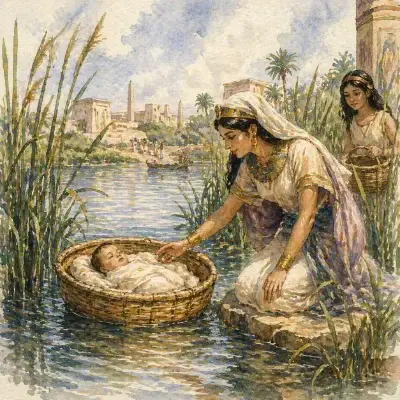
Then she makes a small ark out of papyrus reeds, sealing it with tar and pitch so it will float.
The word “ark” is the same word used back in Genesis 6 when God told Noah to build an ark.
Both arks are instruments of rescue floating on waters of death.
The same God who preserved Noah through the flood will now preserve His chosen deliverer through the Nile.
From the beginning, God is showing what it means for His hand to rest on someone.
His protection of Moses is covenant protection—the same faithfulness that kept Noah, Abraham, and Jacob.
The mother places the baby among the reeds by the riverbank and leaves him there and his sister stands at a distance to see what will happen.
Everything in this scene looks like desperation, but behind it all, God is working.
Then, by sheer coincidence, at that very moment Pharaoh’s daughter just happens to come down to the river to bathe.
She hears the baby crying and sends a servant to fetch the basket.
She opens it, sees the child, and feels compassion.
She knows he’s one of the Hebrew boys, yet she spares him.
Here we see God turning things upside down.
Pharaoh’s own daughter defies her father’s command and saves the child he ordered to be killed.
Pharaoh’s edict is thwarted by three women—the child’s mother, his sister, and Pharaoh’s daughter.
And Pharaoh’s daughter evenpays the boy’s own mother to raise him.
God takes the plans of the wicked and uses them to fulfil His own.
When the child grows older, he is brought back to Pharaoh’s daughter, and she names him Moses, saying, “Because I drew him out of the water.”
His name becomes a prophecy of his purpose.
The one drawn out of the water will later be used by God to draw out the Israelites from slavery.
The story then jumps forward about forty years: Moses is now fully grown.
Though raised in Pharaoh’s household, he still sees the suffering of his people, and he identifies as one of them.
One day he sees an Egyptian beating a Hebrew slave.
He looks around, sees no one, and kills the Egyptian, hiding his body in the sand.
It’s important to note that the Bible never calls this murder.
Moses’ action was to defend a Hebrew slave from injustice.
The book of Acts later describes Moses’ act as an act of deliverance.
He knows the risk if he’s discovered, but his actions reveal where his loyalty lies. With God’s people, not Egypt.
The next day, Moses sees two Hebrews fighting and steps in again, trying to make peace.
But the one in the wrong says, “Who made you ruler and judge over us? Are you planning to kill me like you killed the Egyptian?”
Two things are happening here.
First, Moses’ own people reject him. The man’s words show that Moses’ attempt to bring deliverance has failed.
Second, what Moses thought was hidden is now known, and his life is in danger.
Sure enough, when Pharaoh hears about it, he seeks to kill Moses, and Moses flees east to the land of Midian.
Moses is forced to run, but he’s not alone.
The God who preserved Moses as an infant goes with him and preserves him in exile.
After he escapes, Moses sits down by a well. This detail should sound familiar.
In Genesis, wells have often been places where God’s providence unfolds.
Abraham’s servant found Rebekah at a well.
Jacob met Rachel at a well.
And now Moses, the future deliverer, will find his wife at a well too.
Like Jacob, he has fled east to escape danger, and God meets him at the very place where the next part of His plan begins.
Seven daughters of the priest of Midian come to draw water, but shepherds drive them away.
Moses stands up, defends them, and draws water for their flock.
Once again, God’s providence is at work through ordinary events.
At this well in Midian, Moses finds rest, refuge, and the family through whom God will sustain him for the next forty years.
When the daughters return home, their father, Reuel, asks how they got back so quickly and they tell him an Egyptian rescued them.
Reuel tells them to invite the man, offering hospitality.
In Scripture, hospitality is the mark of faith.
Those who trust God welcome the stranger, believing that He orders every encounter.
We saw this in Genesis when Abraham received the visitors at Mamre and when Lot protected the messengers in Sodom.
So once again, in a distant land, God’s purpose unfolds through an act of faith.
Moses stays with them, marries Zipporah, and they have a son.
Moses names him Gershom, saying, “I have been a sojourner in a foreign land.”
The name captures his whole situation.
He is exiled from his people, waiting for what God will do next.
The chapter closes by returning to Egypt, many years later.
The king of Egypt dies, but nothing improves for the Israelites.
They groan under their slavery, and their cry rises to God.
This is Israel’s first prayer as a people.
Their groaning is not lost in the air; it reaches the covenant God who hears, remembers, sees, and knows.
God hears their pain, remembers His promise, sees their suffering, and knows them as His own.
Their groaning becomes the language of faith under oppression—the same word later used to describe how the Spirit intercedes for us with groanings too deep for words.
The prayers of the helpless are never wasted.
God hears and God acts.
The curtain rises on the next act of redemption, not because Israel finds its strength, but because God keeps His covenant.
Everything in Exodus 2 has been leading to this point.
The ordinary marriage, the hidden child, the irony of Pharaoh’s house, the exile in Midian—each moment shows that God’s purposes unfold even when He seems silent.
He has not forgotten His people.
He has been preparing their deliverer all along.
And through that deliverer, His faithfulness will soon be seen.