
Genesis 46
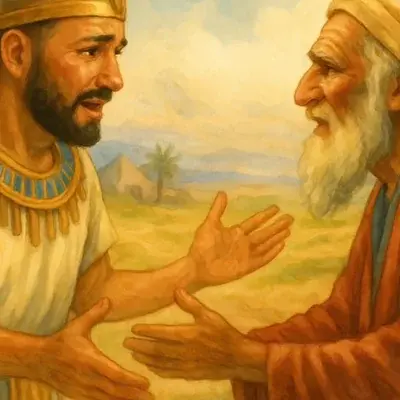
Genesis 46 shows how God leads Jacob and his family into Egypt, not as exiles cast off, but as His covenant people preserved for the promises to Abraham.
God’s plan to preserve his Covenant People in Egypt.
Genesis 46 opens with Jacob on the move. Yet before leaving the land promised to Abraham and Isaac, he pauses at Beersheba and offers sacrifices. Beersheba, at the southern edge of Canaan, had already been a place of covenant encounters for Abraham and Isaac, and now Jacob stands there as if at the threshold of the land itself.
This pause is not incidental. Jacob is about to leave Canaan behind, perhaps never to return in life, and the weight of such a step presses heavily. Egypt had always carried mixed associations in the book of Genesis. It could provide refuge in famine, but it also carried danger, temptation, and the risk of compromise. Abraham had faltered in Egypt, and Isaac had been forbidden to go there. Jacob’s hesitation is understandable.
Into that moment of sacrifice, God appears to Israel and speaks with words that anchor the entire chapter: “I am God, the God of your father. Do not be afraid to go down to Egypt, for I will make you a great nation there. I Myself will go down with you to Egypt, and I Myself will also bring you up again, and Joseph will close your eyes with his hand.” These assurances transform Jacob’s journey from a desperate migration into a divinely ordained stage of the covenant.
God Himself will accompany His people into Egypt. The promise of nationhood will be fulfilled in Egypt, just as God had declared earlier at Bethel in Genesis 35:11–12 when He named Jacob Israel and said, “I am God Almighty. Be fruitful and multiply. A nation and an assembly of nations shall come from you, and kings shall come forth from you. And the land which I gave to Abraham and Isaac, I will give it to you, and I will give the land to your seed after you.”
In both places, God speaks as God Almighty, the one who has power to bring forth nations and kings from Abraham’s line. Now at Beersheba, He reaffirms that the nation will indeed take shape, not in Canaan immediately, but in Egypt. Jacob is assured of eventual return, both through his descendants who will come back in the Exodus and through his own burial in the promised land. Even his death is enveloped in covenant care, for Joseph’s hand will close his eyes.
God is not casting His people out of the land, but directing them through Egypt for His purposes in order to accomplish what He had already sworn when He called Jacob by the name Israel.
The narrative then expands to describe the household that makes the descent. Pharaoh’s wagons, sent to carry them, are loaded with Jacob, his sons, their wives, their children, and their possessions. What might have been a brief note becomes a long genealogical record, naming each of Jacob’s sons and their children, arranged by their mothers.
At first glance, it reads like a census, but its theological weight is immense. The promise to Abraham was that his seed would multiply and become a great nation, and now the line has grown into seventy persons in all. The number is not casual. Seventy is a number that signifies fullness and completeness, marking Israel as a whole, a distinct nation in seed form, corresponding to the seventy nations of the world listed in Genesis 10 and showing that God’s promise to Abraham has reached a stage of covenant wholeness.
Verse 26 specifies that sixty-six persons came out of Jacob’s loins and travelled with him, but the reckoning rises to seventy by including Jacob himself, along with Joseph and his two sons who were already in Egypt. In other words, even those already present in Egypt are counted as part of the family’s descent. Joseph and his sons arrived first, but they are still part of the same covenant household.
The entire family is gathered, not one tribe missing, not one line extinguished. Even the note about Er and Onan, who died in Canaan, highlights this point. The ones who were evil in the sight of God are named, but not included in the seventy. The number counts only the preserved covenant seed, not those cut off in judgment.
In Genesis 42:36, when Simeon was held in Egypt and Benjamin was demanded, Jacob cried out, “You have bereaved me. Joseph is no more and Simeon is no more, and you would take Benjamin. All these things are against me.” But this list of Jacob’s children and his children’s children declares that God has preserved his household intact.
At this point, the narrative narrows from the household to the long-awaited reunion. Jacob sends Judah ahead to guide the way into Goshen, and Joseph comes to meet his father in his chariot. The encounter is brief in words, but rich in meaning.
Joseph falls on Jacob’s neck and weeps for a long time, and Jacob, who once spoke of dying in grief, now says he can die in peace because he has seen Joseph alive. For years, Jacob had lived under the shadow of loss, convinced that the covenant line had been broken by Joseph’s death. Now God has given back the son as if raised from the grave.
The one rejected and betrayed now stands as ruler over the nations, through whom life is given to his brothers. Joseph is embraced as if resurrected, once counted among the dead, yet now revealed in glory, exalted to preserve the covenant family in their hour of need. The father’s tears of grief are turned to joy, for the son thought destroyed has appeared alive and reigning, the very one through whom salvation comes to Israel.
The chapter concludes with Joseph’s instructions for how the family is to present themselves to Pharaoh. They are to declare their trade as shepherds, knowing Egyptians despise shepherding as an abomination.
This cultural note is more than a curiosity. It is a window into how God will protect His people. In Egyptian society, herding animals was considered lowly and was often relegated to foreigners. Egypt’s wealth and identity were rooted in the Nile and in settled farming, not in pastoral wandering.
Because of this, Egyptians benefited from livestock, but despised those who kept them. In effect, it worked like a caste distinction. The animals were valued, but the shepherds were scorned.
This disdain, however, is precisely what secures Israel’s distinctness. Pharaoh, in royal generosity, calls Goshen the best of the land, rich in pasture at the eastern edge of the Nile Delta. From one perspective, it is marginal land removed from Egypt’s religious and political centre. From another, it is fertile and ideal for herds.
The irony is striking. Israel receives the best land in Egypt precisely because their occupation is despised. To Egyptians, shepherding was an abomination, but to Israel it was their calling, and God turns that tension into preservation.
Goshen gives them abundance without assimilation. They will grow into a great nation, separate yet thriving, under God’s protection.
Genesis 46 therefore unfolds as a carefully structured narrative in four movements. God reassures Jacob at Beersheba that Egypt will be the place of multiplication and that His presence will not depart. The genealogy demonstrates that this promise is already underway, with the seed gathered into a complete household of seventy.
Even those who had already gone before, Joseph and his sons, are counted, because God’s preservation extends to the whole family together. The reunion between Joseph and Jacob displays God’s providence in giving back the son as if from the dead, restoring life where there had been grief and separation.
Finally, the arrangement in Goshen shows how God works even through cultural disdain to protect His people, giving them the best of the land while keeping them distinct. What looked like exile is revealed to be preservation, and what the Egyptians considered shame is turned by God into blessing.
The God who went down with Jacob will one day bring his descendants up again, for His covenant promises cannot fail.