
Exodus 13
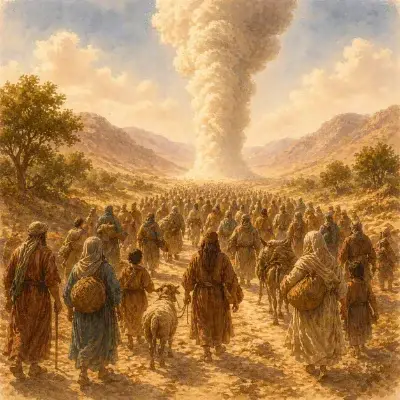
Exodus 13 explains what follows the night of the Passover. Those spared by the blood of the lamb now belong to Yahweh. In this chapter, Yahweh claims Israel’s firstborn because they lived when judgment fell on Egypt. What He redeemed, He now owns. The redemption of the firstborn, the Feast of Unleavened Bread, and the instruction of children all flow directly from the Passover and are meant to preserve the exodus as a lived reality for every generation. Exodus 13 also shows how Yahweh leads His redeemed people. He does not take them by the shortest route, but by the way of the wilderness, going before them in a pillar of cloud by day and a pillar of fire by night. Yahweh Himself goes before the host of Israel.
Exodus 13 Explained: The Firstborn Belong to Yahweh and the Pillar of Cloud and Fire
Exodus 13 follows immediately from the night of the Passover. Yahweh speaks to Moses and declares what that night means for Israel’s life from this point on.
Yahweh commands that every firstborn among the sons of Israel be sanctified to Him, both of man and beast.
It’s important to note this command does not apply to every child. It applies to the firstborn, the very ones who were spared on the night Yahweh struck Egypt.
They belong to Him because they lived when the destroyer passed through the land.
They did not perish because of the lamb that died in their place.
This command mirrors the final plague exactly.
In Egypt, every firstborn died. In Israel, every firstborn lived because Yahweh passed over their houses.
Yahweh now claims what He spared.
The chapter later makes this connection explicit in verse 15: When Pharaoh hardened his heart with stiffness about letting us go, Yahweh killed every firstborn in the land of Egypt.
The consecration of Israel’s firstborn is the direct result of that night.
Moses then speaks to the people and commands them to remember the day they came out from Egypt.
He speaks while they are still in the land, on the very day they are going out.
The exodus is spoken of as accomplished while they are still departing.
Moses institutes the Feast of Unleavened Bread as a permanent memorial.
For seven days they are to eat unleavened bread, and the seventh day is to be a feast to Yahweh.
Nothing leavened is to be eaten, and nothing leavened is even to be seen anywhere within their borders.
The removal of leaven is total. It marks a decisive break from Egypt. What belonged to their life of slavery is not carried forward into the life Yahweh is giving them.
Moses explains why this feast must be kept. When a son asks what this service means, the father is to answer, “It is because of what Yahweh did for me when I came out of Egypt.”
Redemption is not treated as distant history.
Each generation must speak of the exodus as if it happened to them personally.
Yahweh then explains the meaning of this remembrance using symbolic language. It will be as a sign on the hand and as a memorial between the eyes, so that the law of Yahweh may be in their mouth.
The hand symbolises action. What Israel does is to be shaped by Yahweh’s deliverance.
The space between the eyes symbolises constant remembrance. What Israel considers and meditates on is to be governed by what Yahweh has done.
The mouth shows that this deliverance is to be spoken and passed on.
Yahweh’s act of salvation is to shape obedience, understanding, and instruction together.
The chapter then returns to the command concerning the firstborn, this time with fuller explanation and with an explicit look ahead to life in the land Yahweh has sworn to give.
The opening command follows immediately after the Passover night.
Verses 11–16 explain how that principle will be practiced once Israel has entered the promised land.
Yahweh speaks of the land with certainty. He does not say IF He will bring them there, but when.
Every firstborn belongs to Yahweh. The firstborn of clean animals are to be sacrificed.
The firstborn of unclean animals, such as the donkey, cannot be offered directly.
They must be redeemed with a lamb or destroyed. Life continues only through substitution.
The donkey lives because another dies in its place.
The same logic applies to Israel’s sons. Every firstborn son must be redeemed.
Like the unclean animal, he belongs to Yahweh but cannot be given up in death.
His life is preserved through redemption. This draws the meaning of the Passover forward into Israel’s daily life.
The lamb that spared Israel’s firstborn on one night establishes an ongoing pattern. Life before Yahweh is sustained only through substitution.
This command is also tied directly to instruction. When a son asks what this means, the father is to recount the same story told in connection with the Feast of Unleavened Bread.
Pharaoh hardened his heart. Yahweh struck Egypt’s firstborn. Yahweh brought Israel out with a strong hand.
Therefore Israel sacrifices the firstborn of animals and redeems the firstborn of sons. Both ordinances are memorials of the same act of deliverance. Both are preserved through teaching.
The language of a sign on the hand and a memorial between the eyes is repeated. The repetition reinforces the point.
Yahweh’s deliverance is to shape how Israel lives and thinks, and it must be kept before them continually.
Because Israel is prone to forget, Yahweh ties remembrance to daily life and to the instruction of children.
The chapter then moves from these instructions to their imminent departure.
When Pharaoh finally lets the people go, Yahweh does not lead them by the direct route through the land of the Philistines, even though it is near.
He leads them by the way of the wilderness toward the Red Sea. Yahweh explains His reason.
If the people face war too soon, they may turn back to Egypt. This is not delay or miscalculation. It is mercy.
Yahweh knows His people and guides them accordingly.
Israel does not leave as a fleeing mob. They go up from Egypt in battle array. The language echoes the description of Israel leaving as hosts at the end of Exodus 12.
Yahweh sees His people as an ordered company under His command. They may not yet feel like an army, but Yahweh is already forming them as His people.
Moses then takes the bones of Joseph with him. Joseph had made the sons of Israel swear that they would carry his bones up when Yahweh visited them.
This act ties the exodus to the promises Yahweh made in Genesis.
Joseph trusted that Yahweh would surely visit His people, and now THAT certainty governs Israel’s departure.
The generation that leaves carries his bones with them and honours the oath their fathers swore to Joseph.
As Israel journeys from Succoth to Etham, verse 21 tells us Yahweh goes before them in a pillar of cloud by day, and a pillar of fire by night.
It is Yahweh Himself who goes before them. The pillar gives direction, light, and protection and it is with them constantly. It never leaves them.
From the moment Israel leaves Egypt, they are not only redeemed. They are continually led by Yahweh’s presence.
Exodus 13 shows that the exodus is not only rescue from slavery.
Those spared by the blood now belong to Yahweh. Their lives are ordered by obedience.
Their story is preserved through instruction. Their path is directed by Yahweh Himself.
Deliverance is not the end of the story. It begins a life that belongs entirely to Yahweh.