
Ruth 4
Ruth 4 brings the book of Ruth to its conclusion. Ruth has come out of Moab, been fed in Bethlehem, and sought rest through the redeemer. Now Boaz acts publicly at the gate to redeem Ruth and Naomi, receiving Ruth the Moabitess, preserving the name of the dead, and bearing the cost that the nearer redeemer refused. But the chapter reaches beyond Boaz’s hesed and legal act: we see a deeper level of redemption as Yahweh gives conception, restores Naomi’s emptiness, and carries the line forward to David.
Ruth 4 Explained: The Redeemer Acts
Ruth 4 completes the movement that has been building from the beginning of the book. Ruth 1 traced Ruth’s exodus from Moab to Yahweh. Ruth 2 brought her into the fields of Bethlehem, where Yahweh fed her through His law, her labour, and Boaz’s kindness. Ruth 3 showed Naomi seeking rest for Ruth through the redeemer. Ruth 4 now shows the redeemer acting to save Naomi and Ruth and preserve the name of the dead.
The request for redemption was made at night on the threshing floor, but redemption itself must be settled in public. Therefore Boaz must go to the gate of Bethlehem, the place where legal matters were handled before witnesses. He does not take Ruth privately and bypass what must be settled in public. He brings the matter into the light, before the nearer redeemer, the elders, and the people.
Boaz first speaks about the land belonging to Naomi. Elimelech’s household has not only lost husbands and sons. The family inheritance is also in danger. In Israel, land was tied to family, name, and future. If the land passed away and no son was raised up for the dead, Elimelech’s house would disappear from Israel.
At first, the nearer redeemer is willing. If the matter is only land, he says, “I will redeem it.” But Boaz then names the full cost. The day the man buys the field, he also acquires Ruth the Moabitess, the widow of the dead, in order to raise up the name of the dead on his inheritance.
That little detail changes everything. Redemption is not only the buying of land. It is the costly preservation of another man’s name. Therefore the nearer redeemer says, “I cannot redeem it for myself, lest I ruin my own inheritance.”
Any son born to Ruth would be raised up for the name of the dead. That son would be counted as belonging to Mahlon’s line and would inherit the land the redeemer had paid to recover.
Redemption is now too costly for him. He was willing when the land appeared to strengthen his inheritance, but he steps back the moment he sees the true cost involved.
Boaz names Ruth carefully: Ruth the Moabitess, the widow of the dead. Her Moabite ancestry is not hidden at the moment of redemption. The story has kept calling her the Moabitess because Yahweh’s mercy is reaching a woman from outside Israel, from a people once marked by hostility to Yahweh’s people.
Boaz is willing to bear the shame attached to her name. He does not redeem an Israelite widow. He receives Ruth the Moabitess, names her publicly before the elders, and takes her as his wife. Ruth is brought openly into Israel through the redeemer’s hesed.
There is also a striking irony here. The nearer redeemer refuses to preserve the name of the dead, and the book leaves him unnamed. Boaz acts to preserve another man’s name, and Yahweh honours his name. The people pray that Boaz would be renowned in Bethlehem, and the genealogy at the end places him in the line of David.
The sandal custom may sound strange, and verse 7 shows that it was already an old custom when Ruth was written. The story pauses to explain it because the sandal makes the transfer public and binding. This was the sign used in former times concerning redemption and exchange. The nearer redeemer removes his sandal and gives up his right before the elders and the people.
A sandal fits the matter at hand because the issue is land, and inheritance. Yahweh told Abraham to walk through the land He would give him. Joshua was told that every place the sole of Israel’s foot touched had been given to them. The sandal is what touches the land. So the man who gives up the sandal gives up his claim, and Boaz receives the right to redeem.
The scene also recalls Deuteronomy 25, where the sandal is removed from a man who refuses to raise up the name of the dead. Ruth 4 is not exactly the same case, because the nearer redeemer is not Mahlon’s brother, and Ruth does not shame him by spitting in his face. But the same themes are present: a widow, the elders at the gate, refusal, a dead man’s name, and a removed sandal.
Boaz then declares what he has done. He has bought from Naomi all that belonged to Elimelech, Chilion, and Mahlon. He also takes Ruth the Moabitess, the widow of Mahlon, as his wife, to raise up the name of the dead on his inheritance, “that the name of the dead may not be cut off from his brothers and from the gate of his native place.”
This is the legal centre of the chapter. Boaz’s hesed now takes legal form. He preserves the land, receives Ruth, protects the name of the dead, and gives Naomi’s house a future.
The witnesses answer with blessing. They pray that Yahweh would make Ruth like Rachel and Leah, “who together built the house of Israel.” Ruth is still the woman from Moab, yet the people bless her by naming the mothers of Israel. The outsider has been brought so fully into the covenant people that the elders pray Yahweh would build through her as He built through the women of Jacob’s house.
They also pray that Boaz would act worthily in Ephrathah and be renowned in Bethlehem. Boaz has acted for the sake of another man’s name, and the people pray that his own name would be honoured. That prayer is answered beyond anything they could have seen. Boaz’s name is remembered not only in Bethlehem, but in the genealogy that leads to David.
Then they mention Perez, whom Tamar bore to Judah. The line of Judah had already been preserved through an unusual and difficult story involving Tamar, Judah, offspring, and the continuation of a family line. The elders now pray that Boaz’s house would be like the house of Perez. Yahweh has preserved this line before, and He is doing it again through Ruth.
The legal centre reveals the hesed of Boaz, but verse 13 reveals the greater hesed of Yahweh. Boaz can redeem at the gate. He can marry Ruth. He can preserve the name of the dead. But Boaz cannot give life. The chapter turns when we are told, “And Yahweh gave her conception, and she gave birth to a son.”
This is especially striking because Ruth had been married in Moab for about ten years and had no child. In Moab there was marriage without offspring, followed by death. In Bethlehem, through the redeemer, Yahweh gives conception. Boaz acts, but Yahweh gives life.
Yahweh’s covenant name appears four times in this chapter. In verse 11, the witnesses pray that Yahweh would make Ruth like Rachel and Leah. In verse 12, they speak of offspring which Yahweh will give through this young woman. In verse 13, Yahweh gives conception. In verse 14, the women bless Yahweh because He has not left Naomi without a redeemer. The witnesses ask Yahweh to give offspring, the narrator says Yahweh gives conception, and the women bless Yahweh for not leaving Naomi without a redeemer.
This shows the difference between the hesed of Ruth and Boaz, and the hesed of Yahweh. Ruth’s hesed is real. Boaz’s hesed is real. Ruth can cling to Naomi, labour for her, and seek the redeemer. Boaz can protect Ruth, redeem the land, marry her, and preserve the name of the dead. But only Yahweh can give life. His covenant kindness covers the entire story.
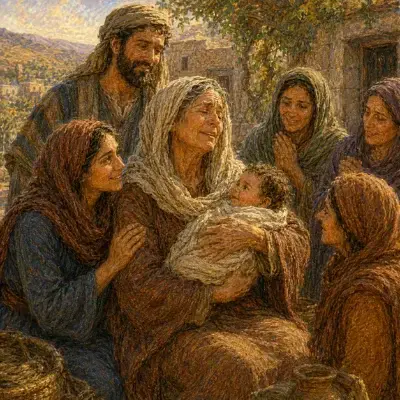
After the birth, the focus turns back to Naomi. That may seem surprising because Ruth has borne the child. But the book began with Naomi emptied by famine, death, and loss. Now the women of Bethlehem speak to Naomi: “Blessed be Yahweh, who has not left you this day without a redeemer.”
This scene answers Ruth chapter 1. When Naomi returned to Bethlehem, the women asked, “Is this Naomi?” She told them not to call her Naomi, but Mara, because the Almighty had dealt very bitterly with her. She said, “I went out full, but Yahweh has brought me back empty.” Now the women speak again, and their words have changed. Naomi is no longer only the woman who came back empty. Yahweh has not left her without a redeemer.
The child is called a restorer of life and a sustainer of Naomi’s old age. Ruth bore him, but Naomi receives him into her arms. This shows that the child also answers Naomi’s emptiness. The house that seemed finished now has life. The name that seemed cut off now continues.
Then the women say something extraordinary about Ruth: “For your daughter-in-law, who loves you, who is better to you than seven sons, has given birth to him.”
In a world where sons represented strength, inheritance, and family future, the statement is immense. Ruth, the foreign widow, has become Yahweh’s instrument of fullness to Naomi. The woman Naomi once tried to send back to Moab has become better to her than the fullest household of sons.
The women name the child Obed. He becomes the father of Jesse, the father of David. At that point, the book reveals the full reach of Yahweh’s work. Ruth was never only about one widow’s grief, one foreign woman’s loyalty, or one man’s righteousness. It was about Yahweh preserving the line of the king.
The final genealogy is not an appendix. It is the final revelation of the book’s purpose. Ruth began “in the days when the judges judged,” in the world where Israel had no king and everyone did what was right in his own eyes. Ruth ends with David. In the days when Israel had no king, Yahweh was already preserving the line of the king.
Ruth 4 completes the movement from exodus, to food, to rest, to redemption. Boaz acts as redeemer at the gate, but Yahweh acts more deeply by giving life and carrying the story to David. Boaz’s hesed is costly, public, and directed toward preserving another man’s name. Yahweh’s hesed stands over the whole story: He gives conception, restores Naomi, brings Ruth fully into Israel’s story, and continues the line of the promised king. The book ends with David, because Yahweh was working through all of it to bring His king.