
Exodus 14
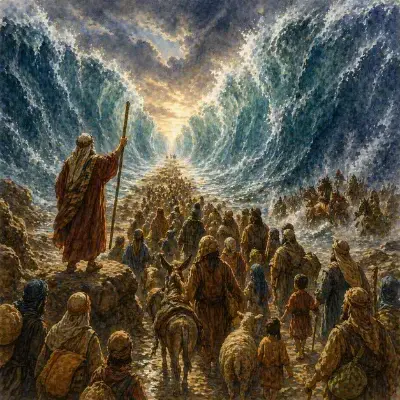
Exodus 14 records Yahweh’s decisive act of deliverance as He brings Israel through the waters of the Red Sea by His mighty hand. At the beginning of the chapter, the sons of Israel lift up their eyes and see Pharaoh’s army approaching, and fear overwhelms them. By the end of the chapter, they lift up their eyes again, see the great hand of Yahweh, and fear Him. Between those two moments stands a deliverance accomplished entirely by Yahweh, while Israel contributes nothing but fear and complaint. This chapter shows Yahweh deliberately positioning His people where escape is impossible, hardening Pharaoh’s heart, and drawing Egypt into judgment so that His name may be known. Israel’s cries quickly turn into accusation, exposing unbelief, while Moses removes them from the action altogether and declares that Yahweh Himself will fight for them.
Exodus 14 Explained: From Fear of Pharaoh to Fear of Yahweh
In Exodus 14 Yahweh delivers Israel through the waters of the Red Sea by His mighty hand.
At the beginning of the chapter, the sons of Israel lift up their eyes and see Pharaoh’s army, and fear overwhelms them. But by the end of the chapter, they see the great hand of Yahweh, and fear Him.
Between those two events, Yahweh delivers His people, while Israel contributes nothing but fear and complaint.
Yahweh begins by speaking to Moses and directing Israel with deliberate precision.
They are not to press forward, but to turn back and camp by the sea, in a position that apparently leaves them trapped between the wilderness, the water, and Egypt.
This is not poor navigation on Yahweh’s part, and it is not hesitation.
Yahweh states in advance what Pharaoh will conclude, that Israel is wandering in confusion and shut in by the land.
Yahweh declares that He will harden Pharaoh’s heart so that he will pursue them.
Moreover, He will be glorified through Pharaoh and all his army, and the Egyptians will know that He is Yahweh.
Israel does exactly as Yahweh commands.
When Pharaoh is told that the people have fled, his heart and the hearts of his servants change.
Their regret is immediate: They have lost their slaves, and they move to recover them.
Pharaoh prepares his chariots and takes six hundred choice chariots, along with all the chariots of Egypt, each with its officer.
This is the full force of Egypt’s military power bearing down on a defenceless people.
Yahweh hardens Pharaoh’s heart with strength, just as he said he would do.
Pharaoh pursues Israel as they go out with an exalted hand, free, but not yet secure.
When the Egyptians overtake Israel by the sea, the sons of Israel lift up their eyes and see the army of Egypt bearing down on them.
The wording is deliberate and recalls other parts of Genesis, where people lift their eyes.
For example, in Genesis 22, Abraham lifted up his eyes in obedience to Yahweh’s word and saw Yahweh’s provision of the Ram caught in the thicket.
In contrast with Abraham, Israel lift their eyes, but instead of faith, there is fear and doubt.
Israel sees Pharaoh’s army marching after them, and they become very afraid.
They cry out to Yahweh.
Almost immediately, their fear turns into accusation.
They speak against Moses and reject the very deliverance Yahweh had promised them.
They claim it would have been better to serve the Egyptians than to die in the wilderness.
Their eyes register the threat before them, but their hearts do not yet trust Yahweh’s word.
Moses answers the people with words that remove them from the action altogether.
He commands them not to fear.
He tells them to stand firm and see the salvation of Yahweh which He will accomplish for them that day.
The Egyptians they see now, they will never see again.
Yahweh will fight for them.
They are to keep silent. That command to silence stands in sharp contrast with earlier Scripture.
In Genesis 22, Isaac submitted without protest as Yahweh’s purpose unfolded, and his silence signified trust and obedience.
Here, silence must be commanded, because Israel’s words have already exposed their unbelief.
They must be still and let Yahweh fight for them.
When Moses tells them to be silent, he is commanding trust and obedience.
They need do nothing but quietly wait on Yahweh to deliver them.
Moses himself does not act independently. He cries out to Yahweh, and Yahweh answers by telling him what to do.
Moses is to tell the people to go forward.
He is to raise his staff and stretch out his hand over the sea.
Moses acts only at Yahweh’s word.
He is an instrument, not the source of deliverance.
Yahweh again declares what He will do.
He will harden the hearts of the Egyptians so that they will follow Israel into the sea.
He will be glorified through Pharaoh, his chariots, and his horsemen.
The same path through the sea will be salvation for Israel and judgment for Egypt.
Before the sea is divided, Yahweh places Himself between Israel and Egypt.
The angel of God and the pillar of cloud move from before the camp of Israel to behind them.
The same presence gives light to Israel and darkness to Egypt.
All night long, the two camps do not come near one another.
Yahweh stands where His people would otherwise be exposed.
At Yahweh’s command, Moses stretches out his hand over the sea.
Yahweh drives the sea back by a strong east wind all night.
He makes the sea into dry ground.
The waters are split.
Israel walks through the midst of the sea on dry land.
The waters stand as walls on their right and on their left.
Dry land emerges where there was none.
Yahweh makes a way that only He can make.
The Egyptians pursue.
Pharaoh’s horses, chariots, and horsemen enter the sea after them.
At the morning watch, Yahweh looks down on the camp of the Egyptians through the pillar of fire and cloud.
He throws their camp into confusion.
He causes their chariot wheels to swerve.
He makes them drive with difficulty.
Only then do the Egyptians speak truly.
They recognise that Yahweh is fighting for Israel against Egypt.
The recognition comes too late.
Yahweh commands Moses to stretch out his hand once more.
As the Egyptians flee, the sea returns to its normal state.
Yahweh overthrows the Egyptians in the midst of the sea.
The waters cover the chariots and the horsemen.
Pharaoh’s entire army that entered the sea after Israel is destroyed.
Not one of them remains.
Yahweh saves Israel that day from the hand of the Egyptians and Israel sees the Egyptians dead on the seashore.
Israel sees the great hand which Yahweh used against Egypt and their fear is redirected.
They no longer fear Pharaoh.
They fear Yahweh.
They believe in Yahweh and in His servant Moses.
Exodus 14 shows that Israel is delivered not because of faith, but in the presence of unbelief.
Before the sea, they see Egypt and despair.
After the sea, they see Yahweh and believe.
The deliverance is Yahweh’s work from beginning to end.
He sets the situation, commands His servant, restrains the enemy, parts the sea, and brings judgment.
Israel is delivered while helpless and afraid, and Yahweh alone receives the glory.