
Ruth 1
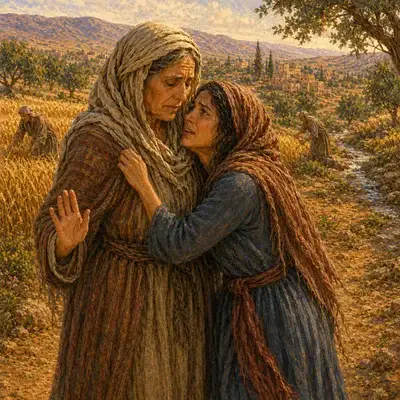
In the days when Israel had no king and everyone did what was right in his own eyes, Ruth 1 begins with famine, death, and exile in Moab. It looks like a story of tragic loss and grief, but beneath the surface, Yahweh is drawing a Moabite woman out of her land, away from her people and their gods, and bringing her under His covenant name. Ruth is not brought out of Egypt like Israel was. But her movement follows the same covenant pattern: she leaves a land of false gods, binds herself to Yahweh’s people, confesses Yahweh’s name, and enters the land of promise.
Ruth 1 Explained: Ruth’s Exodus from Moab to Yahweh
The book of Ruth begins with famine in Bethlehem. The word Bethlehem means “house of bread,” but in the midst of famine there is no bread. Back in Exodus, Yahweh promised to bring His people into a land flowing with milk and honey, but the opening scene shows hunger in the land of promise. This famine is not random hardship. It happens “in the days when the judges judged,” and that single line brings the sin, violence, idolatry, and disorder of Judges into the story.
Yahweh had warned Israel that this would happen if they turned from Him. In Deuteronomy, He told them that covenant unfaithfulness would bring hunger, drought, and barrenness upon the land. If Israel would not listen to His voice, the heavens over them would become bronze and the earth beneath them iron. So famine in Bethlehem is not random suffering. The empty fields testify against Israel’s covenant unfaithfulness. Yahweh had promised blessing for obedience and curse for rebellion, and the house of bread now has no bread.
The book of Judges records a repeating spiral. Israel turns from Yahweh to other gods, falls under enemy oppression, cries out, receives deliverance, then returns again to the same sins. As the book goes on, the cycle grows worse. The judges grow more flawed, and the people grow more hardened. By the end, the land is filled with violence, all kinds of wickedness, civil war, and spiritual blindness. Judges closes with the verdict: “In those days there was no king in Israel; everyone did what was right in his own eyes.” Ruth opens in exactly that world. Israel has been living as though Yahweh were not King, and the land itself is feeling the curse Yahweh had warned them about.
The book of Ruth moves from Israel’s national failure to one household in Bethlehem. A man named Elimelech leaves Bethlehem in Judah with his wife Naomi and their sons Mahlon and Chilion. Elimelech means “My God is King.” In a time when Israel lived as though there were no king, this man’s name confesses Yahweh’s kingship, yet he walks away from the land of covenant blessing into Moab.
The text does not open Elimelech’s heart to us, but it shows the direction of his feet. He is not just changing geography. He is stepping outside the land Yahweh gave to His people, the land where Yahweh had promised to bless them if they listened to His voice. The man whose name confesses Yahweh as King walks away from the land of his God and King.
Moab was not neutral territory. The Moabites came from Lot’s line, through the incest recorded after the destruction of Sodom. They refused Israel bread and water on the way to the Promised Land and hired Balaam the diviner to curse them. In Deuteronomy 23:3, Yahweh says that no Moabite may enter the assembly of Yahweh, even to the tenth generation. This was not because foreign blood was impossible to redeem. It was because Moab had set itself against Yahweh, His people, and His promise. For an Israelite family, Moab was a place of old hostility, false worship, and covenant danger.
Elimelech settles in Moab. His sons are Mahlon and Chilion, names which mean sickness and destruction - so probably not their real names. The story does not dwell on that, but the names fit the way the chapter moves from hunger to death. Life is fading from this household. Elimelech dies first, and Naomi is left with her two sons.
Then Mahlon and Chilion marry women from Moab. Their names are Orpah and Ruth. Their Moabite identity now carries the weight of everything Deuteronomy had said. Yahweh had excluded Moab from the assembly of His people, and this family has now become joined through marriage to a people who worship false gods. Later Naomi will say that Orpah has returned to her people and her gods, showing that the issue is not ethnicity by itself, but allegiance: whom they belong to and which god they serve.
Ten years pass. Elimelech’s family has not simply waited out the famine and returned home. What began as sojourning has become settled life, and the family has put down roots outside the land of promise. Then Mahlon and Chilion also die. Naomi is left childless, widowed, and without any visible hope. What began as escape from famine has become a graveyard. But the deaths also tear her roots out of Moab. The land that seemed to offer survival becomes the place of graves, and Naomi is left with no future there.
In the midst of this tragedy, the first sign of mercy comes in verse 6. Naomi hears in Moab that “Yahweh had visited His people and given them food.” This is the first time the covenant name Yahweh appears in the book. That wording takes us back to the Exodus, when Yahweh visited His people in Egypt and began their deliverance. Yahweh has not abandoned His people. He acts first.
Naomi’s return begins because Yahweh has already acted for His people by giving them food. She hears that Yahweh has visited His people, and that news draws her back toward Bethlehem. The story moved from Bethlehem to Moab because there was famine. Now it begins moving from Moab back to Bethlehem because Yahweh has given food.
The word “return” now carries the chapter forward. Naomi returns from Moab. Orpah returns to Moab. Ruth refuses to return from following Naomi. Naomi is moving back toward the land. Orpah will move back toward her people and gods. Ruth will leave Moab behind and bind herself to Yahweh.
As Naomi begins the journey, she urges her daughters-in-law to return to their mothers’ houses. She prays, “May Yahweh show lovingkindness with you as you have shown with the dead and with me. May Yahweh grant that you may find rest, each in the house of her husband.” Naomi is sending them back because she sees no future for them with her: no more sons, no security, no rest.
We should pause here to consider what many English translations call “lovingkindness.” The Hebrew word is hesed. This word is far richer than ordinary kindness. Exodus 34 uses this word when Yahweh declares His own name to Moses: “Yahweh, Yahweh God, compassionate and gracious, slow to anger, and abounding in lovingkindness and truth; who keeps lovingkindness for thousands.” Before hesed describes Ruth or Orpah, it describes Yahweh Himself. It is covenant love in action: loyal kindness, steadfast mercy, and faithful love shown because Yahweh keeps His word and binds Himself to His people.
Naomi is asking Yahweh to deal with Ruth and Orpah according to His own covenant character. They have shown hesed to the dead and to her through faithful care in a house marked by grief. Naomi now prays that Yahweh would show that same covenant kindness to them.
The word hesed also exposes the contrast between Ruth and Moab. Deuteronomy says Moab failed to meet Israel with bread and water when Israel came out of Egypt. Moab withheld kindness from Yahweh’s people and sought their curse. Ruth, even though she is a Moabitess, has shown hesed to Naomi and the dead. She comes from Moab, but she does not act like Moab.
Naomi asks Yahweh to show hesed to Ruth, while Ruth herself is already becoming Yahweh’s gift of hesed to Naomi. Naomi cannot yet see it, but the woman beside her is part of the answer to her own prayer. The word begins here because covenant kindness will come up again and again as the story progresses.
Naomi continues pressing them to turn back. She asks whether she still has sons in her womb. She says she is too old to have a husband. Even if she could bear sons that very night, Ruth and Orpah could not wait until they were grown. Naomi looks at her own life and sees no way for anyone to be restored through her.
Then she says, “No, my daughters; for it is more bitter for me than for you, for the hand of Yahweh has gone forth against me.” Naomi names Yahweh again. Her grief is honest, and she names Yahweh - the Covenant God - as the One whose hand is over her life. She does not think her suffering is random. She interprets her bitterness under Yahweh’s hand.
Naomi has not stopped believing in Yahweh, but grief has blinded her. She still speaks His covenant name. She still prays for His kindness. She still believes He gives rest. She still believes He rules over her life. But she can see Yahweh’s hand in her suffering, while she cannot see Yahweh’s kindness in the woman standing beside her.
Orpah kisses Naomi and returns to Moab, but Ruth clings to her. Naomi presses her again: “Your sister-in-law has gone back to her people and her gods. Go after her.” The choice for Ruth is now clear: return to Moab and its gods, or bind herself to Yahweh’s people.
Everything turns on Ruth’s answer:
“Do not plead with me to forsake you, to turn back from following you; for where you go I will go, and where you lodge I will lodge. Your people shall be my people, and your God my God. Where you die I will die, and there I will be buried. Thus may Yahweh do to me, and worse, if anything but death separates you and me.”
Ruth is speaking in the language of covenant belonging. She names a people, a God, a land, a death, a burial, and seals it with an oath in Yahweh’s name. She is not simply expressing affection for Naomi. She is saying that she now belongs with Naomi’s people and Naomi’s God.
Just as Yahweh once said to Israel, “I will take you for My people, and I will be your God” in Exodus 6:7, Ruth now speaks that same pattern as a Moabite woman being brought in. She will leave her people, her gods, and her land to follow Yahweh.
Ruth does not cease to be called a Moabitess. The story keeps calling her a Moabitess because her origin displays the reach of Yahweh’s mercy. But covenantally, she has left Moab and the false gods of Moab behind. Naomi says Orpah has returned to her people and her gods, and Ruth refuses that road. Her ancestry remains Moabite, but her allegiance is now with Yahweh and His people.
The whole chapter bends around this moment. It begins with famine, departure, Moab, and graves. At the centre, Ruth confesses Yahweh. From there, the movement turns back toward Bethlehem.
Ruth’s confession and oath stand at the centre of the chapter. In the middle of famine, death, and return, Yahweh is drawing a Moabite widow to Himself. Moab once withheld kindness and sought Israel’s curse. Ruth, though a Moabitess, shows hesed and binds herself to Yahweh.
Naomi sees that Ruth is determined and stops urging her. They arrive in Bethlehem. The town is stirred: “Is this Naomi?” She replies, “Do not call me Naomi; call me Mara, for the Almighty has dealt very bitterly with me. I went out full, but Yahweh has brought me back empty.”
Naomi means pleasant. Mara means bitter. She is no longer only describing what has happened to her. She is naming herself by her grief.
Naomi still speaks as a woman who knows Yahweh rules. She names Yahweh the Almighty. She knows God rules over loss and return. But her interpretation is incomplete. She left “full” of family but in a time of famine; she returns in a time of harvest, with Ruth at her side.
Naomi has truly lost her husband and sons. The grief is real. But she is not as empty as she thinks. Yahweh has brought her back with Ruth, the Moabitess who has confessed His name and bound herself to His people.
The story does not correct Naomi with words. It corrects her with presence. Naomi feels empty, but Yahweh has already placed a woman of hesed - lovingkindness - at her side, the very answer to the prayer Naomi herself prayed earlier.
The chapter closes: “So Naomi returned, and Ruth the Moabitess her daughter-in-law with her… They came to Bethlehem at the beginning of the barley harvest.”
Ruth 1 does not yet remove the bitterness. Naomi is still grieving. Ruth is still a foreign widow. But the reversal has begun. Yahweh has visited His people with bread. And, most importantly, He has drawn a Moabite woman away from death and false gods and into covenant loyalty. He is using even the losses that emptied Naomi to bring her home, with Ruth beside her, at the very moment the harvest begins.
The heart of the chapter is not Naomi’s pain or the famine, but Ruth’s allegiance to Yahweh. In a time when Israel had no king and everyone did what was right in his own eyes, a Moabite widow shows what true covenant faithfulness looks like. Yahweh is already beginning to fill what Naomi sees is empty.