
Exodus 17
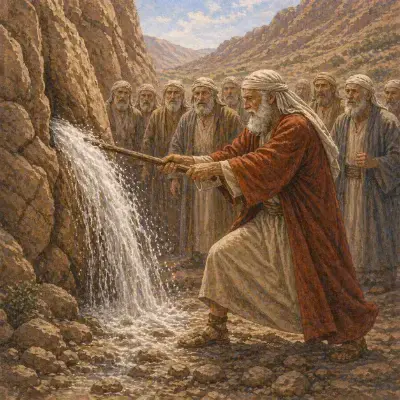
Exodus 17 brings Israel to another moment of crisis in the wilderness, this time without water at Rephidim. Though they arrive according to the command of Yahweh, the people contend with Moses and test Yahweh, asking, “Is Yahweh among us or not?” The place is named Massah and Meribah, marking Israel’s unbelief even as Yahweh stands before them on the rock and provides water. The chapter then turns to conflict with Amalek. Israel does not seek the battle, yet Yahweh gives victory in a way that cannot be mistaken for military strength or religious technique. The outcome rises and falls with the staff of God in Moses’ hand, not because the staff has power, but because Yahweh is teaching Israel that victory comes from Him alone.
Exodus 17 Explained: Is Yahweh Among Us? Water from the Rock and Victory over Amalek
Exodus 17 continues the wilderness journey by repeating what is now becoming a familiar pattern. Once again Israel arrives at a place of need, and once again that place is reached “according to the command of Yahweh.” It’s clear from the outset that the lack of water at Rephidim is not an accident. They have not taken a wrong turn in the wilderness. This is part of Yahweh’s deliberate leading of His redeemed people.
The chapter sharpens the description of Israel’s response by saying that “the people contended with Moses,” language stronger than grumbling and suggestive of open confrontation rather than complaint, and Moses immediately exposes the deeper reality by asking, “Why do you contend with me? Why do you test Yahweh?” As before, the issue is not Moses’ leadership but Israel’s refusal to trust the God who brought them out of Egypt and continues to guide them.
Their words show how their unbelief escalates here, because they now accuse Moses of bringing them out of Egypt to kill them, their children, and their livestock with thirst, framing their charge as though Moses were responsible for their deaths, even though they have already seen water at Marah, daily bread each morning, and quail in the previous chapter.
The crisis is more severe than before. Moses now fears for his life, saying that the people are ready to stone him, and this rising hostility explains the urgency of his response.
He cries out to Yahweh rather than addressing the people further, again doing what Israel refuses to do, which is to bring their need before God in trust rather than turning it into accusation.
Yahweh answers by directing Moses to act publicly and deliberately, taking elders as witnesses and carrying the same staff with which he struck the Nile, tying this act of provision directly to the judgments that humbled Egypt, and Yahweh declares, “Behold, I will stand before you there on the rock at Horeb,” making clear that the provision of water rests on His presence rather than on Moses’ authority or strength.
The mention of Horeb signals that Israel has reached the region of Sinai, drawing their need for water into the shadow of the mountain where Yahweh will soon reveal His law, and Moses’ striking of the rock brings forth water in the sight of the elders, leaving no doubt that life in the wilderness flows only from Yahweh’s word and action.
Yet the place is named Massah and Meribah, meaning Testing and Contending, because when the people ask, “Is Yahweh among us or not?” they expose their unbelief despite overwhelming evidence, since the pillar of cloud and fire still leads them and manna still lies on the ground each morning.
The chapter then turns abruptly to conflict with the Amalekites. Amalek comes and fights against Israel without provocation, and Israel does not seek this battle but must respond to it, showing that wilderness dependence involves not only provision for hunger and thirst, but protection from enemies they cannot avoid.
Moses appoints Joshua to lead the fighting, introducing him for the first time as the commander on the field, while Moses himself goes up the hill with the staff of God in his hand, placing the focus not on strategy or strength, but on Yahweh’s presence among His people.
Yahweh orders the battle so that its outcome cannot be explained by military strength. Israel prevails when the staff of God is raised, and Amalek prevails when it is lowered, not because the staff has power in itself, but because Yahweh is teaching Israel, in full view of the battle, that victory comes from Him alone.
When Moses’ arms grow heavy, the battle shifts, not because Yahweh is weakened, but because the lesson is being pressed home. Aaron and Hur place a stone under Moses and support his hands until sunset, so that the sign remains before the people, and Israel prevails until Joshua overwhelms Amalek with the edge of the sword.
Yahweh then commands that this event be written as a memorial and recited in Joshua’s hearing, binding Joshua’s future leadership to the certainty that Amalek stands under divine judgment, and the declaration that Yahweh will blot out the memory of Amalek lifts this battle beyond a single generation, revealing that opposition to Israel is ultimately opposition to Yahweh’s rule.
Moses responds by building an altar and naming it “Yahweh is My Banner,” declaring that Israel does not fight under its own name or strength, but under Yahweh Himself as the rallying point of their identity and victory, and the final words of the chapter place this conflict within Yahweh’s sworn purpose, that He will have war against Amalek from generation to generation.
Exodus 17 therefore brings together two closely linked truths that define Israel’s wilderness life.
Yahweh deliberately leads His people into places of need in order to test what is in their hearts, exposing whether they will trust His word or accuse His character, and Israel repeatedly fails this test by contending, accusing, and questioning His presence.
At the same time, Yahweh proves Himself faithful to provide and protect, standing before His people on the rock, giving them water in the desert, and fighting for them against their enemies, so that their survival depends not on their faithfulness to Him, but on His faithfulness to His own promises.
The chapter shows that redemption does not immediately produce trust, that testing follows deliverance, and that Yahweh remains present and powerful even when His people doubt Him, because He is teaching them that life, safety, and victory in the wilderness come only from dependence upon Him.