
Genesis 28
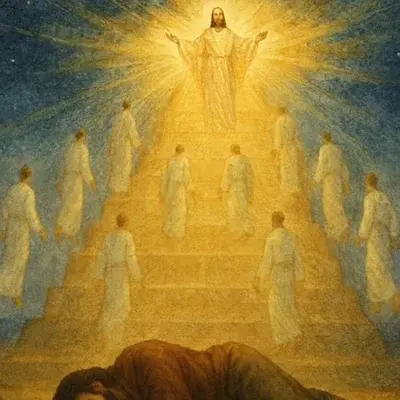
Genesis 28 marks a pivotal moment in the unfolding of Yahweh’s covenant purposes. As Jacob flees from the fallout of his deception, he is met not with judgment, but with a vision of divine grace. In a dream, he sees a stairway reaching to heaven, with angels ascending and descending, and Yahweh standing above it. Yahweh appears to Jacob and pronounces a reaffirmation of the covenant he made with Abraham—land, seed, and blessing.
Jacob’s Dream, Yahweh’s Promise.
Genesis 28 opens with Isaac blessing Jacob without disguise or deceit, his words aligning with Yahweh’s declaration before the twins were born. Unlike the deception of chapter 27, this blessing is deliberate, passing the covenant promise from Abraham to Jacob through open obedience.
With this blessing, Isaac sends Jacob to Paddan-aram to seek a wife from Laban’s family, ensuring the chosen line remains distinct, just as Abraham insisted for Isaac in Genesis 24:3–4. There are some differences. Abraham sent a servant, whereas Isaac sends Jacob himself. However, the purpose is the same: to marry within the line of faith.
Isaac’s blessing in verse 1, echoed in Esau’s observation in verse 6, forms an inclusio that frames the scene, which underscores its alignment with Yahweh’s covenant purposes. The narrative now shifts to Jacob, who becomes the sole heir of the promise, not only blessed by his father, but confirmed by Yahweh.
This chapter marks the formal passing of the covenant from one generation to the next. It is the moment Jacob steps into his role as the bearer of God’s promise. Isaac openly blesses Jacob, saying, “May God Almighty bless you and make you fruitful and multiply you, that you may become an assembly of peoples.” The language echoes Abraham’s blessing from Genesis 12:2–3, but expands on it, pointing to the multitude of descendants, including the twelve tribes, by invoking the blessing of Abraham and naming the land as Jacob’s inheritance.
Isaac confirms God’s purpose, fulfilling the divine oracle that the older shall serve the younger. Yet Jacob carries this promise as a man alone, fearful of his brother, far from home, and not yet strong in faith. What follows is not just a journey to find a wife, but the beginning of Jacob’s walk with God, shaped by the vision and promise that await him at Bethel.
Verses 6 to 9 return briefly to Esau, offering a final note of resolution before the focus shifts fully to Jacob. Esau sees that Jacob has been blessed by Isaac and sent away in obedience to find a wife, and that this pleases his parents. Wanting to be blessed himself, he takes another wife, Mahalath, the daughter of Ishmael. The attempt is flawed. He does not send away his Canaanite wives, and there is no sign that he seeks Yahweh. Still, we can see his desire now is to appease his parents, and he is seeking blessing. And that is where the story leaves Esau for now.
The focus then shifts to Jacob, now alone and on the run, but not outside the reach of God. As the sun sets, he stops to sleep in an unnamed place, laying his head on a stone. Yahweh gives Jacob a dream, a stairway set on the earth with its top reaching to heaven and the angels of God ascending and descending on it.
The image is rich with meaning. Jacob sees a connection between heaven and earth, but not one he built. This is no tower of Babel, no man-made attempt to reach up to God. This stairway is God’s doing, and its traffic flows both ways. Angels move between realms under Yahweh’s command, showing that the living God is present, active, and sovereign even here in the middle of nowhere.
Jacob is not in a temple. He is not seeking a vision. He is running for his life. God meets him where he is, not because Jacob reaches up, but because Yahweh reaches down. The covenant promise is not tied to geography, nor to something Jacob earned. It is tied to God’s word, and now that word rests on Jacob.
Yahweh appears and speaks directly: “I am Yahweh, the God of your father Abraham and the God of Isaac.” This is the first time Jacob hears Yahweh speak to him personally. The promises that follow repeat the core of the Abrahamic covenant: land, seed, and blessing.
But they go further. Jacob’s seed will spread north, south, east, and west, and in him and his seed all the families of the earth shall be blessed. This is the global horizon first revealed to Abraham in Genesis 12, now reaffirmed to the third generation.
Then comes the final word: “Behold, I am with you and will keep you wherever you go. I will not forsake you until I have done what I have promised you.” This promise, “I am with you,” is not new. Yahweh said it to Abraham (Genesis 21:22), to Isaac (Genesis 26:24), and will say it again to Moses and Joshua. It is the steady thread of His covenant, not just a promise of land or seed, but of His own presence with those He calls.
It is this assurance that will sustain Jacob, just as it sustained those before and after him. The covenant God is not just the God of Canaan. He is the God who goes with Jacob, who guards his steps, who ensures that every word He has spoken will come to pass.
When Jacob wakes, he is overwhelmed. “Surely Yahweh is in this place, and I did not know it.” The place that was nowhere now becomes Bethel, the house of God. Bethel is the same place where Abraham built an altar when he entered the land, calling on the name of Yahweh. Though Jacob is unaware, he now worships where his grandfather once did.
Jacob takes the stone he slept on, sets it up as a pillar, and anoints it with oil. These are not random acts. Jacob is responding in worship. This moment marks a shift in Jacob himself. The man who once schemed for blessing now stands in awe, overwhelmed by Yahweh’s holiness. It is the first recorded moment where Jacob expresses reverence and worship.
While his full transformation lies ahead, this scene shows the beginning of faith taking root. His vow could be misunderstood as a bargain, but the language Jacob uses here reflects trust. “If God will be with me, then Yahweh will be my God.” Jacob is not testing Yahweh’s faithfulness. He is pledging loyalty to the God who has just spoken.
The vow anticipates return. The pillar is a marker of future worship. This stone will be God’s house. The tenth he promises is not payment, but recognition that all things come from Yahweh and belong to Him.
And that is where the chapter ends. In Genesis 28, the covenant promise passes securely from father to son, confirmed by Isaac’s deliberate blessing and Yahweh’s direct revelation to Jacob.
The vision of the stairway with angels ascending and descending reveals that God is near even in Jacob’s flight and exile. At Bethel, meaning house of God, Jacob responds in awe and worship, marking the place where Yahweh speaks. His vow reflects trust in the God who promises to be with him, to guard him, and to fulfil every word spoken.
This chapter is not just a turning point for Jacob, but the affirmation of Yahweh’s unchanging purpose. The covenant rests not on human strength or merit, but on the God who speaks, keeps, and never forsakes His chosen.