
Exodus 12
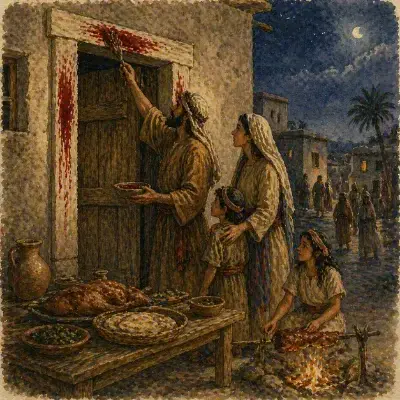
Exodus 12 records the defining night of Israel’s redemption. Yahweh strikes Egypt with final judgment, passes over the houses marked by the blood of the lamb, and brings His people out exactly as He promised. In this chapter, Yahweh establishes the Passover, reveals the meaning of substitutionary atonement, judges the gods of Egypt, and forms Israel as a redeemed people. Protection does not come through strength, worth, or heritage, but through obedience to Yahweh’s word and shelter beneath the blood He provides.
Exodus 12 Explained: Salvation Through the Blood of the Lamb
Exodus 12 opens with Yahweh speaking in the land of Egypt and declaring that this month will be the beginning of months for Israel.
The calendar changes because Yahweh’s act of deliverance will now define Israel’s life.
Instead of following the Egyptian pattern for marking months, their calendar will begin with the month of their salvation from Egypt.
This month celebrates the day Yahweh brought them out, and Israel will count their months from the moment He redeemed them.
Yahweh commands every household to take a lamb on the tenth day—a male without blemish, a year old—and keep it until the fourteenth.
For four days the lamb stays in the home and is looked after. Each family kills the lamb they have kept and cared for.
In this way Yahweh teaches them the cost of atonement through the lamb that lived with them.
When the fourteenth day arrives, the whole assembly kills their lambs at twilight.
Every household participates together.
Judgment will fall on every house in Egypt, and the protection Yahweh provides will rest on every house in Israel that obeys His word.
The redemption is applied household by household, but Yahweh binds the entire nation into one act of obedience.
Yahweh then commands them to take a bunch of hyssop, dip it in the blood, and strike the lintel and the two doorposts.
The hyssop used here to apply the blood of atonement foreshadows its role in later purification rites, for example in Leviticus 14 where it is used for cleansing from defilement, and also in Numbers 19.
The blood is placed where it can be seen and visibly marks the entrance of the home as the place where a death has already occurred.
Yahweh says the blood will be a sign for them.
It is a physical mark of obedience, not a hidden power in the blood itself.
Israel must understand that their safety does not come from themselves, their strength, or their worth.
It comes from the death of the lamb that was slain.
Israel shows faith by eating the lamb and marking their doors as Yahweh commanded.
When Yahweh sees the blood He will pass over the house and will not allow the destroyer to enter.
The destroyer will not act independently or outside the control of Yahweh.
He goes where Yahweh sends him and is stopped where Yahweh sets His limit.
The judgment sweeps through Egypt, and every house is visited.
However, every house with blood on the door is passed over because the lamb has died in place of the firstborn.
This event gives the clearest statement so far in Scripture that a life stands in the place of another.
Earlier passages point toward this pattern.
In Eden, after Adam and Eve sinned, Yahweh provided animal skins as a covering, showing that a life is taken so another may stand before Him.
However, here Yahweh establishes the idea of substitution openly.
The lamb must be roasted with fire and eaten that same night with unleavened bread and bitter herbs.
It is roasted whole and eaten as Yahweh commands, and they do not break any of its bones.
They eat bitter herbs to recall their slavery, and they eat unleavened bread because they will leave in haste.
They eat with loins girded, sandals on their feet, and staff in hand.
This manner of eating demonstrates obedience to Yahweh’s word.
They eat while prepared to leave because He has told them they are about to leave.
Yahweh announces that He will pass through Egypt and strike every firstborn, both man and beast, and that He will execute judgments against all the gods of Egypt.
Pharaoh refused to release Yahweh’s firstborn son.
Now Yahweh strikes Pharaoh’s firstborn and the firstborn of the land, exactly as He declared in Exodus 4:22–23.
Egypt had tried to destroy Israel’s sons by drowning them in the Nile.
Yahweh now brings that sin back upon them with perfect justice.
Israel once cried out under oppression.
Now Egypt cries out under judgment.
Yahweh gives them a command: They must keep this day as a memorial and remove leaven from their houses for seven days.
Removing leaven marks a break from Egypt.
The bread they eat carries no link to what they left behind.
Anyone who eats leaven during the feast is cut off, whether native or sojourner.
This command shows the seriousness of the memorial.
Israel must remember that Yahweh delivered them in haste, and they must live as a people who belong to Him rather than to Egypt.
This shows that faith and obedience belong together.
The one who believes Yahweh’s word obeys it.
Moses gives the instructions to the elders and repeats Yahweh’s warnings, including the command that no one leave the house until morning.
To disobey and leave the house is to step outside Yahweh’s protection.
Moses also instructs the fathers on how to answer their children so Yahweh’s deliverance will always be remembered.
When the next generation asks about the Passover, they must say that Yahweh passed over the houses of Israel when He struck Egypt.
In response to Moses’ words, Israel bows and obeys together.
At midnight Yahweh strikes every firstborn in Egypt.
The judgment falls exactly as He said it would.
Yahweh passes through, strikes the firstborn, and withholds the destroyer where He sees the blood.
There is a great cry throughout the land because no house escapes death.
Pharaoh calls Moses and Aaron and tells them to take the people and go.
The Egyptians urge Israel to leave because they fear further judgment.
Israel gathers their unleavened dough and their kneading bowls and departs with the silver, gold, and clothing they had requested from the Egyptians.
Yahweh gives them favour and fulfils His promise to Abraham that his descendants would leave with great possessions.
The text then notes that a mixed multitude goes up with them.
These are people who heard Yahweh’s warnings, believed His word, marked their doors with blood, and stayed inside an Israelite house that night.
Their presence shows that Yahweh’s redemption was open to all who believed His word and entered the covenant through its sign, regardless of whether they were Abraham’s descendants or not.
However, Yahweh also sets a boundary: no uncircumcised male may eat the Passover.
Whoever believes Yahweh’s word and receives the covenant sign belongs to the people He redeems.
Israel leaves Egypt as “hosts,” an ordered people under Yahweh’s direction.
Their departure fulfils the promise given to Abraham.
They leave on the very day Yahweh appointed, four hundred and thirty years after the sojourn began.
The precision of the timing shows that Yahweh governs every detail of His word.
Yahweh then gives Israel the permanent statute of the Passover.
It must be eaten in one house.
None of the lamb’s flesh is to be taken outside.
No bone may be broken.
No uncircumcised person may eat it.
These commands teach Israel to recognise that the substitute must remain whole and that only those who stand within the covenant may share in it.
The same law applies to native-born and sojourner.
Yahweh forms one people who obey His word.
The chapter ends by stating that Yahweh brought Israel out by their hosts.
The deliverance belongs entirely to Him.
Israel obeys, but Yahweh saves.
Judgment falls on Egypt, yet the blood of the lamb protects those who believe His word.
Yahweh fulfils His covenant, judges Egypt’s gods, and answers the cry of the oppressed.
This chapter sets the pattern Yahweh establishes for His people: Yahweh provides deliverance, and His people respond to His word with obedience.
Those who listen to His word and respond in faith and obedience are protected by the blood of the lamb, while those who reject His word face His judgment.