
Ruth 3
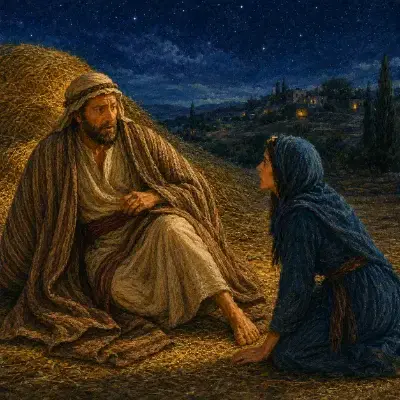
Ruth 3 continues the movement from exodus, to food, to rest. Ruth has left Moab for Yahweh, been fed in Bethlehem through the harvest and the kindness of Boaz, and now Naomi seeks rest for her through the redeemer. At the threshing floor, Ruth asks Boaz to spread his wing over her, and Boaz answers with hesed, righteousness, and a promise to act before Yahweh. The chapter ends unresolved, but not hopeless: Ruth waits because the redeemer will not rest until the matter is finished.
Ruth 3 Explained: Rest Through the Redeemer
Ruth 1 traced Ruth’s exodus from Moab to Yahweh. She left her land, her people, and her gods, and came into the land of promise under Yahweh’s covenant name. Ruth 2 brought her into the harvest fields of Bethlehem, where Yahweh fed her through His law, her labour, and Boaz’s kindness. Ruth 3 now turns to rest.
This movement is not accidental. Yahweh brought Israel out of Egypt, fed them in the wilderness, and brought them toward the land where He would give them rest. Ruth is walking into that covenant story from the outside. She has come out of Moab. She has been fed in Bethlehem. Now Naomi seeks rest for her through the redeemer.
Naomi says, “My daughter, shall I not seek rest for you, that it may be well with you?” This reaches back to chapter 1, where Naomi prayed that Yahweh would grant Ruth and Orpah rest, each in the house of her husband. At that point, Naomi thought Ruth’s rest would be found by returning to Moab. But Ruth refused Moab, clung to Naomi, came to Yahweh, and entered Bethlehem at the beginning of barley harvest.
Now Naomi seeks Ruth’s rest in Bethlehem. Ruth’s rest will not be found among the gods of Moab, but in the land of promise, through the redeemer Yahweh has brought into view.
Rest is a loaded word in Scripture. Yahweh did not bring Israel out of Egypt so they would wander forever. He brought them out in order to bring them in. Deuteronomy 12 says, “for you have not as yet come to the resting place and the inheritance which Yahweh your God is giving you. But you will cross the Jordan and live in the land which Yahweh your God is giving you as an inheritance, and He will give you rest from all your enemies around you so that you will live in security.”
Rest meant security, inheritance, settled life, and the blessing of living under Yahweh’s care in the land He had given. That is what Naomi now seeks for Ruth. Food has kept Ruth and Naomi alive, but food alone does not settle Ruth’s future. Ruth needs rest: a household, covering, protection, and a place within the covenant people. She has come into the land, but she still needs the redeemer.
Naomi is playing the part of matchmaker, but more than matchmaking is happening. She has begun to see Yahweh’s kindness at work. In chapter 1, she said Yahweh brought her back empty. In chapter 2, Ruth returned from Boaz’s field with grain, and Naomi blessed Yahweh because He had not forsaken His lovingkindness to the living and the dead. Naomi now sees that Boaz may be the man through whom Ruth finds rest and Elimelech’s house is preserved.
Naomi’s plan places Ruth in a tense and vulnerable situation. The threshing floor was a place of harvest, work, and guarded grain. Grain was separated from chaff there, often at night when the wind helped with the work. Men might sleep near the grain to protect the harvest. But Scripture also shows that threshing floors could become places where harvest joy was corrupted by sin. Hosea 9:1 says Israel had “played the harlot” and loved “harlots’ earnings on every threshing floor.”
So the setting is not morally neutral in the way the reader feels it. Ruth is going at night to a man who is asleep, in a situation that could easily be misunderstood. Naomi seeks a good thing for Ruth, but the scene must be read carefully. This is still the time of the judges, when many in Israel did what was right in his own eyes. At the threshing floor, Ruth and Boaz will both be tested by what they do in the dark.
When Boaz wakes and asks, “Who are you?” everything turns on Ruth’s answer. Ruth does more than follow Naomi’s instructions. Naomi told her to wait for Boaz to tell her what to do, but Ruth speaks. She says, “I am Ruth your servant. So spread your wings over your servant, for you are a redeemer.” Her words make the scene clear. She has come to ask Boaz to act as redeemer.
The phrase “spread your wings” takes us back to chapter 2. Boaz had blessed Ruth by saying, “May Yahweh fully repay your work, and may your wages be full from Yahweh, the God of Israel, under whose wings you have come to seek refuge.” Boaz recognised that Ruth had come under Yahweh’s wings. Now Ruth asks Boaz to spread his wing over her. The man who blessed her for seeking refuge under Yahweh is now being asked to become the human means of that refuge.
Scripture often uses wings as a picture of Yahweh’s protection. Psalm 91 says that Yahweh covers His people with His wings, and under His wings they take refuge. Ruth has already come under Yahweh’s wings, as Boaz said in chapter 2. Now she asks Boaz to spread his wing over her. She is asking the redeemer to become the means of Yahweh’s shelter.
To spread the wing over her means to take her under his protection. Ruth is asking Boaz to cover her, protect her, marry her, and act as redeemer. This is a request for covenant responsibility. Ruth is asking Boaz to bring the refuge of Yahweh’s wings into action.
Ruth’s request is the hinge of the chapter, but Boaz’s answer is the theological centre. Ruth has asked the redeemer to spread his wing over her. Boaz now interprets her action, names her hesed, recognises her character, and promises to act before Yahweh.
Boaz begins by blessing Ruth in Yahweh’s name: “May you be blessed of Yahweh, my daughter.” His speech begins with Yahweh’s name and ends with the oath, “as Yahweh lives.” The covenant name tops and tails his words. Boaz is not speaking as a man ruled by the darkness of the moment. He speaks before Yahweh.
Then Boaz says, “You have shown your last lovingkindness to be better than the first by not going after young men, whether poor or rich.” The word translated “lovingkindness” is hesed. Ruth has already been marked by hesed. She showed covenant love in action when she left Moab, clung to Naomi, and bound herself to Naomi’s people and Naomi’s God. She showed it again when she gleaned for Naomi in Boaz’s field.
Now Boaz says her last hesed is greater than the first. Ruth could have sought her own future apart from Naomi’s household. She could have gone after younger men, whether poor or rich. But she seeks the redeemer. Her request is not driven by wealth, attraction, or convenience. She is seeking the preservation of Naomi’s house and the name of the dead. Her covenant love now moves her to seek covenant redemption.
Ruth is a woman of hesed who seeks the redeemer. She is a woman of excellence, marked by covenant love, seeking the man whose words and actions have already shown that he honours Yahweh. She does not use the darkness of the threshing floor for sin. She brings the matter into the light by asking Boaz to act as redeemer.
Boaz calls Ruth “a woman of excellence.” Boaz was introduced in chapter 2 as a man of excellence, and now Ruth is described with the same kind of language. Before the legal matter is resolved, the reader sees the character of both. In the days of the judges, when everyone did what was right in his own eyes, Ruth and Boaz both act in a way that is right before Yahweh.
Boaz is willing to redeem, but another redeemer is nearer than he is. He will not take what does not yet belong to him. If the nearer redeemer will redeem, then he must redeem. If he will not, Boaz promises, “then I will redeem you, as Yahweh lives.”
Boaz does not use the darkness of the threshing floor to take what he wants. He does not ignore the nearer redeemer. He does not exploit Ruth’s vulnerability. He blesses her, honours her, protects her, and promises to deal with the matter rightly before Yahweh. Ruth seeks rest, but her rest must come through the redeemer acting in righteousness.
Boaz also protects Ruth’s name. Ruth rises before one person can recognise another, and Boaz says, “Let it not be known that the woman came to the threshing floor.” He is not hiding sin. He is guarding Ruth from suspicion. Nothing improper has taken place, but Boaz knows how easily the scene could be misunderstood. In chapter 2, he protected Ruth from harm in the field. Here he protects her reputation. His care for Ruth includes her name, not only her future.
Then Boaz gives Ruth six measures of barley and says, “Do not go to your mother-in-law empty-handed.” That sentence reaches back to Naomi’s bitterness in chapter 1. Naomi had said, “I went out full, but Yahweh has brought me back empty.” In chapter 2, Ruth returned from Boaz’s field with grain. In chapter 3, Boaz deliberately sends Ruth back with barley so that she will not return to Naomi empty-handed. The grain is a visible answer to Naomi’s emptiness.
The grain also fits the movement of the book. Ruth has come out of Moab. She has been fed in the land. Now, as she seeks rest through the redeemer, Boaz sends her back with a sign that the provision has not stopped. Yahweh’s kindness has not run out at the edge of the harvest field. The same God who fed Ruth in chapter 2 is now moving the matter toward rest in chapter 3.
When Ruth returns, Naomi understands that the matter is now in Boaz’s hands. She says, “Stay, my daughter, until you know how the matter falls, for the man will not rest until he has completed the matter today.” That final sentence answers the first verse of the chapter. Naomi began by seeking rest for Ruth. The chapter ends with Boaz unable to rest until the matter is completed. Ruth must now wait because the redeemer has promised to act.
Ruth 3 continues the Exodus-shaped movement of the book. Ruth has come out of Moab, been fed in Bethlehem, and now seeks rest in the land through the redeemer. Naomi cannot give that rest. Ruth cannot secure it by her own strength. Boaz must act. The chapter ends with Ruth waiting because the redeemer has sworn by Yahweh’s life and will not rest until the matter is finished.
Ruth’s request is the hinge, but Boaz’s reply is the centre. Ruth asks for shelter under the redeemer’s wing. Boaz answers by blessing her in Yahweh’s name, recognising her hesed, naming her a woman of excellence, and promising to redeem only in the right order. The chapter shows that rest comes through hesed, righteousness, and the redeemer’s pledged action.
Naomi’s emptiness is not yet fully answered, but Ruth has returned with barley. Boaz has sworn by Yahweh’s life. The nearer redeemer must still be dealt with. The chapter leaves the matter unresolved, but not hopeless. Ruth waits, because the redeemer will not rest until the matter is finished.