
Exodus 34
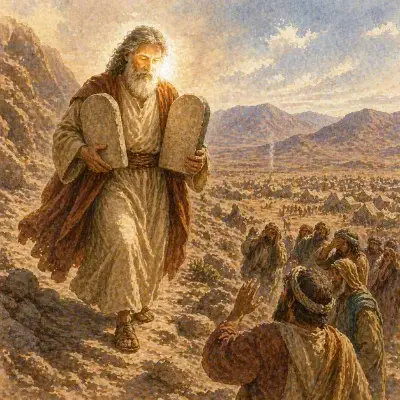
Exodus 34 records the renewal of the covenant after Israel’s sin with the golden calf. Yahweh declares His own character as compassionate and gracious, yet just, and writes the covenant again on new tablets. The laws that follow guard Israel from idolatry, and Moses continues to stand as mediator between Yahweh and the people. The chapter shows that the covenant endures not because of Israel’s obedience, but because of Yahweh’s mercy and the mediation He provides.
Exodus 34 Explained: Covenant Renewal, Yahweh’s Character, and the Mediator
Exodus 34 begins with Yahweh commanding Moses to carve two stone tablets like the former ones, and Yahweh says that He will write on the tablets the words that were on the first tablets which Moses shattered. The covenant had been broken by Israel’s sin with the golden calf, but the command to make new tablets shows that the covenant relationship is not ended. It continues because Yahweh is compassionate and gracious.
However, the tablets are now cut by Moses, not provided entirely by God as before. The covenant continues after sin, after judgment, and through a mediator. The relationship between Yahweh and Israel now visibly depends on mediation and mercy.
Moses is commanded to come up the mountain alone, and no man or animal is to be seen anywhere on the mountain. This repeats the earlier boundary around Sinai and reminds the reader that Yahweh’s holiness is dangerous. The people cannot approach casually. Moses alone may come, and even he will not see Yahweh fully.
When Yahweh descends in the cloud and stands with Moses, He proclaims His own name. This is the centre of the chapter. Yahweh declares what He is like: compassionate and gracious, slow to anger, abounding in lovingkindness and truth, forgiving iniquity, transgression, and sin, yet not leaving the guilty unpunished.
This declaration explains everything that has happened since the golden calf. Israel still exists because Yahweh forgives. But He is not indifferent to evil. He is both merciful and just, and Israel’s survival depends entirely on His character.
When Moses hears this, he bows low and worships, and he asks Yahweh to go in the midst of the people, to pardon their iniquity and their sin, and to take them as His inheritance. Moses understands that Israel’s only hope is Yahweh’s presence and forgiveness.
Yahweh then says, “Behold, I am going to cut a covenant.” This is a formal renewal after the covenant was broken. What follows is not a full restatement of all the law, but a focused restatement of commands that guard against idolatry.
Yahweh promises to drive out the nations, but Israel must not make a covenant with them. They must tear down their altars, break their pillars, and cut down their Asherim. Yahweh declares, “You shall not worship any other god, for Yahweh, whose name is Jealous, is a jealous God.” Idolatry is covenant unfaithfulness.
Yahweh then explains how this unfaithfulness develops. If Israel makes covenants with the nations, they will join in their sacrifices, share their meals, intermarry, and be led into idolatry. The progression moves from agreement to participation to worship. Yahweh forbids the entire chain at its beginning.
After these warnings, the chapter turns to positive commands. Israel must keep the Feast of Unleavened Bread to remember the exodus. The firstborn belongs to Yahweh and must be redeemed. The Sabbath must be kept, even during plowing and harvest.
This requires trust. Israel’s survival does not depend on uninterrupted work, but on Yahweh’s provision. They must also celebrate the Feast of Weeks and the Feast of Ingathering, and three times a year all the males must appear before Yahweh.
Yahweh promises that when they obey and come to worship, no one will covet their land. Their work, their calendar, and their worship are to be ordered around Yahweh, not around the practices of the nations.
The commands about sacrifices, firstfruits, and not boiling a young goat in its mother’s milk all belong in this same context. Israel must not worship Yahweh in the way the nations worship their gods. Worship must be according to His command.
The sin of the golden calf was not a lack of religion, but false worship. The people tried to worship Yahweh in a way He had not commanded.
Yahweh then tells Moses to write down these words, and Moses remains with Him forty days and forty nights without eating or drinking. During this time Yahweh writes on the tablets the words of the covenant, the Ten Commandments. The covenant is formally restored.
When Moses comes down from the mountain, the skin of his face shines because he has been speaking with Yahweh. He does not know it, but the people are afraid to come near him. The glory of Yahweh is reflected in Moses, and it is dangerous to sinners.
Moses calls them near and speaks to them all that Yahweh commanded. Then he puts a veil over his face. Whenever he goes in before Yahweh, he removes the veil, and when he comes out to speak to the people, he covers his face again.
A clear pattern is established. Yahweh speaks to Moses, and Moses speaks to the people. The mediator stands between Yahweh and Israel.
Exodus 34 shows that the covenant continues after sin because Yahweh is compassionate and gracious, yet also holy and just. Israel can live with Yahweh in their midst only because He forgives and because a mediator stands between Him and them.
The repeated commands show that Israel must worship Yahweh alone and must not mix His worship with that of the nations. The shining face of Moses shows that Yahweh’s presence is real and glorious, but also dangerous, and that the people can approach Him only through the mediator He has appointed.