
Ruth 2
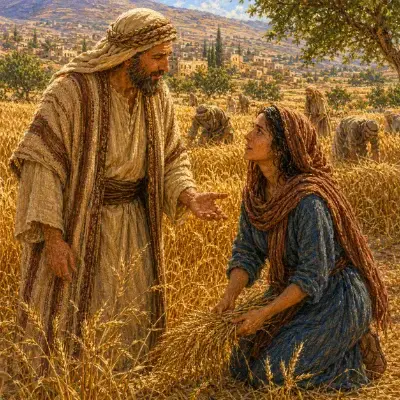
Ruth 2 follows Ruth from her exodus out of Moab into the harvest fields of Bethlehem, where Yahweh begins to show what refuge under His wings looks like. Ruth goes out to glean for Naomi, but she “happens” upon the field of Boaz, a kinsman of Elimelech and a righteous man who honours Yahweh. Through gleaning laws, hard work, protection, food, and unexpected kindness, Yahweh begins to fill Naomi’s emptiness and shows His hesed to the living and the dead.
Ruth 2 Explained: Under the Wings of Yahweh
Ruth 1 ended at the beginning of barley harvest. Naomi had returned to Bethlehem saying Yahweh had brought her back empty, but Ruth stood beside her. Ruth 2 now brings Ruth into that harvest, and the emptiness Naomi felt begins to be answered through grain, work, law, and unexpected kindness.
The chapter opens by naming Boaz before Ruth ever meets him. Naomi had a relative of her late husband from the family of Elimelech, and his name was Boaz. Verse 1 plants the word “kinsman,” and verse 20 will call him one of their “redeemers.” The chapter begins with Boaz as a relative and ends with Naomi recognising him as one of their redeemers. Ruth does not know this when she enters the field, but the reader knows that help exists before Ruth sees it.
A kinsman-redeemer, or goel, was a close relative who could act for a vulnerable family member in serious need. This was one way Yahweh protected households from losing land, name, and future. Leviticus 25 allowed a near relative to buy back family land that had been sold because of poverty. Deuteronomy 25 also shows Yahweh’s concern that a dead man’s name not be blotted out from Israel. Ruth is not a simple textbook case of either passage, but the book draws these themes together: land, name, family line, widowhood, and the danger of a household being cut off. Naomi came home empty, but the chapter begins by telling us there is a kinsman in Bethlehem.
Ruth takes the initiative. She asks Naomi to let her go to the field and glean after someone in whose eyes she may find favour. Naomi does not send her. Ruth asks to go. The oath of chapter 1 now becomes labour in chapter 2. She had clung to Naomi on the road from Moab, and now she goes out to gather food for them both.
Gleaning was not begging outside Yahweh’s care. It was Yahweh’s provision written into Israel’s law. Leviticus 19 commanded Israel not to reap the field right to its edges or gather every fallen piece of grain. Deuteronomy 24 said that forgotten sheaves were to be left for the sojourner, the orphan, and the widow. Ruth fits the need from every angle. She is poor, widowed, foreign, and caring for Naomi, who is also a widow. The Moabite woman who has entered Yahweh’s people now steps into the mercy Yahweh had commanded Israel to leave in the fields.
The wording of Ruth’s request is a little awkward in English. She wants to glean after someone “in whose eyes” she may find favour. That means she is hoping the owner or overseer of the field will look on her with mercy and let her gather grain safely. Ruth has no husband to protect her, no land of her own, and no standing in Bethlehem apart from Naomi. She needs someone with power over the field to see her and show favour.
She goes out, and the text says she “happened” to come to the portion of the field belonging to Boaz. From Ruth’s perspective, she has simply gone looking for grain. From the reader’s perspective, Yahweh is directing her steps. The same God who visited His people with bread and brought Ruth out of Moab now guides her to the field of Elimelech’s kinsman.
Ruth has entered covenant land, and Boaz’s field begins to show what that land was meant to be when Yahweh’s word was honoured. Here there is harvest instead of famine. Here the poor and the foreigner can glean because Yahweh’s law has made room for them. Here a vulnerable widow can find safety instead of danger. The manna does not fall from heaven in Ruth 2, but the echo is hard to miss. Yahweh once fed Israel in the wilderness when they had no bread, and now He feeds Naomi and Ruth through barley fields, gleaning laws, and the kindness of a righteous man. The provision is ordinary, but it is still from Yahweh.
Boaz arrives from Bethlehem and immediately reveals the character of his field. He says to the reapers, “May Yahweh be with you,” and they answer, “May Yahweh bless you.” Yahweh’s covenant name is spoken in the middle of ordinary work. In the days of the judges, this is striking. Here is a field where Yahweh is honoured, workers are blessed rather than exploited, and authority is exercised with reverence.
Boaz notices Ruth. She is identified again as the Moabite woman who returned with Naomi from the fields of Moab. The text does not let us forget where she came from. Ruth has confessed Yahweh, but Bethlehem still knows her as the foreign woman from Moab. Yet her conduct is also becoming known. She asked permission to glean, and she has worked from morning until now. Ruth’s faithfulness is no longer only heard in an oath. It is seen in her labour.
Boaz then speaks to Ruth with fatherly kindness. “Have you not heard, my daughter?” does not mean he is rebuking her for missing something. It is a way of drawing her attention: listen carefully, my daughter. He tells her not to go to another field, but to stay close to his young women. He has commanded the young men not to touch her. When she is thirsty, she may drink from the water they have drawn.
Boaz gives Ruth more than permission to glean. He gives her protection, water, dignity, and a safe place to work. That protection is not a small detail. Ruth is a poor foreign widow in the days of the judges. Boaz knows another field may not be safe. His field is safe because he orders it under righteousness.
Ruth falls on her face and asks why she has found favour in his eyes, since she is a foreigner. She understands the distance. She does not assume kindness is owed to her. Boaz answers by showing that he knows her story. He has heard what she did for Naomi after the death of her husband, and how she left her father, mother, and native land to come to a people she did not previously know.
Then comes the centre of the chapter: “May Yahweh fully repay your work, and may your wages be full from Yahweh, the God of Israel, under whose wings you have come to seek refuge.”
Yahweh’s name appears five times in Ruth 2. Twice in verse 4, in the exchange of blessing between Boaz and his workers. Twice in verse 12, in Boaz’s blessing over Ruth. Once in verse 20, when Naomi blesses Boaz and recognises Yahweh’s lovingkindness. Yahweh’s covenant name stands over the field, over Ruth, and over Naomi’s awakening hope.
Verse 12 explains Ruth’s journey. She has not simply changed countries. She has come under Yahweh’s wings. The woman who said, “Your God shall be my God,” has sought refuge in the God of Israel. She has left Moab, her people, and her gods, and has come under Yahweh’s shelter.
Boaz then becomes part of the answer to his own prayer. He asks Yahweh to repay Ruth, and then he acts as one of the means by which Yahweh begins to provide for her. At mealtime, he invites her to eat with the reapers, serves her roasted grain, and gives her enough that she is satisfied and has some left over. Ruth came to glean in hope of finding favour. She now sits among the workers and receives food from the owner of the field himself.
After the meal, Boaz orders his men to let Ruth glean even among the sheaves. They are not to shame her. They are to pull out grain from the bundles and leave it for her to gather. Boaz does not only obey the minimum of the gleaning law. He embodies its purpose. He gives Ruth room to work, and he arranges the field so that her work will be fruitful. She receives generosity without being stripped of dignity.
This is hesed in action before the word is spoken again. Boaz shows covenant kindness through protection, provision, honour, and generosity. He uses his strength to shelter a woman who has no strength or standing of her own.
Ruth gleans until evening and beats out what she has gathered. She comes home with about an ephah of barley, a generous amount for one day. She also brings Naomi the food left over from Boaz’s meal. Ruth’s loyalty remains practical. She works, gathers, eats, saves, and brings provision home.
Naomi sees the amount and knows someone has noticed Ruth. When Ruth says the man’s name is Boaz, Naomi’s understanding changes. Boaz is not only generous. He belongs to the family.
Naomi says, “May he be blessed of Yahweh who has not forsaken his lovingkindness to the living and to the dead.” The word translated “lovingkindness” is hesed. Naomi is beginning to see what she could not see in chapter 1. Yahweh has not forsaken His covenant love in action. He has shown hesed to the living, Naomi and Ruth. He has also shown hesed to the dead, because the house of Elimelech has not disappeared from the story.
Naomi’s words sound different now. In chapter 1, she said Yahweh had brought her back empty. She said His hand had gone out against her. In chapter 2, she blesses Boaz in Yahweh’s name and recognises that Yahweh has not abandoned His hesed. The kindness comes through Ruth’s labour and Boaz’s generosity, but the deepest source is Yahweh Himself.
Then Naomi says, “The man is our relative; he is one of our redeemers.” Now the opening of the chapter comes into view. Verse 1 told the reader that Boaz was a kinsman. Verse 20 tells Naomi what that means. Boaz is one of their redeemers. Full redemption has not yet happened, but possibility has entered the story.
Ruth tells Naomi that Boaz said she should stay close to his workers until the harvest is finished. Naomi agrees, and wisely says Ruth should stay close to Boaz’s young women, so that no one falls upon her in another field. Naomi understands the danger. Boaz’s field is safe, but not every field would be.
So Ruth stays close to Boaz’s young women and gleans until the end of the barley harvest and the wheat harvest. Yahweh’s provision is not one meal or one fortunate day. Naomi and Ruth are sustained through the harvests.
The final line says, “And she lived with her mother-in-law.” Ruth has found favour in Boaz’s field, but she has not left Naomi behind. She remains the woman who said, “Where you go, I will go.” Her faithfulness is steady. She works in Boaz’s field, stays where Boaz told her to stay, and returns to live with Naomi.
Ruth 2 continues the movement begun in Ruth 1. Ruth left Moab and came to Yahweh. Now, in the land of promise, she finds food, safety, favour, and shelter under Yahweh’s wings. The chapter begins with Boaz named as a kinsman and ends with him recognised as a redeemer. In between, Ruth goes out seeking favour, Boaz shows hesed in action, and Naomi begins to see that Yahweh has not forsaken His lovingkindness to the living or the dead.
In a time when many did what was right in their own eyes, Boaz’s field shows what covenant land should look like: Yahweh’s name is honoured, the vulnerable are protected, the hungry are fed, and kindness is shown in concrete action. The emptiness Naomi felt is beginning to be filled through ordinary harvest, hard work, and unexpected mercy.