
Psalm 8
Psalm 8 opens and closes with the same declaration: "O Yahweh, our Lord, how majestic is Your name in all the earth." Within that frame, David considers mankind's remarkable place in creation, crowned with glory and majesty and appointed to rule over the works of Yahweh's hands. The Psalm reaches back to Genesis 1, where God made mankind in His image and gave him dominion, and forward to Hebrews 2, where that dominion is not yet fully realised in fallen man but is fulfilled in Jesus Christ, the true Man crowned with glory and honour.
Psalm 8 Explained: How Majestic Is Your Name
“O Yahweh, our Lord, How majestic is Your name in all the earth, Who displays Your splendor above the heavens!” David begins Psalm 8 with Yahweh and ends in exactly the same place. The identical declaration returns in verse 9, forming a frame around everything the Psalm says about creation, mankind, glory, dominion, weakness, and strength.
Whatever dignity David is about to attribute to mankind must therefore be understood within the greater majesty of Yahweh. The Psalm begins with His name filling the earth and His splendour displayed above the heavens, and when David has finished considering mankind’s remarkable place within creation, his attention returns immediately to the majesty of the God who gave him that place.
The name David uses is significant. He addresses “Yahweh, our Lord”. The covenant God known by name to Israel is the Creator whose splendour stands above the heavens. David will shortly look at the moon and stars and call them the work of Yahweh’s fingers, before describing the same order of creation and dominion established in Genesis 1.
Genesis 1 repeatedly says that “God” created, spoke, blessed, and gave mankind dominion, while Psalm 8 identifies that Creator as Yahweh. The absence of the name Yahweh from Genesis 1 does not imply Yahweh isn’t the Creator. Yahweh is the One acting there.
David then turns to one of the most striking images in the Psalm: “From the mouth of infants and nursing babies You have established strength because of Your adversaries, to make the enemy and the revengeful cease.” Yahweh answers His enemies through those who appear least capable of opposing them.
Infants and nursing babies have no military strength, political authority, or power of their own, and still Yahweh establishes strength through their mouths. The means appear completely disproportionate to the result because the power belongs to Yahweh.
This pattern runs throughout Scripture. Yahweh repeatedly accomplishes His purposes through weakness so that His own strength is displayed. Gideon’s army is deliberately reduced before battle. David confronts Goliath without the weapons and armour expected of a warrior. Israel itself is reminded that Yahweh did not choose them because they were more numerous than the nations.
That same pattern begins to shape the rest of Psalm 8. David moves from infants and nursing babies to mankind standing beneath the vast heavens, and in both cases apparent insignificance becomes the setting in which Yahweh displays His greatness. Mankind appears almost negligible beneath the heavens; Yahweh has crowned him with glory and majesty and appointed him to rule.
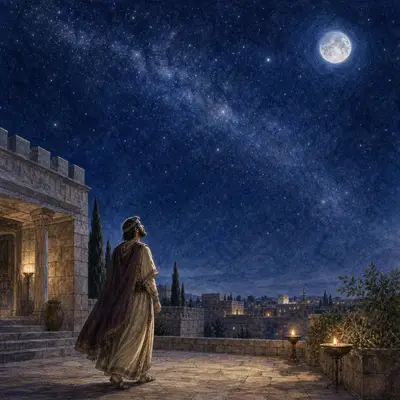
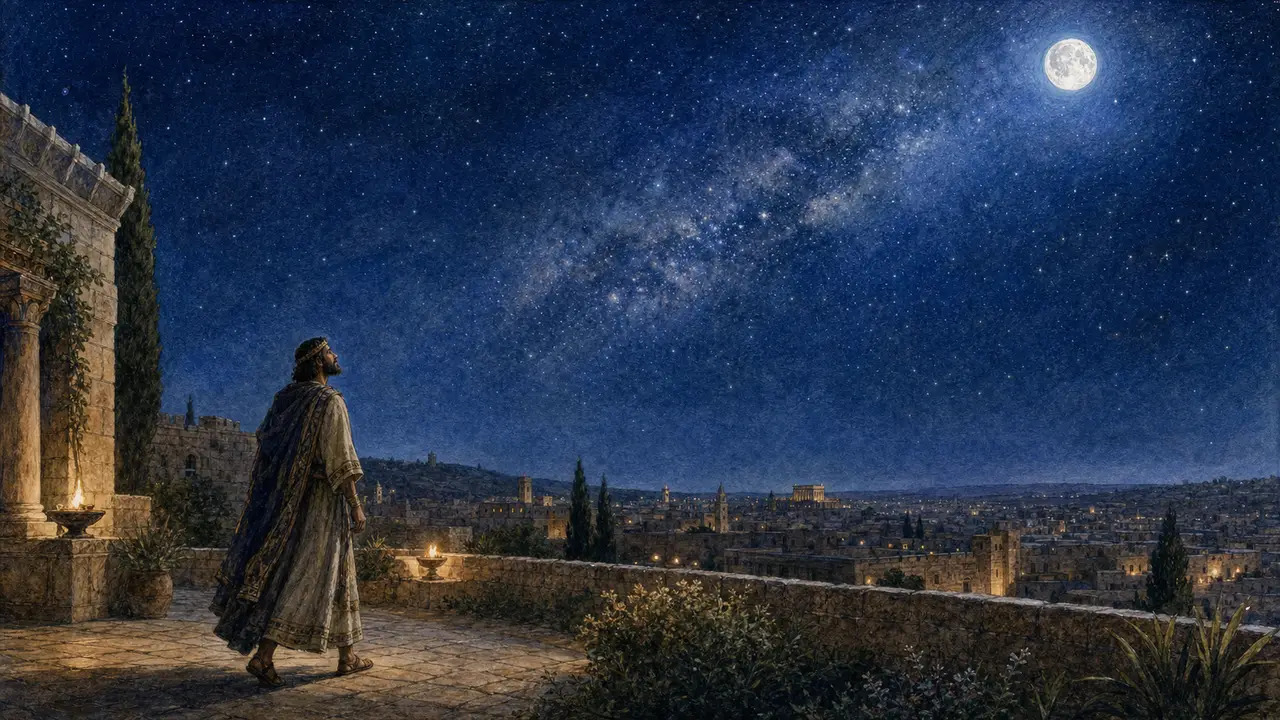
David says, “When I see Your heavens, the work of Your fingers, the moon and the stars, which You have established; what is man that You remember him, and the son of man that You care for him?”
The scale of the heavens produces the question. David looks upward at a creation so vast that even the moon and stars are described as the work of Yahweh’s fingers. Against that scale, mankind appears incredibly small.
David is expressing wonder at the attention Yahweh gives to man. Why should the Creator who established the heavens remember him? Why should He care for him? The question arises from mankind’s smallness before God, but David’s answer reveals that smallness does not mean worthlessness. Mankind possesses an extraordinary dignity because Yahweh has chosen to give it to him.
“Yet You have made him a little lower than the angels, and You crown him with glory and majesty!” Mankind occupies a unique place in the created order. He belongs to creation and remains beneath the heavenly beings, but Yahweh has crowned him. The language of glory and majesty is remarkable because these are qualities associated above all with God Himself, and here Yahweh gives a creature a position of honour within His creation.
The reason becomes clear as David continues: “You make him to rule over the works of Your hands; You have put all things under his feet.” Psalm 8 is reaching directly back into Genesis 1. There God says, “Let Us make man in Our image, according to Our likeness,” and immediately connects that image-bearing status with mankind’s dominion over the creatures.
God then blesses the man and woman and commands them to fill the earth, subdue it, and exercise dominion. The image of God and the dominion mandate belong together. Mankind is appointed to represent God’s rule within the world God made.
Psalm 8 takes that creation mandate and turns it into praise. David does not need to repeat the words “image of God” because the structure of Genesis 1 is already present. Yahweh makes mankind, gives him a uniquely exalted position within creation, and appoints him to rule over the works of His hands. Mankind’s authority is therefore representative and delegated. Yahweh is the Creator and sovereign King; mankind rules within creation because Yahweh has appointed him to do so.
This also gives mankind an inherent dignity that comes from God Himself. Our significance does not depend upon wealth, intelligence, physical ability, social standing, or usefulness to other people. Yahweh made mankind in His image and gave him a place within creation that no animal possesses. Sin has terribly corrupted mankind, but it has not erased what God made us to be. Fallen man remains accountable precisely because he remains a creature made in God’s image.
The creation mandate also remains in force. God did not revoke mankind’s image-bearing status after Adam sinned, and He did not revoke mankind’s responsibility to exercise dominion. Genesis 9 confirms both truths after the flood.
God still grounds the sanctity of man’s life in the fact that man was made in His image, and He again commands Noah and his sons to be fruitful, multiply, and fill the earth. James 3 later speaks of men as those who have been made in the likeness of God. Sin has corrupted our nature and our stewardship, but Yahweh has not withdrawn the identity and vocation He established at creation.
This is where the relationship between commission and covenant deserves some attention. A commission describes a task entrusted to someone, while a covenant formally establishes a relationship with defined commitments and obligations. The two terms are therefore not interchangeable.
Even so, the creation mandate belongs to the foundational order Yahweh established with mankind from the beginning: He creates mankind in His image, blesses them, speaks to them, gives them a defined vocation, and places the earth under their stewardship. That order stands before every later covenant recorded in Scripture, and Yahweh’s later dealings with mankind develop His purposes without simply erasing what came before. The covenant with Noah continues when Yahweh calls Abraham. The promises given to Abraham are not cancelled when the Law is given through Moses, and the Davidic covenant does not annul Yahweh’s earlier commitments. We remain image-bearers, and we remain responsible for how we exercise the authority and stewardship He has entrusted to mankind.
David then reinforces the Genesis connection by describing the creatures placed under man’s feet: “All sheep and oxen, and also the animals of the field, the birds of the heavens and the fish of the sea, whatever passes through the paths of the seas.”
These categories closely follow Genesis 1. Land animals, birds, and fish all come under the dominion God gave mankind. David is surveying the created order and recognising that the mandate given at the beginning still stands in his own day.
There is also a deliberate relationship between the works of Yahweh and the rule of man. David calls the heavens “the work of Your fingers”, then says Yahweh makes man rule “over the works of Your hands”. The world belongs to its Maker.
Mankind exercises authority within something that remains entirely Yahweh’s possession. We neither created the world nor established our own right to rule it. Yahweh made the world and then entrusted its stewardship to those He made in His image.
This creates a tension that Psalm 8 itself does not fully resolve. David can truthfully say that Yahweh has put all things under mankind’s feet, yet that is not straightforwardly our experience of the world.
Hebrews 2 takes up Psalm 8 at exactly this point and explains where the Psalm is ultimately heading. After quoting its words about man being made lower than the angels, crowned with glory and honour, and having all things placed under his feet, Hebrews observes that God left nothing outside the dominion described by the Psalm. Then comes the crucial acknowledgement: “But now we do not yet see all things subjected to him.”
That is the world as we presently know it. God’s purpose has not failed, and the creation mandate has not been revoked.
Hebrews then turns our eyes to the One who does fulfil it: “But we do see Him who was made for a little while lower than the angels, namely, Jesus.” The language of Psalm 8 is now applied directly to Christ. Jesus enters the condition of mankind described by David. He becomes truly man, takes the place of weakness and mortality, and because of the suffering of death is crowned with glory and honour.
Christ therefore fulfils Psalm 8 as the true Man. Where Adam rebelled against God’s rule, Jesus obeyed His Father perfectly. Where fallen mankind exercises dominion under the corruption of sin, Christ receives a kingdom characterised by righteousness. Where every other son of Adam eventually falls beneath the power of death, Jesus enters death and conquers it.
The path to that dominion also brings us back to the beginning of the Psalm. Yahweh establishes strength through the mouths of infants and nursing babies, and in Christ the pattern of divine strength displayed through weakness reaches its highest expression.
The Son of God takes flesh, humbles Himself, suffers, and dies. Through that apparent weakness He defeats the one who has the power of death and delivers those held in slavery by its fear. The road to the crown passes through the cross.
Jesus Himself also draws Psalm 8 into His ministry. When the chief priests and scribes object to children crying out in the temple, “Hosanna to the Son of David,” Jesus answers them with the words of Psalm 8 concerning praise coming from infants and nursing babies.
The Psalm speaks of Yahweh establishing praise and strength through children, and Jesus receives that praise as the Son of David. What David sang concerning Yahweh’s majesty reaches its fulfilment in the Messiah standing in Yahweh’s temple.
The New Testament continues to apply the language of all things being placed under His feet to Christ. The dominion first entrusted to mankind in Genesis 1 reaches its perfect expression in Him. Jesus does not abandon the purpose for which mankind was created. He fulfils it. As the true image of God and the last Adam, He exercises the righteous dominion that the first Adam and all his descendants failed to exercise faithfully.
Psalm 8 therefore stretches from creation to Christ. Yahweh is the God who made the heavens, the moon, and the stars. Yahweh is the God who made mankind in His image and entrusted the earth to his rule. The fall corrupted mankind’s obedience without cancelling Yahweh’s purpose. We remain His image-bearers, accountable for the stewardship He gave us.
Then Hebrews tells us where to look: “We do see Him.” We see Jesus, truly man, made for a little while lower than the angels, suffering death and then crowned with glory and honour. In Him the unresolved tension of Psalm 8 begins to find its answer. The dignity given to mankind at creation, the dominion placed in man’s hands, and the promise implicit in all things being placed under his feet find their fulfilment in the Son of Man.
And so David ends exactly where he began: “O Yahweh, our Lord, How majestic is Your name in all the earth!” The glory of mankind’s position finally returns to the glory of the One who gave it.
In Christ Jesus, the true Man, we see the One crowned with glory and honour, under whose feet all things will finally be brought into the order God intended from the beginning. The whole Psalm therefore magnifies Yahweh, whose majestic name fills the earth and whose purpose for His creation reaches its fulfilment in Christ.