
Exodus 16
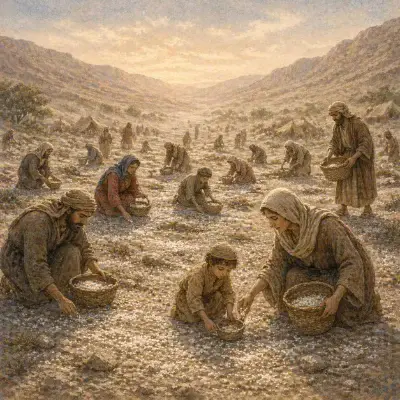
In Exodus 16, Yahweh provides manna from heaven, but He also tells us exactly why He does it: “that I may test them, whether or not they will walk in My law.” This passage is not only about food in the wilderness. It is about trust, obedience, unbelief, and daily dependence on the word of God. Hunger exposes Israel’s heart, and Yahweh answers by feeding His people in a way that makes self-reliance impossible.
Exodus 16 Explained: Why God Gave Manna and Tested Israel
Exodus 16 begins with Israel departing Elim, “on the fifteenth day of the second month after their departure from the land of Egypt,” about a month after arriving at the springs described in chapter 15.
There is no food, and the whole congregation grumbles against Moses and Aaron.
In chapter 15 it was a lack of water that set them grumbling; this time it is a lack of food.
The wording is important because it names Moses and Aaron, yet the chapter itself insists that this is only the surface of the sin, since Moses exposes the deeper reality: “in the morning you will see the glory of Yahweh, for He hears your grumblings against Yahweh; and what are we, that you grumble against us?”
Israel speaks as though Moses and Aaron are the problem, but Yahweh is the One who brought them out, Yahweh is the One who leads by cloud, and Yahweh is the One who has bound Himself to them by His name, so their complaint is not truly about Moses and Aaron but against the God who redeemed them.
Their grumbling also shows how unbelief leads them to exaggerate how good Egypt was.
They depict Egypt as a place of contentment, “when we sat by the pots of meat, when we ate bread to the full,” which is an ironic rewriting of the very land where they groaned under slavery and where their sons were cast into the Nile.
Hunger makes them speak as though bondage was abundance and freedom is starvation.
This is the same pattern that surfaced earlier when they lacked water, and the repetition matters, because Scripture is showing that the problem is not the specific trial but the heart that receives the trial.
They have now grumbled over food in the same way they grumbled over water, and in both cases they speak of Yahweh’s deliverance as though it were leading them toward death rather than life.
Yahweh answers by providing for them, and He does not hide His reason in doing so.
He says to Moses, “Behold, I will rain bread from heaven for you,” and then He adds the interpretive key for the whole chapter, “that I may test them, whether or not they will walk in My law.”
This means the manna is not merely a miracle to keep them alive; it is a divinely ordained training ground where Yahweh exposes what is in their hearts and teaches them what it means to have faith.
Yahweh gives the command in a pattern of work and rest, six days of gathering and a seventh day of rest, echoing the order established in Genesis 1, so that Israel must learn that Yahweh provides and that they are to live by faith rather than self-reliance.
Moses and Aaron then speak to the congregation in a way that points the people toward the knowledge of Yahweh.
“At evening you will know that Yahweh has brought you out of the land of Egypt; and in the morning you will see the glory of Yahweh.”
They do not present food as the ultimate comfort; they present food as the means by which Yahweh will make Himself known to a people who keep doubting His intentions.
This is why Moses repeats the point with force: “Your grumblings are not against us but against Yahweh.”
Israel is treating the wilderness as though it were Moses’ plan, but Yahweh is the One who brought them here, and Yahweh is the One who will feed them and look after them.
When Aaron calls the people to come near before Yahweh, they turn toward the wilderness, and Yahweh reveals His glory in the cloud.
Israel looks toward the wilderness, the place they fear, and Yahweh makes Himself known there.
He shows them that the wilderness is not a place where He is absent or where they must fend for themselves, but a place where He will teach them to trust and depend on Him.
Yahweh then states what is going to happen plainly: “At twilight you shall eat meat, and in the morning you shall be filled with bread, so that you shall know that I am Yahweh your God.”
The gifts are not an end in themselves, because Yahweh uses them to lead Israel into covenant knowledge, so that they recognise that the God who struck Egypt is the same God who now feeds His people.
The food arrives exactly as promised.
Quail cover the camp in the evening, and in the morning the dew lies around the camp, and when it lifts there is “a fine flake-like thing, fine as the frost on the ground.”
Israel’s first response is confusion: “What is it?” and their question becomes the name by which it is remembered.
Moses interprets the moment theologically: “It is the bread which Yahweh has given you to eat.”
Israel’s life will now depend on receiving what they did not plant, cannot preserve, and cannot store, and that dependence is the point.
Yahweh commands each man to gather “as much as he should eat,” an omer per person, enough for a single day’s food. Yahweh gives them food for the day, that is, their daily bread.
When the manna is measured, Yahweh’s provision proves exact.
Some gather much and some gather little, yet when they measure it “he who had gathered much had no excess, and he who had gathered little had no lack.”
This is not skill or efficiency on Israel’s part.
It is Yahweh giving each person exactly what he needs.
No one goes hungry, and no one is allowed to build security beyond the day.
Yahweh provides the perfect amount, teaching the whole congregation to live under His care together, day by day, without storing up food out of doubt in His provision for tomorrow.
Yet the test immediately exposes what is in them, because Moses commands, “Let no man leave any of it until morning,” and the text states plainly that “they did not listen to Moses.”
Some keep it, and it breeds worms and becomes foul.
What Yahweh gave them for sustenance becomes filled with maggots.
The maggot-ridden manna is a fitting sign of corrupted faith, because Yahweh’s provision has not failed, but their trust in it has.
They keep it as though Yahweh’s provision for tomorrow cannot be relied upon, and the bread God provided to sustain them is corrupted.
In this way Yahweh forces dependence and exposes unbelief. He gives them only a day’s worth of food, so that trust is shown in obedience and unbelief is revealed when they attempt to store up bread for themselves.
Moses’ anger fits the moment, because the command is simple and the provision has already been given.
Yahweh has given them food, and they answer His provision with doubt and self-reliance.
Morning by morning they gather, and when the sun grows hot what is left melts away.
Yahweh leaves no room for stockpiles and no space for self-security. They must rise each day and gather according to His word.
When the sixth day arrives the test intensifies, because they gather twice as much, and the leaders come to Moses, and Moses explains, “Tomorrow is a sabbath observance, a holy sabbath to Yahweh.”
Here the sabbath becomes the public expression of trust, and Yahweh also removes any possibility of treating the manna as a natural process.
By giving a double portion on the sixth day and withholding it on the seventh, Yahweh makes it impossible for Israel to explain the bread as something that simply happens each morning.
The manna is not a naturally occurring phenomenon. It appears at Yahweh’s command, and its timing proves that their food is His daily provision.
When they put the excess manna aside it does not become foul and no maggots appear, as it did on the previous days of the week.
Yahweh shows that both corruption and preservation are not properties of the manna itself but gracious gifts from above.
Despite Yahweh’s command, some go out on the seventh day to gather, and they find none.
This is now the clearest act of unbelief in the chapter, because Yahweh has already spoken, Yahweh has already provided, and Yahweh has already shown them what obedience looks like.
So Yahweh says to Moses, “How long do you refuse to keep My commandments and My laws?”
The question gathers the whole pattern into a single rebuke.
Israel has grumbled repeatedly, first over water and then over food, and even after Yahweh rained bread from heaven they hoarded it in unbelief and violated His sabbath, and only after this accumulation of refusal does Yahweh speak with such severity.
His patience stands out, because He fed them before they obeyed, continued feeding them after they disobeyed, and ordered their days as instruction rather than sweeping them away in judgment.
He speaks to Moses because Moses stands as mediator, yet the rebuke is aimed at Israel, because Yahweh is exposing the people’s sin and calling them to obedience.
The chapter now turns from Yahweh feeding Israel each day to Yahweh preserving a witness for the future, because He commands that an omerful of manna be kept “throughout your generations,” so that they may see the bread He fed them in the wilderness when He brought them out of the land of Egypt.
Moses tells Aaron to place it “before Yahweh” to be kept, and the later description, “before the Testimony,” shows that this bread will stand alongside the covenant witness at the heart of Israel’s worship.
The text looks ahead to the covenant witness that will be established at Sinai, the tablets of stone Moses will bring down from the mountain.
Exodus later names them explicitly in chapter 31 verse 18: “He gave Moses the two tablets of the Testimony, tablets of stone”.
It is before this covenant witness that the manna will eventually be kept, because Yahweh knows His people are quick to forget what He has done for them.
What fed them day by day must also stand as testimony that their life in the wilderness depended entirely on Yahweh’s provision.
The final note again looks ahead, stretching the significance of the manna across Israel’s entire wilderness life, because they ate it forty years, until they came to an inhabited land, that is, until they reached the border of Canaan.
The text is not merely closing the episode but anchoring the provision of manna within the whole wilderness journey, showing that what Yahweh begins here continues without interruption until the promised land itself is reached.
Yahweh feeds them with this bread from heaven for decades, teaching them to trust Him day by day and to live in continual dependence on His provision.
Exodus 16 therefore shows how Yahweh deals with a redeemed people who are still learning how to live under His rule.
He feeds them generously, but He does not allow them to separate provision from obedience.
Their grumbling exposes hearts that still doubt His goodness, their hoarding exposes fear about tomorrow, and their refusal to rest exposes resistance to trusting His sufficiency.
Yet despite their unbelief, Yahweh remains patient, providing before they obey, sustaining them while they learn, and ordering their life in such a way that dependence on Him becomes unavoidable.
By raining bread from heaven, by attaching it to His word, and by sustaining them for forty years, Yahweh teaches Israel that life does not rest on what they can secure for themselves, but on trusting the God who redeemed them and continues to provide for them day by day.