
John 1
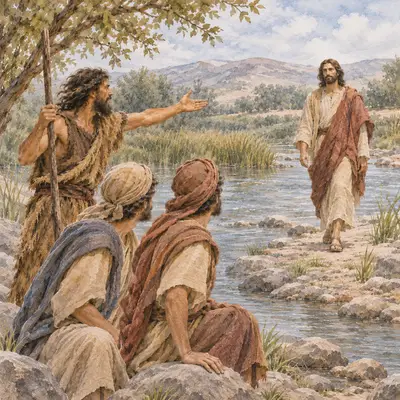
John opens his Gospel before creation: in the beginning was the Word, and the Word was with God, and the Word was God. All things came into being through Him, and the Word became flesh and dwelt among us, full of grace and truth. John the Baptist denies that he is the Christ, calls himself a voice preparing the way of the Lord, and points to Jesus as the Lamb of God who takes away the sin of the world. Andrew, Peter, Philip and Nathanael begin to follow Him, and Jesus promises that they will see the heavens opened and the angels of God ascending and descending on the Son of Man.
John’s Gospel opens with one of the clearest declarations of the deity of Jesus Christ in all of Scripture. Unlike Matthew and Luke, who begin with the circumstances surrounding Jesus’ birth, or Mark, who begins with the ministry of John the Baptist, John takes us back to the very beginning of creation. His opening words, “In the beginning was the Word,” deliberately recall the first words of Genesis, “In the beginning God created the heavens and the earth.” But John takes us even further back, before anything had been created, to establish who Jesus Christ is and has always been. When the beginning occurred, the Word already existed. John does not describe the Word coming into existence, because the Word is eternal.
John then makes two statements that must be understood together: “the Word was with God, and the Word was God.” The Word existed in personal relationship with God, while Himself possessing the full nature of God. These words establish both the distinction between the Father and the Son and their unity in deity. John is not describing two gods, nor is he suggesting that the Word is simply another name for the Father. The Son is personally distinct from the Father, while being equally and eternally God. This is foundational to the Christian doctrine of the Trinity, which the rest of Scripture develops by revealing the Father, Son, and Holy Spirit as three distinct persons who are the one true God.
The title “Word” also takes us back to Genesis, where God creates by speaking. Throughout Genesis chapter 1, the repeated declaration is “Then God said,” followed by the appearance of what He commanded into existence. Psalm 33 similarly declares, “By the word of Yahweh the heavens were made.” John now identifies the divine Word through whom creation took place. Verse 3 states that “All things came into being through Him, and apart from Him nothing came into being that has come into being.” This statement leaves no room for Jesus to be regarded as a created being. If the Word Himself had been created, He would belong to the category of things John says came into being through Him. Instead, the Word stands on the Creator’s side of the distinction between God and His creation. Paul teaches the same truth in Colossians chapter 1, declaring that all things were created through Christ and for Him, and that He is before all things.
John continues the connection with Genesis by introducing the themes of life and light. “In Him was life, and the life was the Light of men.” God is the source of all life, and the eternal Word possesses life in Himself. In Genesis, God brings light into the darkness by His command, and John now speaks of the Word as the Light shining in a world darkened by sin. Light represents the revelation of God, His truth, His holiness, and the life that comes from knowing Him. Darkness represents the ignorance, evil, and spiritual blindness that characterise mankind in rebellion against God. John declares that the darkness did not overtake the Light. The darkness cannot extinguish the Light or prevent it from accomplishing its purpose. This introduces a conflict that will continue throughout the Gospel, as Jesus reveals the truth about God while encountering unbelief and hostility from the very people He came to save.
Having established the eternal identity of the Word, the apostle John introduces us to another man named John, whom we know as John the Baptist. The distinction between Jesus and John the Baptist is deliberate. The Word existed before creation, while John was a man sent by God. Verse 6 says, “There was a man having been sent from God, whose name was John.” John’s ministry was not self-appointed. God deliberately raised up a man to testify concerning His Son. The eternal Word, through whom all things were created, would enter the world, and God prepared for His coming by sending a man to announce His arrival. This follows the pattern of God’s dealings with Israel, where He repeatedly sent prophets to declare His word and call His people to repentance. The difference is that John the Baptist was sent to announce the arrival of the One to whom the prophets had been pointing.
John’s commission was “to bear witness about the Light, so that all might believe through him.” The purpose of his ministry was to direct people towards faith in Jesus Christ. God chose to make His Son known through human testimony, a pattern that would continue through the apostles and the proclamation of the gospel. Verse 8 states it plainly: “He was not the Light, but he came to bear witness about the Light.” John did not possess the light within himself as its source. He was a witness, entrusted with the responsibility of identifying the One whom God had sent. The distinction returns later in the chapter, when John refuses to allow others to misunderstand his own identity or importance.
The true Light was coming into the world, and John explains the response that awaited Him. “He was in the world, and the world was made through Him, and the world did not know Him.” The Creator entered the world He had made, but those who lived in it failed to recognise Him. John uses the word “world” in two senses. It can refer to the created order, but it also describes mankind living in alienation from God. The world owes its existence to Christ, and mankind’s sin has turned it against its Creator in spiritual blindness and hostility. The coming of Jesus is therefore both an act of extraordinary grace and a revelation of the true condition of mankind.
John narrows his attention in verse 11: “He came to what was His own, and those who were His own did not receive Him.” The language distinguishes what belongs to Christ from the people who rejected Him. The immediate historical reference is to Israel, the nation God had chosen and prepared through the covenants, the Law, the prophets, and the promises concerning the Messiah. Israel had received the Scriptures that testified about His coming, but when He arrived, His own did not receive Him. This rejection will become increasingly apparent as John’s Gospel progresses, especially among the religious authorities who should have recognised the fulfilment of God’s promises.
Nevertheless, the rejection of Christ was not universal. John immediately declares that “as many as received Him, to them He gave the right to become children of God, even to those who believe in His name.” The invitation extends to everyone who believes in Jesus Christ, regardless of ancestry or their position in society. To receive Him means to believe in who He is and to entrust oneself to Him. Becoming a child of God is a privilege that Christ grants, establishing a new relationship with God that cannot be obtained through natural descent.
Verse 13 explains why this relationship cannot be inherited or produced by human effort. Those who become God’s children “were born, not of blood nor of the will of the flesh nor of the will of man, but of God.” John rules out ancestry, natural human desire, and human decision as the ultimate source of this new birth. It is God who gives spiritual life. Being descended from Abraham did not automatically make someone a child of God in the sense John describes, and neither does membership in a Christian family. This teaching will be expanded on more with Jesus’ conversation with Nicodemus in chapter 3, where He explains that a person must be born again, born of the Spirit, to enter the kingdom of God. Salvation originates in God’s gracious work, and those who receive Christ do so through faith in His name.
John then reaches the central declaration of his introduction: “And the Word became flesh, and dwelt among us.” The eternal Son of God, who existed before creation and through whom everything was made, entered His creation as a genuine human being. The word “flesh” emphasises the reality of His human nature. Jesus did not only appear to be human, nor did He temporarily assume a visible form without becoming a man. He truly became flesh, possessing a human body and sharing in the ordinary conditions of human life, while remaining fully God. The One who created mankind became a man. This is what Christians mean by the incarnation.
The Greek word translated “dwelt” has the sense of pitching a tent or dwelling in a tabernacle. In Exodus chapter 25, Yahweh commanded Israel, “let them make a sanctuary for Me, that I may dwell among them.” The tabernacle was the sign of Yahweh’s covenant presence with the people He had redeemed from Egypt, and Exodus chapter 40 describes the glory of Yahweh filling the completed tabernacle. John now declares that the Word became flesh and dwelt among us, and immediately adds, “we beheld His glory.” The language invites us to recognise the fulfilment of what the tabernacle represented. Yahweh had dwelt among Israel through the tabernacle and later the temple; now God had come personally in the flesh, in Jesus Christ.
Exodus also explains what John means by “we beheld His glory.” Throughout the Old Testament, God’s glory refers to the visible manifestation of His divine majesty and presence, as well as the perfection of His character. In Exodus chapter 33, after Israel had broken the covenant by worshipping the golden calf, Moses asked to see God’s glory, and Yahweh answered that He would make all His goodness pass before him and proclaim His own name. In the next chapter, Yahweh passed by and proclaimed Himself “compassionate and gracious, slow to anger, and abounding in lovingkindness and truth.” Lovingkindness translates the Hebrew word hesed, Yahweh’s steadfast loyalty to His covenant promises. Moses then pleaded with Yahweh to pardon the people’s iniquity and sin, and God answered, “Behold, I am going to cut a covenant.” John’s description of Jesus as “full of grace and truth” closely echoes this revelation. The glory of the covenant God, who forgives a people who have broken His covenant, is now revealed personally and fully in Jesus Christ. His glory is seen through His words, His works, His signs, His holiness, and ultimately through His death and resurrection. John will repeatedly return to this theme, showing that Jesus reveals the Father’s glory through everything He accomplishes.
John describes this glory as belonging to the “only begotten from the Father.” The expression identifies the Son’s unique relationship with the Father. Jesus is the eternal Son, who shares the divine nature and stands in a relationship with the Father unlike that of any created being. Believers become children of God by grace, as John has already explained, but Jesus is the Son in a unique and eternal sense. His sonship does not mean that He was created or that there was ever a time when He did not exist, as the opening verses have already shown.
The apostle then returns briefly to John the Baptist’s testimony. Although Jesus appeared publicly after John began his ministry, John the Baptist declared, “He who comes after me has been ahead of me, for He existed before me.” Luke’s Gospel tells us that John the Baptist was born before Jesus. In terms of their birth order and public ministries, John came first. But John recognised that Jesus existed before him, because Jesus is the eternal Son of God.
John continues, “For of His fullness we have all received, and grace upon grace.” The fullness belongs to Christ because He possesses the complete grace and truth of God. The expression “grace upon grace” describes the abundance of divine favour received through Him, and the next verse places that grace within the history of God’s dealings with Israel. Yahweh had already shown extraordinary grace in redeeming Israel from Egypt, giving His Law, dwelling among His people, and renewing His covenant after the golden calf. Now, through Jesus Christ, that grace reaches its promised fulfilment. From the fullness of Christ, believers receive what they could never earn or provide for themselves: forgiveness of sins, adoption as God’s children, the gift of the Holy Spirit, and eternal life.
Verse 17 sets the two side by side: “For the Law was given through Moses; grace and truth came through Jesus Christ.” Moses was God’s appointed servant through whom Israel received the Law, including the commandments, sacrifices, and regulations governing the nation’s covenant relationship with Yahweh. The Law was itself a gracious gift, revealing God’s holiness, exposing sin, and teaching Israel how to live as His people. The Law revealed God’s righteous requirements and anticipated the work of the Messiah, while Jesus accomplished the salvation to which the Law and the prophets pointed. The sacrifices could testify to the need for atonement, the removal of sin’s guilt so that sinners may be reconciled to God, but Christ would actually provide it.
This is also the first occasion in John’s Gospel where the name Jesus Christ appears. The word “Christ” is a title, not a surname. It comes from the Greek word Christos, meaning “Anointed One,” and corresponds to the Hebrew word Messiah. In the Old Testament, kings and priests were anointed with oil when appointed to their offices, and the prophets spoke of a coming Anointed One who would fulfil God’s promises to Israel. By identifying Jesus as the Christ, John declares that He is the promised Messiah, the One appointed by God to accomplish redemption and reign as King. The eternal Word who became flesh is the same Jesus whom Israel had been awaiting.
Verse 18 brings John’s introduction to its conclusion: “No one has seen God at any time; the only begotten God who is in the bosom of the Father, He has explained Him.” At first this may seem difficult because the Old Testament describes occasions when men encountered visible manifestations of God. Moses, for example, spoke with Yahweh and witnessed His glory. However, no human being has seen God in the fullness of His invisible divine nature. Yahweh told even Moses in Exodus chapter 33, “no man can see Me and live!”
Jesus Christ makes the Father known in a way that no prophet or previous revelation could accomplish. John calls Him “the only begotten God,” again affirming His deity, and describes Him as being “in the bosom of the Father,” an expression of the closest possible personal relationship. The Son knows the Father perfectly because He eternally shares the divine nature. The word translated “explained” means to make known or disclose. It is the source of our word exegesis, which describes the careful explanation of a text. Those who hear His teaching, witness His works, and come to know Him encounter the fullest revelation of God’s character and purposes. As Jesus will later tell Philip in John chapter 14, “He who has seen Me has seen the Father.” The invisible God has made Himself known through the visible person of His Son, while the Father and Son remain personally distinct.
With the identity of Jesus Christ established, John moves into the historical events surrounding the beginning of His public ministry. Verse 19 introduces what follows as “the witness of John,” the word the Gospel has used of the Baptist since verse 7. Religious authorities in Jerusalem sent priests and Levites to question John the Baptist about who he was. His preaching and baptising had attracted considerable attention, and the leaders wanted to establish whether he was claiming to be one of the figures expected in Israel’s prophetic promises. John “confessed and did not deny, but confessed, ‘I am not the Christ.’” John stacks the verbs so that no one can mistake the witness for the One he witnesses to. When they asked whether he was Elijah, he answered that he was not.
The question about Elijah arose from Malachi chapter 4, the closing words of the Old Testament prophets. There Yahweh commanded Israel to “remember the law of Moses My servant,” and promised, “Behold, I am going to send you Elijah the prophet before the coming of the great and awesome day of Yahweh.” Elijah would turn the hearts of the fathers to their children, “lest I come and strike the land, devoting it to destruction.” Israel stood under the curses of the covenant, and Elijah’s ministry was Yahweh’s merciful provision to turn His people back before judgment fell. Malachi’s final words pointed back to Moses and forward to Elijah, and in verse 17 John has already named the One both were preparing for.
Elijah had been taken into heaven without dying, as recorded in 2 Kings chapter 2, so some Jews expected his personal return. John denied that he was Elijah himself. Nevertheless, Jesus later identified John as fulfilling the promised ministry of Elijah, and Luke chapter 1, drawing on Malachi’s own words, explains that John would come “in the spirit and power of Elijah.” There is therefore no contradiction. John was not the historical prophet Elijah returned from heaven, but he fulfilled the prophetic role of preparing Israel for the coming of the Lord.
The authorities then asked whether John was “the Prophet.” This refers to the promise given through Moses in Deuteronomy chapter 18, where Moses declared that Yahweh would raise up a prophet like himself from among the people, and “you shall listen to him.” This promise pointed ultimately to Jesus Christ, who would speak God’s words with divine authority. John the Baptist again answered no, because he was neither the Messiah nor the promised Prophet.
Pressed to identify himself, John answered in the words of Isaiah chapter 40: “I am a voice of one crying in the wilderness, ‘Make straight the way of the Lord.’” In Isaiah, the voice cries, “Prepare the way for Yahweh in the wilderness.” The prophecy opens with Yahweh’s words of comfort to Jerusalem, announcing that “her iniquity has been removed,” and promising that Yahweh Himself would come to deliver His people from exile, keeping His covenant word. John applies that prophecy to his own ministry of preparing Israel for Jesus. The way he prepares is the way of Yahweh, and the One who comes is Jesus. John’s testimony therefore identifies Jesus as Yahweh come to His people.
The authorities then challenged John’s practice of baptism. If he was not the Christ, Elijah, or the Prophet, why was he baptising people? Ritual washing was already familiar within Judaism. The Law prescribed various washings associated with ceremonial cleansing, and immersion was practised in Jewish religious life. Water symbolised cleansing from defilement, and the prophets used the language of washing to describe the removal of sin. In Ezekiel chapter 36, Yahweh promises His exiled people, “I will sprinkle clean water on you, and you will be clean,” and goes on to promise a new heart and His own Spirit within them, so that “you will be My people, and I will be your God.” This is the language of the covenant, restored by Yahweh Himself.
John’s baptism drew upon this familiar language of cleansing while calling Israel to repentance in preparation for the Messiah. As Luke explains, he preached “a baptism of repentance for the forgiveness of sins.” John was calling the people to acknowledge their sin, turn back to God, and prepare for the One who was coming. His baptism was a visible expression of repentance and expectation, and it confronted Israel with the need for cleansing. Being descended from Abraham and belonging to the covenant nation did not remove the necessity of repentance.
John answered the authorities by directing their attention away from himself. “I baptize with water, but among you stands One whom you do not know.” The leaders who came from Jerusalem to examine John were already showing the ignorance described in verse 10. The Christ they were asking about was standing among them, and they did not know Him. As the Gospel continues, that failure to recognise Jesus will harden into open rejection. John’s baptism pointed beyond itself, because John could not give the new spiritual life that only God can provide. The One coming after him would baptise with the Holy Spirit, the greater fulfilment of Ezekiel’s promise of both cleansing and the gift of God’s Spirit. John expressed his own unworthiness by declaring that he was not worthy even to untie the strap of Jesus’ sandal, a task associated with the lowliest service.
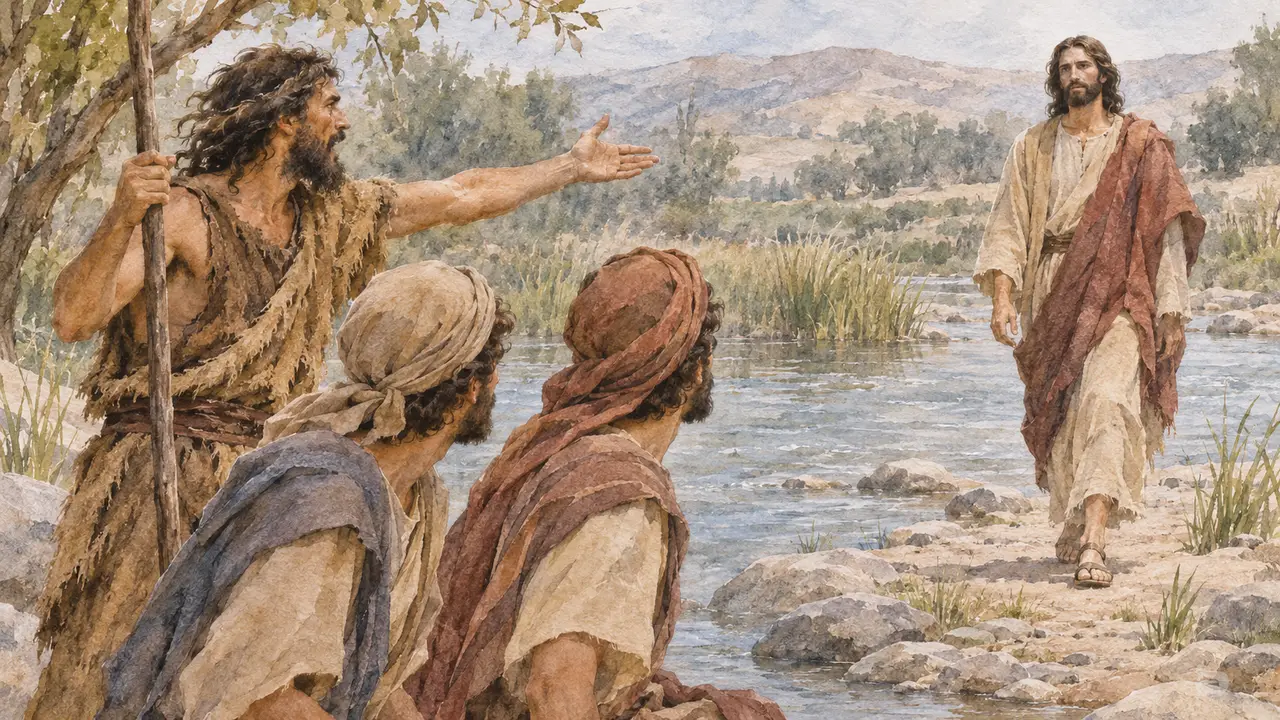
The following day, John the Baptist saw Jesus coming to him and declared, “Behold, the Lamb of God who takes away the sin of the world!” The image of the lamb runs through the Old Testament. In Genesis chapter 22, when Isaac asked Abraham where the lamb for the burnt offering was, Abraham answered that God would provide for Himself the lamb. In Exodus chapter 12, the blood of the Passover lamb protected the Israelites from the judgment that fell upon Egypt, on the night Yahweh redeemed the people He would bind to Himself by covenant at Sinai. Under the Law of Moses, lambs were also offered as sacrifices for sin and as part of Israel’s regular worship. These sacrifices taught that sin brings death and that forgiveness requires atonement. The sacrificial animal died in the place of the worshipper, pointing forward to the perfect sacrifice that God would provide.
Isaiah chapter 53 attaches the lamb to a person. The suffering Servant is led like a lamb to slaughter, bearing the iniquities of God’s people, and Isaiah declares that “Yahweh has caused the iniquity of us all to fall on Him.” John the Baptist now identifies Jesus as the Lamb provided by God, who would take away the sin of the world. Jesus would accomplish what the animal sacrifices could only anticipate. He would bear sin through His own sacrificial death, satisfying God’s justice and securing forgiveness for those who believe.
John speaks of the sin of the world in the singular, drawing attention to the guilt and corruption that characterise mankind in rebellion against God. The Lamb comes to deal with sin itself. The reference to the world also establishes that Christ’s saving work is not confined to Israel. The salvation He brings extends to people from every nation. This does not mean that every person will automatically be saved, because John has already explained that those who become God’s children are those who receive Christ and believe in His name. Rather, the Lamb of God is the Saviour whose work provides the only means of salvation for the world.
John then explained how he came to recognise Jesus. Twice he says, “I did not know Him.” The One who sent him to baptise had told him that the Spirit descending and abiding on Him would identify the One who baptises with the Holy Spirit, and John testified, “I have beheld the Spirit descending as a dove out of heaven, and He abided on Him.” “Beheld” is the word John used in verse 14, “we beheld His glory,” and the Baptist’s sight of the Spirit on Jesus is the first eyewitness testimony to that glory. The other Gospels describe this event at Jesus’ baptism, where, as Jesus came up from the water, the heavens were opened, the Spirit descended, and the Father spoke from heaven. John’s account concentrates on what the event revealed to the Baptist. The descent of the Spirit was the appointed sign confirming Jesus’ identity. John’s statement that he did not know Him concerns this revealed identification of Jesus as the Messiah, rather than requiring us to conclude that the two men had never previously met.
The Old Testament describes the Spirit coming upon particular individuals to equip them for particular tasks, including judges, kings, and prophets. The promised Messiah, however, would have the Spirit abiding on Him permanently and in the fullness required for His ministry. Isaiah chapter 11 had foretold of the coming ruler from the line of David, “The Spirit of Yahweh will rest on Him.” John witnessed the fulfilment of this promise, and he therefore concluded his testimony by declaring, “And I myself have seen, and have borne witness that this is the Son of God.”
The following day, John again saw Jesus and declared, “Behold, the Lamb of God!” This time, two of John’s own disciples heard the testimony and followed Jesus. This was the intended result of John’s ministry. He had been sent to prepare people for the Messiah, and now John was directing his own followers to Christ Himself. John did not attempt to retain their allegiance.
When Jesus turned and noticed the two men following Him, He asked, “What do you seek?” This is the first recorded statement spoken by Jesus in John’s Gospel, and the question introduces an issue that runs through the entire narrative: what are people seeking when they approach Jesus? The two disciples addressed Him as Rabbi, meaning Teacher, and asked, “where are You staying?” Jesus replied, “Come, and you will see.” They came and saw where He was staying, and they stayed with Him that day. At the level of the story, the disciples are asking where Jesus is lodging. In Greek, “staying” and “stayed” are the same word John has just used for the Spirit abiding on Jesus, and in chapter 15 Jesus gives that word its full weight: “Abide in Me, and I in you.” John also records that it was about the tenth hour, approximately four in the afternoon according to the usual Jewish reckoning. The precise detail gives the account the character of remembered eyewitness testimony, identifying the occasion when these men first began to know Jesus.
One of the two disciples was Andrew, Simon Peter’s brother. Andrew first found his own brother Simon and announced, “We have found the Messiah.” John explains that Messiah means Christ, once again connecting Jesus with the promised Anointed One of Israel. Jesus had asked, “What do you seek?” and those who sought Him have found the Messiah. Andrew brought his brother to Jesus, and the witness that began with John the Baptist passed on to those who believed his testimony. When Jesus looked at Simon, He said, “You are Simon the son of John; you shall be called Cephas,” which John translates as Peter. Both names mean rock or stone. In Scripture, giving a new name is an act of authority over a person’s identity and calling, as when God renamed Abram as Abraham and Jacob as Israel. Jesus exercises that same authority here, and the name points towards the role Peter would later fulfil among the apostles.
On the following day, Jesus desired to go into Galilee, and He found Philip and said to him, “Follow Me.” This time the One who finds is Jesus. Andrew had come to Jesus through John’s testimony, and Peter had been brought by his brother, but Jesus personally sought out and called Philip. The disciples who came seeking Jesus discover that He is the One who seeks them. In every case the response required was to follow Christ.
Philip then found Nathanael and said to him, “We have found Him of whom Moses in the Law and also the Prophets wrote,” and named Him as Jesus of Nazareth, the son of Joseph. Philip understood that the Scriptures of Israel pointed towards the Messiah, and he believed that their promises were being fulfilled in Jesus. His reference to Moses and the prophets establishes the continuity between the Old Testament and the ministry of Christ. God had been revealing His purposes throughout Israel’s history, and the coming of the Messiah was the fulfilment of those promises.
Nathanael responded sceptically: “Can any good thing come out of Nazareth?” Nazareth was a small town in Galilee with no place in the prophetic promises concerning the Messiah, and Micah chapter 5 had identified Bethlehem as the birthplace of Israel’s coming ruler. John does not tell us the reason for Nathanael’s objection, but he plainly did not expect the Messiah to come from Nazareth. Philip did not attempt to argue with Nathanael’s objection. He simply answered, “Come and see.” This repeats the invitation Jesus had given the first two disciples and directs Nathanael towards a personal encounter with Christ.
When Jesus saw Nathanael coming to Him, He said, “Behold, truly an Israelite in whom there is no deceit!” The name Israel was first given to Jacob, whose earlier life had been marked by deception. Jacob deceived his father Isaac to obtain the blessing intended for Esau, and Isaac told Esau, “Your brother came deceitfully and has taken away your blessing.” Esau answered, “Is he not rightly named Jacob, for he has supplanted me these two times?” The Septuagint, the Greek translation of the Old Testament widely read in Jesus’ day, uses the same word in Isaac’s sentence that John uses here for “deceit.” Jesus’ description of Nathanael as an Israelite without deceit therefore invites a comparison with Jacob, especially because Jesus will shortly refer to Jacob’s vision in Genesis chapter 28. Nathanael is a true Israelite, a man whose response to the truth is sincere, even though he initially expresses doubt.
Nathanael asked, “From where do You know me?” Jesus answered, “Before Philip called you, when you were under the fig tree, I saw you.” John does not explain what Nathanael had been doing beneath the tree, and there is no need to invent a private conversation, prayer, or spiritual experience to explain his response. Jesus knew something about Nathanael that Nathanael had not disclosed, having seen him before Philip ever approached him.
Nathanael immediately responded, “Rabbi, You are the Son of God; You are the King of Israel.” These two titles are closely connected. Psalm 2 describes Yahweh’s anointed King, whom God calls His Son, and promises Him authority over the nations. Nathanael’s confession therefore recognises Jesus as the promised royal Messiah. The Baptist had come baptising so that Jesus “might be manifested to Israel,” and now a true Israelite confesses Him as Israel’s King. At this stage, Nathanael may not have understood the full implications of Jesus’ divine sonship, but John has already established for the reader that Jesus is the eternal Son of God. The Gospel will progressively reveal the depth of what Nathanael has confessed.
Jesus then told Nathanael that he would see greater things than these. He concluded with a solemn declaration: “Truly, truly, I say to you, you will see the heavens opened and the angels of God ascending and descending on the Son of Man.”
This is a direct allusion to Jacob’s dream in Genesis chapter 28. As Jacob fled from Esau, the brother he had deceived, he dreamed of a ladder standing on the earth with its top touching heaven, and the angels of God ascending and descending on it. Yahweh stood above it and reaffirmed the covenant promises made to Abraham and Isaac, including the promise that “in you and in your seed all the families of the earth shall be blessed.” When Jacob awoke, he said, “Surely Yahweh is in this place, and I did not know it.” He named the place Bethel, meaning “house of God,” and called it “the gate of heaven.”
Jesus now takes that image and applies it to Himself. In Jacob’s vision, the ladder connected heaven and earth, revealing Yahweh’s presence and His covenant purposes for Jacob and his seed. Jesus declares that the angels will ascend and descend upon the Son of Man, identifying Himself as the meeting place of heaven and earth. The title “Son of Man” emphasises Jesus’ genuine identification with mankind, while carrying the royal and divine associations of Daniel chapter 7, where one like a son of man comes with the clouds of heaven and receives everlasting dominion from the Ancient of Days. Jesus is the One through whom God reveals Himself, through whom mankind gains access to the Father, and through whom the blessing promised to all the families of the earth would come. Jesus will say it plainly in John chapter 14: “No one comes to the Father but through Me.”
The promise of opened heavens also answers the end of John’s introduction. Verse 18 declared that “No one has seen God at any time,” and that the only begotten God has explained Him. Now Jesus promises, “you will see,” and although He is speaking to Nathanael, the “you” is plural. Through Jesus, the disciples will behold the glory of the God whom no one has seen, because the Son makes the invisible Father known.
The Word who brought creation into existence has entered His creation to give spiritual life to those who are dead in sin. Through His incarnation, His revelation of the Father, and His coming sacrifice as the Lamb of God, Jesus accomplishes what mankind could never accomplish for itself. He brings sinners to God. The disciples have only begun to understand who Jesus is, but we have already been told the truth that explains everything that follows. The One they are following is God the Son, who has become flesh. Every sign Jesus performs, every word He speaks, and every conflict that develops must be understood in light of that opening declaration: “In the beginning was the Word, and the Word was with God, and the Word was God.”