
John 2
John 2 records the first of Jesus' signs and His first confrontation with the authorities in Jerusalem. At a wedding in Cana He turns the water in six stone jars kept for purification into wine, manifesting His glory, and His disciples believe in Him. At the Passover He drives the traders out of His Father's house and answers the demand for a sign with the sanctuary of His body, destroyed and raised up in three days. The chapter ends with many believing because of His signs, while Jesus does not entrust Himself to them, for He knows what is in man. In each scene John shows that what Israel's worship pointed to is now found in Jesus, and that seeing His signs is not the same as belonging to Him.
John’s Gospel began by telling us who Jesus is before showing us anything He did. The Word was with God and was God, all things came into being through Him, and He became flesh and dwelt among us, so that John could write, “we beheld His glory.” Chapter 2 now begins to show how that glory was seen. Near the end of the Gospel, John explains why he recorded the signs of Jesus: “these have been written so that you may believe that Jesus is the Christ, the Son of God; and that believing you may have life in His name.” This chapter records the first of those signs and then shows us three different responses to them. The disciples believe in Him, the authorities in Jerusalem demand a sign and misunderstand the one He gives them, and many at the Passover believe because of what they see, though Jesus does not entrust Himself to them. Because John has already told us who Jesus is, we read this chapter knowing more than anyone in it. The headwaiter does not know where the wine came from, the authorities think Jesus is speaking about the temple building, and even the disciples only understand His words after He has risen from the dead.
The chapter opens “on the third day.” In chapter 1 John marked a sequence of days, beginning with the Baptist’s testimony to the priests and Levites and continuing with “the next day” in verses 29, 35 and 43. The third day is counted from the last of these, when Jesus set out for Galilee and called Philip and Nathanael. Because the Jewish way of counting included the starting day, the wedding took place two days later, and the whole sequence from the Baptist’s testimony to the wedding at Cana falls within about a week. Jesus had only just told Nathanael, “You will see greater things than these,” and within days the disciples see the first of them.
At the wedding the wine ran out, and the mother of Jesus brought the problem to Him, saying, “They have no wine.” John never names her in his Gospel; she is always called the mother of Jesus. He does not tell us what she expected her Son to do, but he does tell us in verse 11 that this was the beginning of His signs, so she came to Jesus before He had performed any miracle at all.
Jesus answered, “Woman, what do I have to do with you? My hour has not yet come.” “Woman” was a respectful form of address, and Jesus uses it of His mother again from the cross in chapter 19, when He entrusts her to the care of the disciple whom He loved. The question that follows, however, is a rebuke. “What do I have to do with you?” is a Hebrew idiom, and in the Old Testament it is used to protest against the person addressed. The same words appear in 1 Kings chapter 17, where the widow of Zarephath turns on Elijah after her son has died: “What do I have to do with you, O man of God?” In 2 Samuel chapter 16 David uses the same expression to rebuke Abishai, who wants to kill Shimei for cursing the king: “What have I to do with you, O sons of Zeruiah?” Jesus speaks to His mother with respect, but He is correcting her. She brought the problem to Him as His mother, and He tells her that this relationship gives her no claim over the work He has come to do, because that work is governed by His Father and its timing is set by His hour.
The reason Jesus gives is that His hour has not yet come, and this is the first mention of an hour that John’s Gospel returns to again and again. In chapters 7 and 8 the authorities try to seize Jesus but cannot, “because His hour had not yet come,” and in chapter 12, as the cross draws near, Jesus announces, “The hour has come for the Son of Man to be glorified.” The hour is the appointed time of His death, resurrection and return to the Father, when His glory is revealed in full. Chapter 7 also provides a close parallel to what happens at Cana. His brothers urge Him to go up to the feast and “show Yourself publicly to the world,” and Jesus answers, “My time is not yet here.” Then, after they have gone, He goes up Himself, “not publicly, but as in secret.” In both places Jesus refuses to act at the prompting of His family, and then acts according to His own timing. At Cana He does provide the wine, but He does so in a way that neither the headwaiter nor the guests are aware of.
His mother did not argue with Him or tell Him what to do. She said to the servants, “Whatever He says to you, do it.” Corrected as His mother, she responds as a disciple, leaving the matter in His hands. The servants did what Jesus told them, and in verse 9 we learn that they were the ones who knew where the wine came from, while the headwaiter, who only tasted it, did not. At Cana, the knowledge of what Jesus had done belonged to those who had obeyed Him.
There were six stone water jars standing nearby, each holding two or three measures, several hundred litres in all, and John tells us what they were for: “the Jewish custom of purification.” The Law of Moses prescribed various washings for ceremonial uncleanness, the defilement that prevented a person from taking part in worship until he had been cleansed, and Jewish practice had added further customs to those laws.
The jars were made of stone for a reason. Leviticus chapter 11 required an earthenware vessel that had become unclean to be broken, and later Jewish practice held that stone vessels could not become unclean, which is why water for purification was kept in stone jars. Purification is also a thread that runs through these opening chapters. In chapter 1 the authorities asked John the Baptist why he was baptising, and he answered that his baptism with water pointed to the One who was coming after him. In chapter 3 John tells us that “there arose a debate between John’s disciples and a Jew about purification.” Between these two accounts, Jesus performs His first sign using the very vessels kept for the washings of the Law.
Jesus told the servants to fill the jars with water, and they filled them “up to the brim,” leaving no room for anything else to be added. He then told them to draw some out and take it to the headwaiter, and they did so. John does not describe the moment the water changed, nor any action by which Jesus brought it about. There is no recorded prayer or word spoken over the jars. Instead, John records each step: the water was poured in, the servants drew it out, and the headwaiter tasted “the water which had become wine.” Not knowing where it came from, he called the bridegroom and praised him: “you have kept the good wine until now.” Six jars filled to the brim gave far more wine than any wedding needed, and Amos chapter 9 describes Yahweh’s restoration of His people in the same terms: “the mountains will drip sweet wine.”
These precise details give the account the character of eyewitness testimony. At the cross John says of his own account, “he who has seen has borne witness, and his witness is true; and he knows that he is telling the truth, so that you also may believe,” and the same concern lies behind the details at Cana. The sign really happened, and there were people who could testify to it.
John calls this miracle “the beginning of His signs,” and “beginning” is the same word that opened his Gospel: “In the beginning was the Word.” The Word through whom all things were made now begins to reveal His glory in the world He made. John numbers only the first two, calling the healing of the official’s son in chapter 4 “a second sign,” but the signs he records before the cross are usually counted as seven: the wine at Cana, the healing of the official’s son, the lame man at Bethesda, the feeding of the five thousand, Jesus walking on the sea, the man born blind, and the raising of Lazarus.
Numbers in Scripture often carry meaning, and seven is the number of completeness, going back to the creation week, when “on the seventh day God completed His work which He had done.” A Gospel that opens with “In the beginning” and counts its signs from a beginning gives us good reason to see in them a complete set, each one revealing who Jesus is, and all of them leading to the hour when His glory is revealed at the cross.
A sign is a work that points beyond itself to the identity of the one who performs it, and the language goes back to the exodus. When Yahweh sent Moses to Egypt, He gave him signs so that Israel would believe that Yahweh had sent him, and Exodus chapter 4 records that Aaron “did the signs in the sight of the people. So the people believed.” Verse 11 follows the same pattern, telling us that Jesus did this “as the beginning of His signs… and His disciples believed in Him.” John does not draw the comparison himself, but the similarities are interesting. The signs of Moses showed that Yahweh had sent His servant, while the sign at Cana “manifested His glory,” the glory of Jesus Himself, which John described in chapter 1 as “glory as of the only begotten from the Father.” “Manifested” is also the word the Baptist used in chapter 1 when he said he had come baptising “so that He might be manifested to Israel.” What the Baptist was sent to prepare for has now begun.
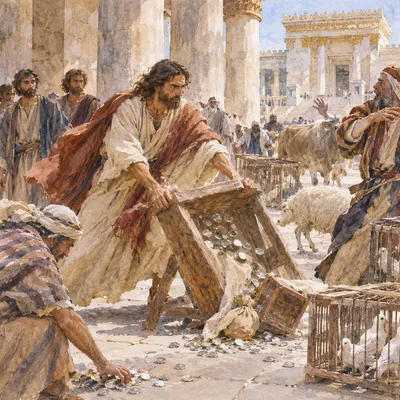
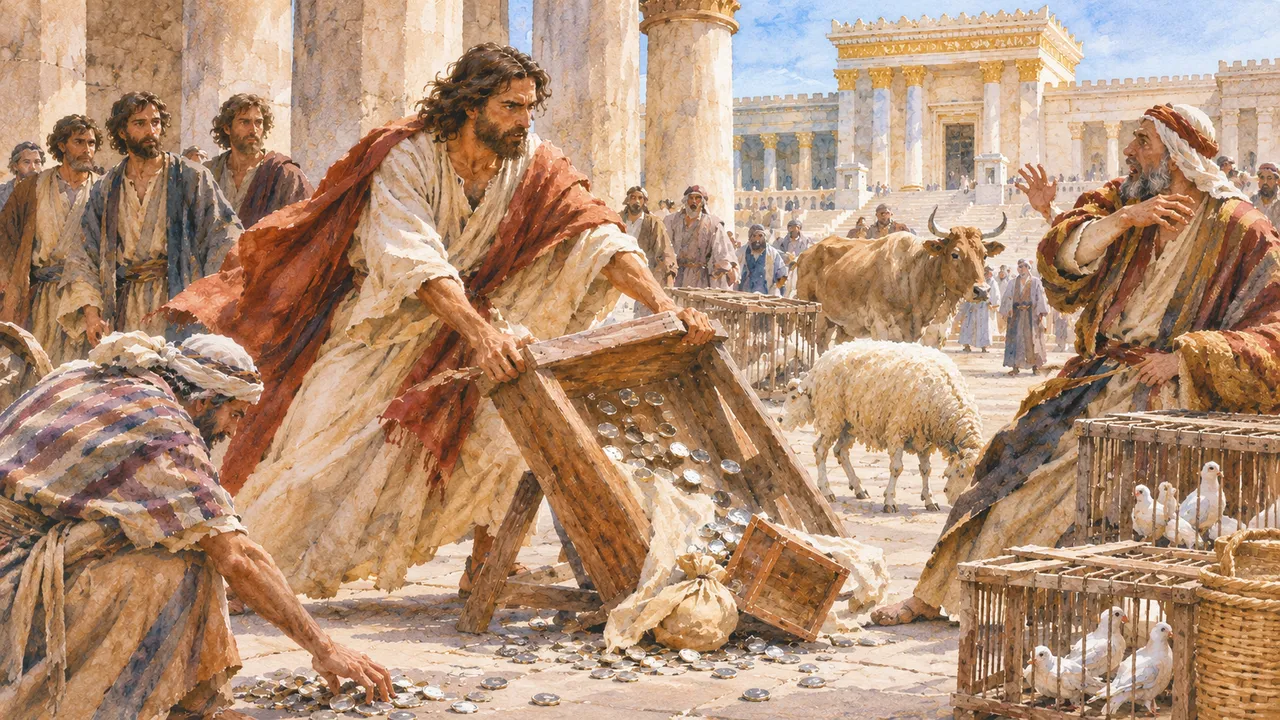
John then tells us that “the Passover of the Jews was near, and Jesus went up to Jerusalem.” In the temple Jesus found men selling oxen, sheep and doves, and money changers sitting at their tables. None of this was foreign to the Law, since pilgrims needed animals for the sacrifices and coins for the temple payment, both of which God had commanded. What Jesus condemned was what this trade had made of the temple, and His words to those selling doves identify the problem: “stop making My Father’s house a place of business.”
Jesus made a scourge of cords and “drove them all out of the temple, with the sheep and the oxen,” pouring out the coins of the money changers and overturning their tables. He did not appeal to the authorities or debate the matter with the traders. He acted with authority, and His words explain the basis of that authority: the temple was “My Father’s house.” It was the house of Yahweh, the place He had chosen for His name to dwell among His covenant people. By calling it His Father’s house, Jesus was claiming to be the Son of the God of Israel, acting to defend His Father’s honour in His Father’s house.
John tells us that “His disciples remembered that it was written, ‘Zeal for Your house will consume me.’” This is the only Old Testament quotation in the chapter, and it comes from Psalm 69, where David cries out to God while suffering because of his devotion to Him. The verse continues, “And the reproaches of those who reproach You have fallen on me.” David’s zeal for God’s house had brought upon him the hatred of those who hated God, and the disciples recognised the same zeal in Jesus.
John returns to Psalm 69 later in his Gospel. In chapter 15 Jesus says that the hatred of His enemies fulfils the word written in their Law, “They hated Me without cause,” drawing on the psalm’s fourth verse, “Those who hate me without cause are more than the hairs of my head.” At the cross, “in order to finish the Scripture,” Jesus said, “I am thirsty,” and He was given sour wine. John does not name the Scripture there, but the scene matches the words of the psalm, “for my thirst they gave me vinegar to drink.” The psalm the disciples remembered in the temple therefore runs right through John’s account of the suffering and death of Jesus.
The Jews then responded, “What sign do You show us as your authority for doing these things?” John used the same name for the Jerusalem authorities in chapter 1, when “the Jews sent to him priests and Levites from Jerusalem” to question the Baptist about who he was and why he was baptising. Now they question Jesus. They understood that His actions in the temple amounted to a claim of authority over it, and they wanted Him to prove it.
Jesus answered, “Destroy this sanctuary, and in three days I will raise it up.” He does give them a sign, and that sign is His death and resurrection. The word “Destroy” works like a condition, meaning “if you destroy this sanctuary,” and it is addressed to them. The destruction would be their doing, and the raising would be His. They heard Him speaking about the building standing in front of them, and replied, “It took forty-six years to build this sanctuary, and will You raise it up in three days?” To them, Jesus’ claim seemed absurd.
John then explains, “But He was speaking about the sanctuary of His body.” When Jesus drove out the traders, John spoke of the “temple,” meaning the whole complex of courts and buildings. When Jesus spoke of destroying and raising it, the word is “sanctuary,” the holy dwelling place of God. In Exodus chapter 25 Yahweh told Israel, “let them make a sanctuary for Me, that I may dwell among them,” and in chapter 1 John told us that the Word became flesh and “dwelt among us.” Jesus was speaking of His own body as the sanctuary. The temple had been the place where Yahweh dwelt among His people and where they approached Him through sacrifice, and that dwelling is now found in the person of the Son. The authorities who demanded a sign were standing in front of the true sanctuary, and they could see only the building.
The two halves of the chapter belong together. At Cana Jesus used the jars kept for the Law’s washings, and in Jerusalem He spoke of the temple itself, and in both He shows that what Israel’s worship pointed to is now found in Him. In chapter 4 He will tell the woman at the well that “an hour is coming when neither in this mountain nor in Jerusalem will you worship the Father.”
The authorities’ misunderstanding is the first of many occasions in John’s Gospel when Jesus says something that His hearers take in an earthly sense while He means something greater. Nicodemus will hear of being born again and ask how a man can enter his mother’s womb a second time, the woman at the well will hear of living water and point out that Jesus has nothing to draw with, and the disciples will hear that Lazarus has fallen asleep and think he will recover. Jesus Himself calls this speaking “in figures of speech,” and He tells His disciples that “an hour is coming when I will no longer speak to you in figures of speech, but will tell you openly of the Father.” The misunderstanding exposes those who judge only by what they can see, and the meaning is made plain once the hour has come, when the Spirit brings to the disciples’ remembrance all that Jesus said.
Twice in the temple account John tells us that the disciples remembered something. In verse 17 they remembered the psalm while the event was taking place. In verse 22, after Jesus had risen, they remembered what He had said, “and they believed the Scripture and the word which Jesus had spoken.” John describes the same pattern in chapter 12: “These things His disciples did not understand at the first; but when Jesus was glorified, then they remembered that these things were written about Him.” He does not tell us which Scripture he means here, but at the empty tomb he writes that “as yet they did not understand the Scripture, that He must rise again from the dead.” Before the resurrection, the disciples believed in Jesus without understanding what He had said about the sanctuary. Afterwards they believed both the Scriptures and the words of Jesus, because the resurrection showed that both had spoken truly about Him. This is also how John’s readers come to believe. We have the Scriptures, the words of Jesus, and the testimony of those who saw Him risen.
John ends the chapter by recording a third response to the signs. While Jesus was in Jerusalem at the Passover, “many believed in His name, when they saw His signs which He was doing.” “Believed in His name” is the same phrase John used in chapter 1 to describe those who received the Word: “as many as received Him, to them He gave the right to become children of God, even to those who believe in His name.” Here it describes many who believed because of what they saw.
John then adds, “But Jesus, on His part, was not entrusting Himself to them, for He knew all men.” The words “believed” and “entrusting” translate the same Greek verb. They believed in Him, but He did not entrust Himself to them. John does not fault them for believing because of His signs. Jesus Himself tells His opponents in chapter 10, “though you do not believe Me, believe the works, so that you may know and continue knowing that the Father is in Me, and I in the Father,” and John wrote down the signs so that his readers would believe. The signs are given to produce faith, but they do not guarantee it. In chapter 6 the crowd who had eaten the loaves went looking for Jesus, and He told them, “you seek Me, not because you saw signs, but because you ate of the loaves and were filled.” They had seen the miracle but missed what it revealed. A person can be impressed by what Jesus does, and even be convinced that He has come from God, and still not belong to Him.
John gives the reason in verse 25: Jesus “had no need that anyone bear witness concerning man, for He Himself knew what was in man.” Chapter 1 was full of witness. God sent John the Baptist to bear witness about the Light, because mankind needed to be told who Jesus is. But no one needs to tell Jesus what mankind is, because He knows what is in every person, as Nathanael discovered when Jesus told him where he had been before Philip called him. John began this chapter with servants who knew where the wine came from and a headwaiter who did not, and he ends it by telling us that Jesus knows all men. This knowledge belongs to God alone. At the dedication of the temple, Solomon prayed to Yahweh, “You alone know the hearts of all the sons of men.” In the same chapter in which Jesus claims the temple as His Father’s house and His own body as the true sanctuary, John tells us that He knows what only Yahweh knows.
John chapter 2 shows the glory of the Word made flesh beginning to be seen, and it also shows that seeing His signs is not enough by itself. The whole chapter points towards the sign Jesus gave the authorities, when the sanctuary of His body would be destroyed and raised up in three days. When His hour comes, the disciples will believe the Scripture and the word Jesus spoke, and that is the belief John writes to produce in us: that Jesus is the Christ, the Son of God, the true sanctuary in whom God dwells among men, who knows what is in man and gives life to those who are born of God.