
Luke 5
Jesus commands a miraculous catch of fish from Simon's boat and calls him to catch men instead. He cleanses a man covered in leprosy and then tells a paralysed man that his sins are forgiven before healing him, provoking the Pharisees to accuse Him of blasphemy. He calls the tax collector Levi to follow Him and eats with tax collectors and sinners, declaring that He has come to call sinners to repentance. Pressed about fasting, Jesus names Himself the bridegroom and explains that the new covenant He is bringing cannot simply be patched onto the old.
Luke 5 continues the question that has been building through the opening chapters of Luke: who is Jesus? The answer now comes increasingly through what He does. Luke has already recorded testimony from angels, prophets, John the Baptist, the Father from heaven, Satan, demons, and Jesus Himself. Now Jesus displays His authority before ordinary people, religious leaders, sinners, and disciples, and each encounter forces a response.
The chapter opens beside the lake of Gennesaret, another name for the Sea of Galilee. A crowd is pressing around Jesus “and listening to the word of God”, and Jesus uses Simon’s boat as a place from which to teach them. Simon has already appeared in the previous chapter when Jesus healed his mother-in-law, so Jesus is not unknown to him. After teaching, Jesus tells Simon to put out into the deep water and lower the nets.
Simon answers, “Master, we labored all night and caught nothing, but at Your word, I will let down the nets.” Simon is the fisherman. He knows the lake, the conditions, and the failure of the previous night. He acts on Jesus’ word regardless, and the result is overwhelming. The catch is so large that the nets begin to break and both boats begin to sink under the weight of the fish.
This is more than an impressive miracle. Jesus has authority over the creatures of the sea. Psalm 8 says that God gave mankind dominion over His works, including “the fish of the sea, whatever passes through the paths of the seas”. Luke has just traced Jesus’ genealogy back to Adam, and Jesus now exercises dominion over creation with a completeness that fallen mankind does not possess. The fish move according to His command.
Simon understands that something far greater than successful fishing has just taken place. He falls at Jesus’ knees and says, “Go away from me Lord, for I am a sinful man!” The miracle produces in Simon an awareness of Jesus’ greatness and of his own sinfulness. He does not treat Jesus as a fortunate teacher who happened to know where the fish were. He recognises that he is in the presence of someone before whom a sinful man has reason to fear.
Jesus answers, “Do not fear, from now on you will be catching men.” The man who has just seen fish gathered at Jesus’ command is now called into Jesus’ service. Simon, James, and John bring the boats to shore and “left everything and followed Him”. The catch itself becomes secondary. Jesus is worth more than the boats, the nets, the fish, and the livelihood they represent.
The next event takes place in one of the cities, where a man appears who is “covered with leprosy”. Luke’s wording emphasises the severity of his condition. The man falls before Jesus and says, “Lord, if You are willing, You can make me clean.” His question is not whether Jesus has the power. He assumes that Jesus can cleanse him. The only question is whether Jesus is willing.
Jesus stretches out His hand, touches him, and says, “I am willing; be cleansed.” Immediately the leprosy leaves him.
The Old Testament law treated serious skin disease as a condition that could make a person ceremonially unclean. Leviticus 13 and 14 gave the priests detailed instructions for examining the person and confirming whether cleansing had occurred. Contact with uncleanness ordinarily carried uncleanness with it, but when Jesus touches this man the movement goes the other way. The uncleanness does not defile Jesus. Jesus’ cleansing power removes the uncleanness.
Luke has also just recorded Jesus speaking about Naaman in chapter 4. Naaman was the leper cleansed in the days of Elisha. In 2 Kings 5, the king of Israel reacts to Naaman’s request by saying, “Am I God, to put to death and to make alive, that this man is sending word to me to cure a man of his leprosy?” The king understood that such cleansing ultimately belonged to God.
Elisha did not cleanse Naaman by his own authority. He directed him to wash in the Jordan, and God healed him. Jesus speaks directly: “I am willing; be cleansed.” Luke has moved from the prophet through whom God cleansed a leper to Jesus, who commands cleansing by His own word.
Jesus then tells the man to tell no one, but to show himself to the priest and offer what Moses commanded “as a testimony to them”. The command to silence does not remove the element of testimony. Jesus directs where the testimony is to go. The priest must examine a man whose disease had been obvious and severe, then confirm according to the Law that he is now clean. The Law of Moses itself becomes the means by which the reality of Jesus’ cleansing work is formally witnessed.
The news spreads anyway, and large crowds gather to hear Jesus and to be healed. Luke then gives a brief but important detail: “He Himself would often slip away to the desolate regions and pray.” The growing crowds do not control Jesus. His ministry remains ordered around obedience to the Father.
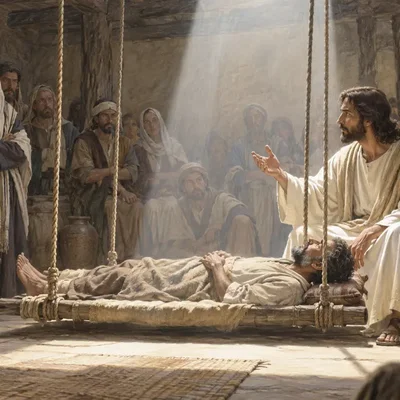
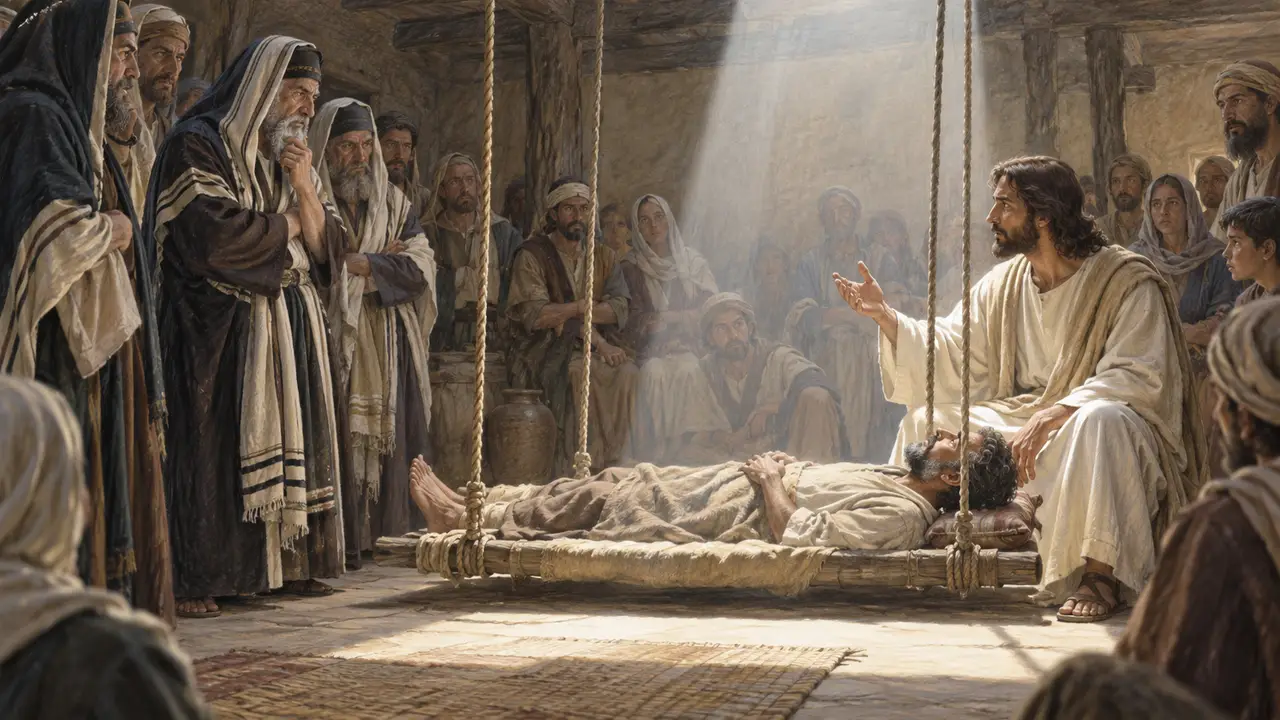
The next scene brings Jesus into direct contact with the Pharisees and teachers of the law. Luke says that they had come from villages throughout Galilee and Judea and from Jerusalem. Opposition is beginning to take organised form. Jesus is teaching inside a house when several men arrive carrying a paralysed man. Because they cannot reach Jesus through the crowd, they go onto the roof, open a way through the tiles, and lower the man directly in front of Him.
Luke says that Jesus sees their faith and tells the paralysed man, “Friend, your sins are forgiven you.”
The physical problem is obvious to everyone. The man cannot walk. Jesus addresses the deeper problem first. Sin separates mankind from God, and forgiveness belongs to God because sin is ultimately committed against Him. The scribes and Pharisees immediately understand the implication of Jesus’ words.
They begin reasoning, “Who is this who speaks blasphemies? Who can forgive sins, but God alone?”
The second question is correct. God alone has the authority to forgive sins. Isaiah 43:25 records Yahweh saying, “I, even I, am the one who wipes out your transgressions for My own sake.” The Pharisees therefore understand the claim embedded in Jesus’ words, but they conclude that He is blaspheming because they reject the possibility that His authority is genuine.
Before Jesus answers them, Luke adds another detail about His identity: Jesus knows their reasoning. They have not spoken their objection aloud to Him, but He knows what is taking place in their hearts. Solomon said of Yahweh in 1 Kings 8 that He alone knows the hearts of all men. Luke continues to place before us attributes and authority that belong to God.
Jesus asks them, “Which is easier, to say, ‘Your sins have been forgiven you,’ or to say, ‘Get up and walk’?” Anyone can pronounce forgiveness because forgiveness cannot be seen. Healing a paralysed man can be immediately tested.
Jesus therefore says, “But, so that you may know that the Son of Man has authority on earth to forgive sins”, and then commands the paralytic, “I say to you, get up, and, picking up your stretcher, go home.”
The man immediately rises, picks up what he had been lying on, and goes home glorifying God. The visible healing confirms the invisible claim. Jesus does have authority on earth to forgive sins.
This is also the first time in Luke that Jesus calls Himself “the Son of Man”. The title will become increasingly important, especially in relation to Daniel 7, where “One like a Son of Man” receives everlasting dominion and a kingdom that will never be destroyed. Here the title first appears in connection with Jesus’ authority to forgive sins.
The people respond with astonishment, fear, and praise to God, but the Pharisees have already begun taking a different path. The same Jesus stands before everyone. The paralytic’s friends act in faith, while the religious leaders reason towards an accusation of blasphemy. Luke is beginning to show the division Simeon had spoken about in chapter 2. Jesus would be appointed “for the fall and rise of many in Israel” and would expose “the thoughts from many hearts”.
After this Jesus sees a tax collector named Levi sitting at the tax office and says, “Follow Me.” Levi responds in the same way that Simon and the others did: “he left everything behind, and rose up and began to follow Him.”
Tax collectors were widely despised because they worked within the Roman taxation system and could profit from the people they collected from. They were treated as compromised men and were commonly grouped with sinners. Jesus calls Levi directly anyway.
Levi then holds a large reception for Jesus in his house, with many tax collectors and others reclining at the table. The Pharisees and their scribes object, asking Jesus’ disciples, “Why do you eat and drink with the tax collectors and sinners?”
Jesus answers, “It is not those who are well who need a physician, but those who are sick. I have not come to call the righteous but sinners to repentance.”
Jesus does not minimise their sin. He calls them sinners and says they need repentance. His presence among them is part of His mission to call sinners away from sin and back to God. A physician goes where the sick are because the sick need healing. Jesus goes among sinners because sinners need repentance and forgiveness.
The Pharisees’ problem is that they do not see themselves as needing the same physician. John the Baptist had already called Israel to repentance and warned those who trusted in their religious standing and descent from Abraham. The coming of Jesus continues to expose the difference between those who recognise their need and those who assume that they are already spiritually secure.
The discussion then turns to fasting. Some people ask why the disciples of John often fast and pray, and why the Pharisees’ disciples do the same, while Jesus’ disciples eat and drink.
Jesus answers with the image of a wedding: “Can you make the attendants of the bridegroom fast while the bridegroom is with them?”
The language of the bridegroom reaches back into the Old Testament. Isaiah describes Yahweh as the husband of His people: “For your husband is your Maker, whose name is Yahweh of hosts.” Hosea also describes Yahweh’s covenant relationship with Israel in terms of marriage.
Jesus now places Himself in the position of the bridegroom.
His disciples do not fast as though the bridegroom were absent because the bridegroom is standing among them. His presence changes the proper response. The Messiah has come, and the promised age is beginning to arrive.
Jesus adds, “But the days will come; and when the bridegroom is taken away from them, then they will fast in those days.” The statement looks ahead to His death. The bridegroom will not remain physically present with them in the same way. There will be a time for fasting, but that time is determined by His presence and absence.
Jesus then tells two related parables. No one tears a piece from a new garment to patch an old one, because the new garment will be damaged and the patch will not properly match the old. Likewise, no one puts new wine into old wineskins, because the fermenting wine will burst the skins and both wine and skins will be lost.
Jesus has not come as an addition to the Pharisees’ existing religious system. His arrival brings the fulfilment of what the Law and the Prophets had been pointing towards. Jeremiah had promised that Yahweh would make a new covenant with His people. Jesus is now bringing that promised new covenant age into history.
The old covenant was given by God and served the purpose for which He gave it. It contained promises, shadows, sacrifices, priesthood, and patterns that pointed forward to what God would accomplish through Christ. When the One to whom those things pointed arrives, He cannot simply be fitted into the old forms as though nothing has changed.
The final saying explains why many resist Him: “And no one, after drinking old wine wishes for new; for he says, ‘The old is good enough.’”
People become attached to what is familiar. The Pharisees have their established categories, practices, interpretations, and religious expectations. Jesus does not fit comfortably within them. Their danger is that they can become so satisfied with the old order that they reject the One to whom that order was pointing.
The One promised in the Old Testament has arrived, but receiving Him requires more than admiring His miracles. Jesus calls men to recognise who He is, repent, leave what must be left behind, and follow Him. The old covenant pointed forward to Him. Now that He has come, the question is whether Israel will recognise the Old Testament’s fulfilment when He stands before them.