
Exodus 9
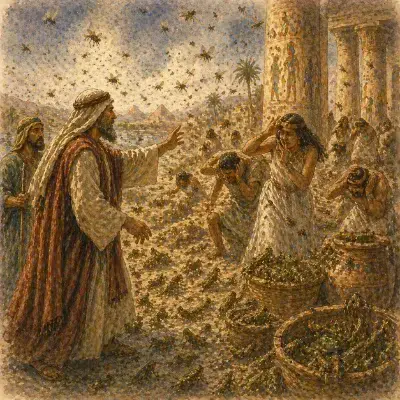
Exodus 9 shows Yahweh escalating His judgments so that Egypt is brought to the brink of collapse. Livestock perish, the magicians are struck with boils, and a storm of fire-hail devastates the land. At the centre of the chapter Yahweh declares that He has caused Pharaoh to stand so that His power is revealed and His name is proclaimed in all the earth.
Exodus 9 Explained: Yahweh Unleashes the Cup of His Judgment on Egypt
Exodus 9 shows Yahweh escalating His judgments so that Egypt’s strength collapses under the weight of His word.
The chapter follows the established plague pattern, yet the plagues now move beyond disruption and begin to strike at the heart of Egypt’s life.
Yahweh again commands Moses to stand before Pharaoh and deliver the same unchanging demand, “Let My people go, that they may serve Me.”
The repetition sharpens the moral force of Pharaoh’s refusal.
Yahweh announces that His hand will fall upon Egypt’s livestock with a very heavy pestilence.
Horses, donkeys, camels, herds, and flocks will be struck.
These animals carried Egypt’s transport, agriculture, food supply, and military strength.
The earlier plagues were temporary hindrances and could be recovered from quickly. This one strikes the pillars of Egypt’s economy and wealth.
Yahweh again makes a clear distinction. None of Israel’s livestock will die.
As with previous plagues, Yahweh sets a definite time, and the judgement falls exactly as He declares. Verse 6 states that “all the livestock of Egypt died”.
This must be read in light of verse 3. The text isn’t saying all the animals died, but rather, the plague affected all the different types of animal mentioned earlier.
Later verses tell us horses and other animals were still present.
The plague is complete within its scope, measured and deliberate, with every kind of animal dying exactly as Yahweh said.
Pharaoh sends men to check whether Israel’s livestock were untouched, and they see the distinction Yahweh made with their own eyes.
Yet Pharaoh hardens his heart with firmness. He receives verifiable evidence, but he refuses to bow. His rebellion is deliberate and deepening.
The next plague arrives without warning. This matches the pattern established earlier: every third plague falls unannounced.
Pharaoh has escalated his unbelief, and Yahweh answers with a blow that comes without negotiation.
Yahweh instructs Moses and Aaron to take “the fullness of your cupped hands of soot from a kiln,” and for Moses to throw it toward the sky in Pharaoh’s sight.
The language is deliberate here. Moses’ hands form a cup, and in that posture he bears the sign of Yahweh’s coming wrath before casting it heavenward.
The gesture is solemn and deliberate, a visible sign carried in his hands before it becomes judgment.
Moses casts the soot heavenward, and Yahweh spreads it as fine dust over Egypt. It becomes boils breaking out with sores on man and beast.
The affliction reaches all Egypt. Even the magicians cannot stand before Moses. Their collapse ends their role in the story and they do not reappear again.
They have no power left to imitate or resist. Yahweh hardens Pharaoh’s heart with strength, confirming him in the path he repeatedly chooses.
The theological heart of the plague cycle appears in verses 14–16.
Here Yahweh explains why the plagues fall in sequence rather than in one swift act.
He says He will send His plagues “against your heart” so that Pharaoh may know that there is none like Yahweh in all the earth.
He declares that if He had chosen to strike Pharaoh with pestilence earlier, Egypt would have been wiped out.
Instead, He has “caused you to stand, in order to show you My power and in order to recount My name through all the earth.”
Pharaoh is not enduring in spite of Yahweh’s sovereignty; he is enduring because Yahweh is holding him up as a monument to divine supremacy.
Egypt’s continued existence is itself an act of divine restraint for the sake of Yahweh’s name.
Yahweh warns that an unprecedented storm will fall the next day. Anyone left in the field will die.
For the first time the plague divides Egypt from within. Some of Pharaoh’s own servants now fear the word of Yahweh and bring their servants and livestock to safety.
Others disregard Yahweh’s word and leave them exposed. The plague reveals hearts among the Egyptians just as it distinguishes between Egypt and Israel.
These Egyptians who fear Yahweh foreshadow the mixed multitude that will leave with Israel.
It won’t only be the Israelites who leave Egypt, but some of the Egyptians who believe in Yahweh will leave too.
They show that the judgments are not only signs of wrath but also signs of salvation to those who heed Yahweh’s warning.
Moses stretches out his staff, and Yahweh sends thunder, hail, and fire flashing continually in the midst of the hail.
The fire uses the same word that describes the fire Yahweh rained on Sodom.
This is not natural lightning but fire bound within the hail, a union of opposites that marks the storm as supernatural.
The hail kills every exposed servant and animal, strikes every plant in the field, and shatters the trees.
Egypt’s agriculture collapses. Yet the text records Yahweh’s restraint.
The barley and flax are destroyed because they ripen early; the wheat and spelt survive because they ripen later.
Judgment is severe but never uncontrolled. Yahweh governs what is broken and what is spared.
Throughout God’s judgment, Goshen remains untouched.
Pharaoh summons Moses and declares, “I have sinned this time; Yahweh is the righteous one, and I and my people are the wicked ones.”
This is the first and only time Pharaoh speaks the covenant name “Yahweh.”
He now knows the name of Yahweh, yet he refuses to fear Him.
His response is the foolishness Scripture describes.
He has full knowledge yet turns away from the fear of Yahweh, which is the beginning of wisdom.
Moses agrees to pray, but he states plainly, “I know that you do not yet fear Yahweh God.”
When Moses spreads out his hands, the storm ceases at once.
Yet as soon as Pharaoh sees relief, he sins again. He hardens his heart with firmness, and his servants follow him.
The chapter closes with a precise summary of the hardening. Pharaoh hardens himself.
He sins again. And Yahweh hardens him exactly as He said He would.
The chapter presents Pharaoh and Yahweh both hardening Pharaoh’s heart, and it does so without embarrassment.
Pharaoh’s hardness is real and chosen, while Yahweh’s hardening is sovereign and just.
Exodus 9 reveals Yahweh escalating His judgments, exposing Pharaoh’s unbelief, dividing Egypt, bringing the nation to the brink of collapse, and declaring His name in the earth.
He speaks, and the livestock die. He delivers judgment through Moses’ cupped hands and covers Egypt with sores.
He sends fire in the midst of hail, and the proudest kingdom on earth is shaken to its foundations.
Through all of it Yahweh magnifies His glory, showing that there is none like Him in all the earth.