
John 4
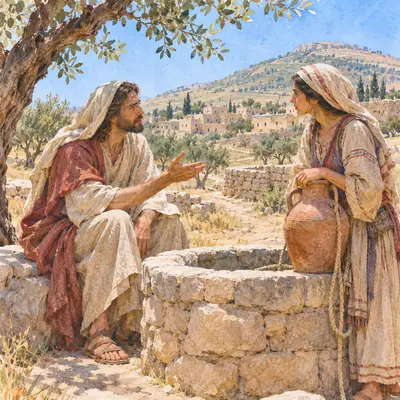
John 4 carries the promise of eternal life beyond the Jewish people. At Jacob's well Jesus offers a Samaritan woman living water, the life that only Yahweh, the fountain of living waters, can give, and He tells her that an hour is coming when the Father will be worshipped in spirit and truth. He then declares that He is the Messiah, and many Samaritans believe His word and confess Him as the Saviour of the world. Back in Cana, a royal official believes the word of Jesus before he sees his dying son healed. The chapter teaches that faith rests on the word of the Son whom the Father has sent.
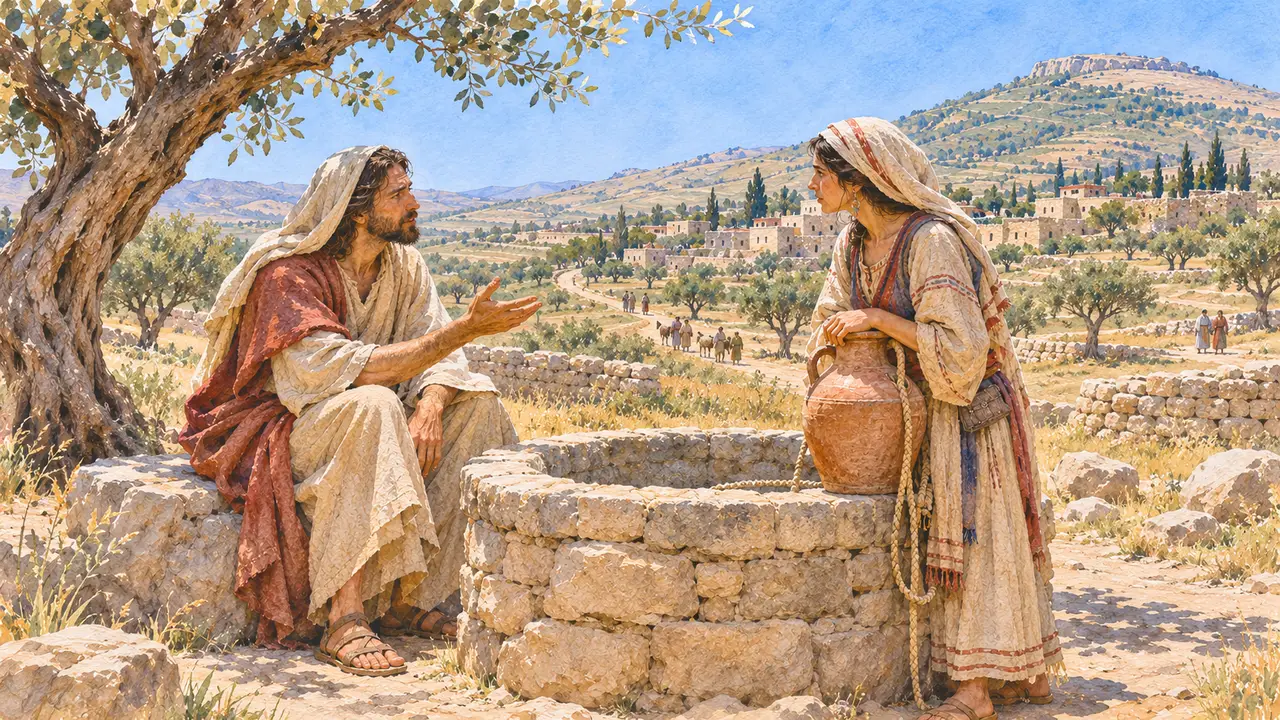
John chapter 3 ended with John the Baptist declaring that the Father had given all things into the hands of His Son, and that whoever believes in the Son has eternal life. Chapter 4 now shows that promise being received beyond the Jewish people, as Jesus travels through Samaria and reveals Himself to a woman who comes to draw water from Jacob’s well. By the end of the encounter, many Samaritans will confess that Jesus is truly the Saviour of the world. The chapter then returns to Galilee, where Jesus heals a royal official’s dying son simply by speaking. Throughout these events, John develops the relationship between Jesus’ testimony, the signs He performs, and the faith of those who receive Him.
The chapter begins with Jesus learning that the Pharisees have heard He is making and baptising more disciples than John the Baptist. John immediately clarifies that Jesus Himself was not performing the baptisms, but His disciples were. This follows directly from the previous chapter, where John’s disciples expressed concern that people were leaving their teacher and going to Jesus. John the Baptist welcomed this development because he understood that his ministry was to prepare the way for the Messiah. The Pharisees, however, had already questioned the Baptist’s authority, and the Jewish leaders had challenged Jesus after He cleansed the temple. Their awareness of Jesus’ growing ministry prompted Him to leave Judea and return to Galilee, avoiding further confrontation with the religious authorities at this stage of His ministry. As He had told His mother at Cana, His hour had not yet come.
John tells us that Jesus “had to pass through Samaria.” Samaria lay between Judea and Galilee, and travelling through it provided a direct route north. John’s wording also points beyond geography. The word translated “had to” is the same Greek word Jesus used in the previous chapter when He said, “You must be born again,” and “even so must the Son of Man be lifted up,” and the Baptist used it when he said, “He must increase.” In John’s Gospel this word frequently expresses the necessity of God’s purposes being accomplished. The route was direct, but what follows gives the journey a greater significance. Jesus will tell His disciples that His food is to do the Father’s will and finish His work, and in Samaria that work will bring many people to faith in Him. His journey belongs to the saving purpose for which the Father sent Him.
The route Jesus must take also brings Him into contact with people whose relationship with the Jews had been marked by centuries of religious division. The Samaritans claimed a connection with the patriarchs of Israel and accepted only the five books of Moses as Scripture, and their worship was centred on Mount Gerizim rather than Jerusalem. The division had historical roots in the separation of Israel’s northern and southern kingdoms and the Assyrian conquest of the north. Second Kings chapter 17 records that the Assyrians resettled the land with foreign peoples who “were fearing Yahweh and serving their own gods.” Disputes over the proper worship of Yahweh continued from there, and by the first century Jews and Samaritans maintained distinct religious communities, each claiming to preserve the true worship of the God of Israel.
Jesus comes to Sychar, near the field Jacob gave to his son Joseph, where Jacob’s well stood. John places the encounter within the history of Israel’s patriarchs. Genesis records that Jacob bought a portion of a field near Shechem, and that before his death he gave Joseph “one portion more than your brothers.” Joshua tells us that Joseph’s bones, brought up from Egypt, were buried at Shechem in the field Jacob had bought, and that it became the inheritance of Joseph’s sons. The Old Testament never mentions the well, but its association with Jacob was recognised in Samaritan tradition. That history lies behind the woman’s later reference to Jacob as “our father” and her question whether Jesus is greater than him. The location also prepares for her question about worship, since Mount Gerizim stood nearby.
John records that Jesus was wearied from His journey and sat by the well at about the sixth hour, around midday by ordinary Jewish reckoning. This is another indication of the genuine human nature of the eternal Word who became flesh. The One through whom all things were created experiences the weariness and thirst of ordinary human life. His disciples have gone into the city to buy food, and when a Samaritan woman arrives to draw water, Jesus asks her for a drink. Women usually drew water in the cooler part of the day. Genesis describes the evening as “the time when the women go out to draw water,” so a woman coming to the well alone at midday is unusual. John does not tell us why she came at that hour, but what Jesus later reveals about her life suggests she may have been avoiding the other women of the town.
The woman is surprised and asks, “How do You, being a Jew, ask for a drink from me, being a Samaritan woman?” John explains that Jews had no dealings with Samaritans. The statement reflects the social and religious divisions between the communities, although the disciples’ willingness to buy food in the city shows that contact between them was not entirely absent. In asking her for water, Jesus has crossed a boundary the woman herself recognises, and the conversation that follows will address divisions much deeper than the sharing of a drink.
Jesus answers, “If you knew the gift of God, and who it is who says to you, ‘Give Me a drink,’ you would have asked Him, and He would have given you living water.” The woman has been concerned with the identity of the man asking for water, and Jesus tells her that if she truly knew who He was, she would be asking Him for something far greater. He has come to the well thirsty, and He has a gift that she cannot obtain from the well.
In ordinary usage, living water meant fresh, flowing water, such as water from a spring, but the prophet Jeremiah used the same language to describe Yahweh Himself. In Jeremiah chapter 2, Yahweh condemns His people for two evils: they have forsaken Him, “the fountain of living waters,” and have hewn for themselves broken cisterns that can hold no water. In chapter 17 the prophet names Him outright as “the fountain of living water, even Yahweh.”
Now Jesus offers that living water to a Samaritan woman, and He claims to possess and give it Himself, the water that brings eternal life. This is consistent with the declaration at the beginning of the Gospel that the Word was God and that in Him was life. The One who asks the woman for a drink is Himself the giver of the life that comes from God.
The woman first understands His words in their ordinary physical sense. She points out that Jesus has nothing with which to draw water and that the well is deep. She then asks, “Are You greater than our father Jacob, who gave us this well, and drank of it himself and his sons and his cattle?” Her question brings the history of the place into the conversation. Jacob had provided water for his household and livestock, and generations later the well continued to serve those who lived in the area. If Jesus could offer water superior to that found in Jacob’s well, His claim would place Him above the patriarch whom the Samaritans regarded as their ancestor.
Jesus answers by explaining the difference between the water Jacob’s well provides and the water He gives: “Everyone who drinks of this water will thirst again; but whoever drinks of the water that I will give him will never thirst—ever.” The well supplies a genuine human need, but its water satisfies only for a time, and those who drink from it must return again and again.
He continues, “But the water that I will give him will become in him a well of water springing up to eternal life.” John’s choice of words here is deliberate. In verse 6 John calls Jacob’s well a pēgē, a spring, but when the woman speaks of the well as deep and as Jacob’s gift, she uses phrear, the ordinary word for a dug well or pit. When Jesus speaks of the water He gives becoming “a well” within the believer, the word is pēgē again. The woman speaks of the deep well Jacob provided, while Jesus promises something greater: a spring that becomes a continuing source of life within the believer. The word John uses for that spring is the same word the Greek translation of the Old Testament uses in Jeremiah chapter 2 for “the fountain of living waters.” The living water is received from Christ and springs up to eternal life.
This connects directly with His conversation with Nicodemus in the preceding chapter. Jesus told Nicodemus that no one could enter the kingdom of God unless he was born of water and the Spirit. The Old Testament background was Ezekiel chapter 36, where Yahweh promised to cleanse His people, give them a new heart, and put His Spirit within them. Here in chapter 4, Jesus describes living water becoming a spring within the believer. Isaiah chapter 44 brings the imagery together when Yahweh promises to pour out water on the thirsty ground and to pour out His Spirit on His people’s descendants. Later, in John chapter 7, Jesus will again invite the thirsty to come to Him and drink, and John explicitly explains that He was speaking of the Holy Spirit whom believers would receive. This is the gift Jesus offers the Samaritan woman, and it is the same divine life that Nicodemus, despite his religious learning and position in Israel, needed to receive.
The woman still understands the promise in terms of physical water. She asks Jesus to give her this water so that she will no longer be thirsty or need to return to the well. Jesus then directs the conversation towards her personal circumstances, telling her to call her husband and come back. She answers, “I have no husband.” Jesus confirms that her statement is true, but reveals that she has had five husbands and that the one she now has is not her husband.
John gives us no explanation of how her previous marriages ended, and we should not invent one. Jesus does establish that the man she now has is not her husband. He reveals the truth about her present relationship and exposes her sin before He declares that He is the Messiah, although John records no rebuke or call to repentance in the conversation itself. His knowledge recalls the statement at the end of chapter 2 that He knew what was in man. Jesus knew Nicodemus’ need before Nicodemus asked his first question, and He now reveals knowledge of this woman’s life that He could not have obtained through their conversation.
The woman responds, “Sir, I see that You are a prophet.” Her understanding of Jesus has begun to develop. Initially He was simply a Jew asking for water. She then questioned whether He could be greater than Jacob. Now she recognises that His knowledge of her life indicates prophetic authority.
She raises a question that goes to the heart of the division between Jews and Samaritans: “Our fathers worshiped on this mountain, and you people say that in Jerusalem is the place where men ought to worship.” The mountain is Gerizim, which the Samaritans regarded as the proper place of worship. The Jews worshipped at the temple in Jerusalem, the city where Yahweh had established His name. In Deuteronomy chapter 12, Yahweh commanded Israel to seek Him “at the place which Yahweh your God will choose from all your tribes, to establish His name there,” and both communities argued from that chapter, the Jews pointing to Jerusalem and the Samaritans to Gerizim. The disagreement was over the place where God had commanded His people to worship Him.
Jesus answers with a declaration that reaches beyond the dispute itself: “Woman, believe Me, an hour is coming when neither in this mountain nor in Jerusalem will you worship the Father.” The same address and the same word appeared at Cana, where Jesus told His mother, “Woman, what do I have to do with you? My hour has not yet come.” Now He tells the Samaritan woman that the hour is coming. Under the old covenant, the covenant Yahweh made with Israel through Moses at Sinai, Jerusalem was the centre of Israel’s worship, where the temple stood and sacrifices were offered. When Jesus’ hour comes, neither Jerusalem nor Gerizim will be the place where the Father must be worshipped.
Jesus does not treat the rival claims as equally valid. He tells the woman plainly, “You worship what you do not know; we worship what we know, for salvation is from the Jews.” The Samaritans worshipped a God they did not know. They rejected the Prophets and the Writings, the very books in which Yahweh named Jerusalem as His chosen place and promised that the Messiah would come from David’s line. Salvation is from the Jews because God’s saving purpose has been revealed through Israel and is now being fulfilled in Israel’s Messiah.
The hour Jesus speaks of has already begun: “But an hour is coming, and now is, when the true worshipers will worship the Father in spirit and truth; for such people the Father seeks to be His worshipers.” The hour is both coming and present because Jesus Himself has arrived. He is the fulfilment towards which the temple, its sacrifices, and the promises of the prophets were pointing. In chapter 2, Jesus had already identified His own body as the sanctuary that would be destroyed and raised in three days. The place of God’s presence among His people is now centred on Christ, and through His coming death and resurrection, worship will no longer depend on access to the temple in Jerusalem.
Jesus explains, “God is spirit, and those who worship Him must worship in spirit and truth.” The word “must” is the same word of divine necessity John used in verse 4, and the woman used it too when she said where men “ought to worship.” The dispute concerned where worship must take place, and Jesus now explains what worship acceptable to the Father requires. God is not confined to a geographical location or a physical sanctuary. True worship must correspond to His nature and to the truth He has revealed. Sincere religious feeling is not enough, because sincerity cannot make false worship acceptable to God, and Jesus has just told the woman that the Samaritans worship what they do not know. Worship must be grounded in the truth of God, and in John’s Gospel that truth is revealed through Jesus Christ, the Word who became flesh, full of grace and truth.
Worship in spirit also depends on the work of the Holy Spirit. Jesus has already explained that spiritual life comes through the Spirit, and that those who are born of the Spirit receive life from God. True worship therefore belongs to those whom God has made alive and brought into the truth revealed by His Son, and these are the worshippers the Father seeks. The Samaritan woman has raised a dispute over two mountains, and Jesus has shown that the decisive question is whether people worship the Father according to His revelation and through the life He gives.
The woman responds by speaking of the coming Messiah: “I know that Messiah is coming (He who is called Christ); when He comes, He will declare all things to us.” She expects the promised One to resolve the questions that have divided her people from the Jews. Jesus has already revealed knowledge of her life and explained the worship the Father requires. He now makes a direct declaration of His identity: “I who speak to you am He.”
The Greek expression Jesus uses is egō eimi, literally, “I am.” The immediate meaning is unmistakable: Jesus is identifying Himself as the Messiah the woman awaits. In the Greek Old Testament, Yahweh uses the same expression in declarations of His divine identity, particularly in Isaiah, and Jesus will use the words again later in John when speaking of His existence before Abraham. Here, at Jacob’s well, the One who has offered the living water associated with Yahweh declares, “I am,” identifying Himself as the promised Messiah. This is the first time in the Gospel that Jesus uses the expression of Himself, and He does so in conversation with a Samaritan woman.
John the Baptist had twice said the opposite of himself. In chapter 1 he declared, “I am not the Christ,” and he repeated it in chapter 3. Now Jesus gives the corresponding affirmation: the Baptist was sent to prepare the way, and Jesus is the Christ whose coming he announced.
At this point, the disciples return and are surprised to find Jesus speaking with a woman. John records their reaction but tells us that none of them questioned Him about it. Meanwhile, the woman leaves her water jar and returns to the city. The detail is fitting in a conversation that began with her coming to draw water, and her immediate concern is now to tell others about Jesus.
She says to the people, “Come, see a man who told me all the things that I have done; is this not the Christ?” Her testimony draws on what Jesus revealed about her own life, and she invites others to come and examine His identity for themselves. She bears witness to what Jesus has said and done, raises the question of His messianic identity, and directs people to Him. The response is immediate: the people leave the city and begin making their way towards Jesus. The woman who came to the well alone becomes the one who brings the town to Him.
While they are on their way, John turns to a conversation between Jesus and His disciples, so that Jesus teaches about the harvest while the harvest is coming towards Him. The disciples urge Jesus to eat, but He replies, “I have food to eat that you do not know about.” Once again, someone understands Jesus’ words in their ordinary physical sense. Nicodemus thought about a second physical birth, the Samaritan woman thought about water from a well, and now the disciples wonder whether someone has brought Jesus food while they were away.
His answer is, “My food is to do the will of Him who sent Me and to finish His work.” His purpose is to accomplish the Father’s will, and that work takes precedence over His immediate physical needs. He has come into the world to fulfil the mission the Father has given Him, a mission that will ultimately be completed through His death and resurrection. The salvation now being received by the Samaritans belongs to that same work.
He then directs His disciples’ attention to the harvest: “Do you not say, ‘There are yet four months, and then comes the harvest’? Behold, I say to you, lift up your eyes and look on the fields, that they are white for harvest.” The ordinary agricultural harvest requires a period of waiting between sowing and reaping. Jesus tells His disciples that the spiritual harvest is ready to be gathered now.
The approaching Samaritans provide the immediate illustration of the harvest Jesus is describing. John has just told us that the people of Sychar are coming towards Jesus in response to the woman’s testimony. While the disciples have been concerned with buying food, the woman has been bringing people to the Messiah, and Jesus tells them to lift up their eyes and recognise the work taking place before them.
He continues, “Even now he who reaps is receiving wages and is gathering fruit for life eternal; so that he who sows and he who reaps may rejoice together.” The harvest concerns eternal life, which connects the teaching directly with Jesus’ earlier promise of living water springing up to eternal life. People are being gathered into God’s kingdom through the revelation of His Son, and those who take part in that work share in the joy of its fulfilment.
The saying that follows explains the disciples’ place in it: “For in this case the saying is true, ‘One sows and another reaps.’ I sent you to reap that for which you have not labored; others have labored and you have entered into their labor.” The disciples are entering a work that began before them. God had already revealed His purposes through the Scriptures and the prophets, John the Baptist had borne witness to the coming Messiah, and Jesus Himself was now revealing the Father and calling people to eternal life. The disciples would take part in gathering the harvest produced through that preceding labour.
The result follows: “From that city many of the Samaritans believed in Him because of the word of the woman who bore witness, ‘He told me all the things that I have done.’” Her testimony has brought many to believe, and when the Samaritans reach Jesus, they ask Him to stay with them. He stays two days, and many more believe because of His own word.
The Samaritans then tell the woman, “It is no longer because of what you said that we believe, for we have heard for ourselves and know that this One is truly the Savior of the world.” Their confession brings the account to its theological conclusion. John has moved deliberately from “the word of the woman” in verse 39 to “His word” in verse 41. Her testimony led them to Jesus, but their faith now rests on what they have heard from Him.
The expression “Savior of the world” takes us back to John chapter 3, where Jesus declared that God loved the world and gave His only begotten Son so that whoever believes in Him should not perish but have eternal life. God did not send His Son into the world to judge the world, but that the world might be saved through Him. Now, in Samaria, people outside the Jewish religious community confess the fulfilment of that saving purpose. Jesus has come from the Jews, as He told the woman, but the salvation He brings extends beyond Israel to the world.
John records no miraculous signs performed during Jesus’ stay among the Samaritans. They believe because of the woman’s testimony and because they hear Jesus speak for themselves. That sets up the contrast with the final account in the chapter, where Jesus returns to Galilee and meets people whose response to Him depends on the signs they have seen.
After the two days in Samaria, Jesus continues into Galilee. John explains, “For Jesus Himself bore witness that a prophet has no honor in his own country.” The statement is followed by what first appears to be a contradiction: the Galileans receive Jesus because they had seen everything He did in Jerusalem during the feast. The preceding account helps explain the apparent contradiction. The Samaritans received Jesus’ testimony and confessed Him as the Saviour of the world. The Galileans welcome Him because of the extraordinary works they witnessed in Jerusalem.
The emphasis on signs recalls the end of chapter 2. There, many believed in His name when they saw the signs He was doing, but Jesus did not entrust Himself to them, because He knew what was in man. The reception Jesus receives in Galilee is therefore not necessarily the honour due to Him as the Son sent by the Father. Their interest has been stirred by His miraculous works, and the following encounter exposes the weakness of a faith that insists on seeing signs before believing His word.
Jesus returns to Cana, where He had turned water into wine. John deliberately identifies the location of His first sign because the account that follows will conclude with what he calls the second sign Jesus performed after coming from Judea into Galilee. The two miracles therefore frame this early period of Jesus’ ministry. At the wedding in Cana, Jesus manifested His glory, and His disciples believed in Him. Now, at Cana again, He will demonstrate His authority over sickness and death through His spoken word.
A royal official whose son is sick in Capernaum hears that Jesus has returned from Judea. The term indicates a man associated with the royal administration, most likely that of Herod Antipas, who ruled Galilee. His son is about to die, and when the official learns that Jesus is at Cana, he goes to Him and keeps asking Him to come down to Capernaum and heal the child before he dies.
The man’s situation is urgent, and his request shows that he believes Jesus has the power to heal. He also assumes that Jesus must travel to the child to do it, and he wants Jesus to come to Capernaum before death makes the situation irreversible.
Jesus responds with a severe rebuke: “Unless you people see signs and wonders, you will never believe.” Although He is speaking to the official, the Greek uses the plural form of “you,” extending the rebuke beyond this individual to the wider Galilean demand for signs and wonders before believing Jesus’ word. The statement follows John’s explanation that the Galileans had welcomed Jesus because of the signs they saw in Jerusalem.
Jesus does not condemn the signs themselves. John has already identified them as demonstrations of His glory, and he will eventually explain that the signs recorded in his Gospel were written so that readers might believe Jesus is the Christ, the Son of God. The problem lies in demanding visible miracles as a condition of believing the One whom God has sent. His words have divine authority and deserve to be believed because He speaks the words of the Father.
The official does not debate the rebuke. His son is dying, and he pleads again, “Sir, come down before my child dies.” Jesus answers, “Go; your son lives.” John records the response plainly: “The man believed the word that Jesus spoke to him and started on his way.” The official receives no visible demonstration that his son has recovered. Jesus does not go with him to Capernaum, and the child remains beyond his sight.
This is precisely the response Jesus’ rebuke calls for. The man came seeking a sign, but he now acts on Jesus’ word before receiving confirmation that the sign has occurred. He believes the word, as the Samaritans believed because of His word. He also learns that Jesus’ power is not limited by physical distance. The One who came from heaven and offers eternal life does not need to stand beside the sick child to restore him to health. His spoken word is sufficient.
While the official is still on his way down, his slaves meet him with the news that his son is alive. He asks when the child began to get better, and they tell him that the fever left him yesterday at the seventh hour. The father knows that this was the hour when Jesus said, “Your son lives.”
The timing confirms that the healing occurred through Jesus’ word. The slaves had seen the recovery in Capernaum, and the father had heard Jesus’ declaration at Cana, and their independent accounts now agree. The man had believed Jesus before seeing the result, and the news confirms that His word accomplished exactly what He promised.
The official himself then believed, together with his whole household. The man had already believed Jesus’ promise in verse 50, but the confirmation of the healing now leads to a fuller response of faith, extending to his household. The word “believe” has run through the whole chapter, from Jesus’ “Woman, believe Me” at the well, through the Samaritans who believed because of the woman’s word and then because of His, to the rebuke of those who will not believe without signs. Here it lands twice on one man: first he believes the word, then he believes with his whole household.
The two main encounters of the chapter mirror each other. The Samaritan woman first misunderstands Jesus’ promise of living water, but she comes to recognise Him as a prophet and hears Him declare that He is the Messiah, and her testimony brings others who hear Him for themselves and confess Him as the Saviour of the world. The royal official begins by asking Jesus to come and perform a healing, but he learns to trust His spoken word without seeing the result, and his household believes with him. In both cases, Jesus reveals Himself to people whose understanding is incomplete, and His word becomes the means through which they come to faith.
The healing also continues the theme of life that runs through these opening chapters. John began his Gospel by declaring, “In Him was life, and the life was the Light of men.” In chapter 3, Jesus explained that whoever believes in the Son has eternal life. Earlier in chapter 4, He offered living water that becomes a spring of water leading to eternal life. Now He restores physical life to a child who is about to die.
Physical healing and eternal life are not the same gift. The royal official’s son has been delivered from a deadly illness, but he remains subject to the ordinary conditions of mortal life. Eternal life is the greater gift Jesus promises to those who believe in Him. The healing demonstrates the authority of the One who gives that life. Jesus has power over sickness and death, and as the Word through whom all things came into being, His word accomplishes what He declares.
The chapter concludes by identifying this healing as the second sign Jesus performed after coming from Judea into Galilee. John called the water made wine “the beginning of His signs,” and he now numbers this healing as the second, although he has already mentioned other signs Jesus did in Jerusalem. His deliberate return to Cana sets the two signs side by side. At Cana, Jesus turned water into wine and manifested His glory. At the same place, He now heals a dying child by His word. Between those signs, John has recorded Jesus’ claim to be the true sanctuary, His teaching on the new birth, the promise of eternal life through faith in the Son, and His revelation of Himself as the Messiah to the Samaritans.
John 4 has moved from Jesus’ conversation beside Jacob’s well to the healing of a dying child in Capernaum, and throughout these events John has emphasised the authority of Jesus’ word and the faith of those who receive it. A Samaritan woman heard Him and bore witness, her neighbours believed His word for themselves and confessed Him as the Saviour of the world, and a royal official believed the word before he saw the sign. The Galileans who welcomed Him for what they had seen in Jerusalem stand in contrast, and the saying that a prophet has no honour in his own country hangs over what follows. In the next chapter Jesus will return to Jerusalem, the opposition to Him will become open, and He will say again that “an hour is coming and now is, when the dead will hear the voice of the Son of God, and those who hear will live.” The Samaritans have already received His word and believed, and the healing of the official’s son has shown the authority of that same word over physical sickness. Jesus’ words are true because He is the Son sent by the Father, and those who believe His testimony receive the eternal life He came to give.