
Genesis 32
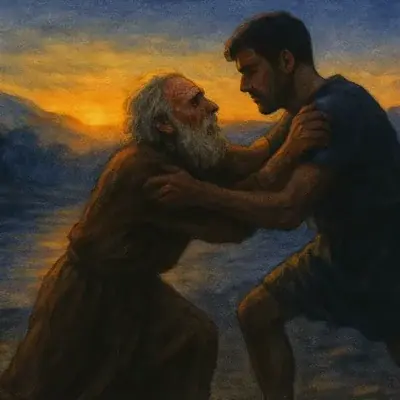
Genesis 32 follows Jacob on his return to Canaan, where he must face his brother Esau for the first time in twenty years. The first part of the chapter shows Jacob’s fear and careful preparations — dividing his camp, sending a massive tribute ahead, and praying for deliverance.
Jacob Prepares to Meet Esau and Wrestles with God
Genesis 32 is bound together with chapter 33 as a single carefully arranged unit. The story begins and ends with God’s watchful presence over Jacob, and at its centre is the night when Jacob meets God face to face. The turning point between fear and reconciliation is not Jacob’s elaborate plan, but God’s deliberate intervention.
The chapter opens with a scene that is strikingly brief, but heavy with meaning: “The angels of God met him.” This is not the first time Jacob has seen such a sight. Twenty years earlier at Bethel, angels ascending and descending marked the beginning of his exile. Now, on the way home, angels meet him again. He names the place Mahanaim, which means two camps, perhaps thinking of his camp alongside God’s camp. God’s army travels with him.
Yet in a matter of a few verses, Jacob will use the same phrase, two camps, to describe a desperate survival tactic. The God who commands angelic hosts is with him, but Jacob will soon have his faith tested as he perceives his life to be in danger.
When Jacob’s messengers return from Esau with the report that he is coming with four hundred men, the effect is immediate: “Jacob was greatly afraid and distressed.” The doubled language drives home the intensity of his fear. He divides his household and flocks into two camps so that if one is attacked, the other might escape. This is human calculation at work. Jacob is not resting in the “I will be with you” promise given by God in chapter 31:3.
Yet alongside his strategising, Jacob does what he has done too rarely in Genesis. He prays. His prayer is grounded in God’s covenant dealings. He calls on the God of Abraham and Isaac, invokes Yahweh’s covenant name, and appeals to the very promise God made to him: “Return to your land and to your kin, and I will do you good.”
He confesses his unworthiness: “I am unworthy of all the lovingkindness and of all the truth which you have shown to your slave.” He remembers crossing the Jordan with only a staff and now returning with two camps. And he asks plainly for deliverance from Esau, “lest he come and strike me down, the mothers with the children.”
This is a good prayer, honest, covenant-based, and specific. But even as the words leave his lips, his fear drives him to further preparations. The gift Jacob prepares for Esau is immense, a tribute of hundreds of animals divided into droves, each with instructions to tell Esau they belong to “your servant Jacob” and are sent to “my lord Esau.” He hopes to appease his face before meeting him. The sheer scale and deliberate arrangement of this tribute reveal how much Jacob’s approach is shaped by fear.
Then in verse 22, the scene shifts into the night. Jacob sends his wives, children, and possessions across the Jabbok and is left alone. And suddenly, without warning or explanation, “a man wrestled with him until the breaking of dawn.” The lack of introduction is deliberate. We, like Jacob, are caught up in the struggle without knowing the man’s identity. What follows is not a dream or a vision. It is a real physical contest.
Some people have wrongly claimed that Jacob was deceived, that he wrestled not with God, but with a demon masquerading as a man. However, this theory collapses under the weight of Scripture itself. For one, the outcome is covenantal blessing. Demons in Scripture deceive, destroy, and lead away from God. They do not confirm God’s promises or leave him declaring, “I have seen God face to face, and yet my life has been delivered.”
Second, Jacob’s own conclusion is affirmed by the rest of the Bible. The prophet Book of Hosea recalls this passage in Hosea 12:3–5: “In the womb he took his brother by the heel, and in his maturity he wrestled with God. Indeed, he wrestled with the angel and prevailed; he wept and sought His favour. He found Him at Bethel, and there He spoke with us, even Yahweh, the God of hosts, Yahweh is His name of remembrance.” Hosea does not correct Jacob’s supposed deception. He confirms Jacob’s words, identifying the man as both God and the angel of Yahweh, the physical manifestation of God who appears throughout the Old Testament.
Third, the man has the authority to bless and to rename Jacob, actions that in Genesis are always God’s prerogative. To deny that Jacob wrestled with God is to deny the plain testimony of both the narrative and the prophets, and it often rests on an unbiblical assumption that God cannot appear as a man. Yet the same God walked and spoke with Adam and Eve and with Abraham in Genesis 18.
The wrestling itself is extraordinary. When the man sees that he has not prevailed against Jacob, he touches the socket of his thigh, dislocating it instantly. This is no contest of equals. The man can disable Jacob with a touch, yet chooses to continue the struggle.
When dawn approaches, he says, “Let me go.” But Jacob replies, through tears as Hosea tells us, “I will not let you go unless you bless me.” This is not arrogance on Jacob’s part. It is desperation.
Jacob’s whole life has been one of striving, with Esau in the womb, with Isaac for the blessing, with Laban for his wages. And now all that striving is distilled into a night of clinging to God.
The man asks his name. “Jacob,” he replies, which means heel-grabber or supplanter. The man renames him: “Your name shall no longer be Jacob, but Israel, for you have striven with God and with men, and have prevailed.”
The name is not a congratulation of Jacob’s strength, but a marker of his persistence. He clung. He would not let go. And in that clinging, he found blessing.
The limp he now bears is the lasting mark of Jacob’s struggle with God. Scripture does not explain why God wounded him, yet the moment is inseparable from the blessing.
Many people experience wounds in life and attribute them to God. Such moments can be a real test of faith. When we face them, we have a choice. We can curse God and die, or we can cling to Him as Jacob did, refusing to let go, knowing there is nowhere else to turn.
Jacob names the place Peniel, meaning face of God. He has seen God in human form and lived. The encounter is the centre of the story of Jacob returning to the promised land. It is here that Jacob’s fear of Esau and his lack of trust in God’s promise are brought into the open, wrestled through in tears, and met by God Himself.
The resolution to this story comes in the next chapter. Jacob leaves Peniel limping, marked by his encounter with God. But how will his faith hold up when he comes face to face with his brother Esau?