
Exodus 35
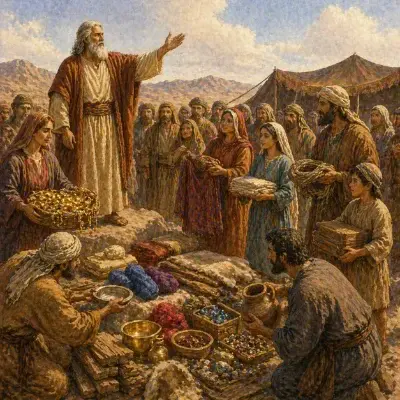
Exodus 35 marks the beginning of Israel’s obedience after the sin of the golden calf and the renewal of the covenant. Moses gathers the people, restates Yahweh’s commands, and the whole congregation responds with willing hearts to bring what is needed for the tabernacle. The chapter shows a clear reversal, the same people who once used their gold for idolatry now give it for Yahweh’s dwelling. It establishes that obedience to Yahweh is expressed in doing exactly what He has commanded, with hearts stirred by Him and strength supplied by Him.
Exodus 35 Explained: Israel’s Obedience in Building Yahweh’s Dwelling
Exodus 35 marks the point where Israel begins to do what Yahweh commanded. The earlier chapters recorded Yahweh’s instructions for the tabernacle, the priesthood, and the covenant life of Israel. Those instructions were interrupted by the sin of the golden calf. The covenant was broken, Moses interceded, and the covenant was renewed. This chapter now shows the people putting into practice what Yahweh commanded.
The movement in this part of Exodus is clear. Yahweh gave the instructions, Israel rebelled, Moses mediated, the covenant was renewed, and now the people begin to obey. The tabernacle will be built by a people who have sinned, been forgiven, and restored through a mediator.
The chapter opens with Moses assembling all the congregation of the sons of Israel and saying, “These are the things that Yahweh has commanded you to do.” The emphasis is on Yahweh’s command. Israel is not free to decide how they will worship or how they will build Yahweh’s dwelling. They must do what He has said.
The first command Moses repeats is the Sabbath. Six days work may be done, but the seventh day is a holy day, a sabbath of complete rest to Yahweh. Whoever does any work on it shall be put to death.
A specific example is given. “You shall not kindle a fire in any of your places of habitation on the sabbath day.” Lighting a fire begins the ordinary work of cooking and labour in the home. By forbidding even this act, Yahweh forbids all ordinary work. The command applies in every household. Obedience to Yahweh must be seen not only at the sanctuary but in daily life.
After this, Moses speaks about the contribution for Yahweh. The people are to bring gold, silver, bronze, coloured yarns, fine linen, skins, wood, oil, spices, and precious stones. This list repeats what Yahweh had already commanded. The tabernacle will be built according to His word, not according to human design.
The contribution is to come from everyone whose heart is willing. This is repeated throughout the chapter. The people are not forced. Their obedience is expressed through willing hearts.
Moses then calls for the skilled craftsmen to come and make everything Yahweh commanded: the tabernacle, its coverings, its structure, the ark, the table, the lampstand, the altars, the garments, and all the furnishings. The list repeats earlier instructions almost item by item, showing careful obedience.
The next section describes the people’s response. The congregation departs from Moses, and then they return bringing their contributions. The text repeatedly says that everyone whose heart stirred him and everyone whose spirit moved him came and brought Yahweh’s contribution.
Men and women bring gold, jewellery, fabrics, skins, wood, spices, and stones. The leaders bring precious stones. The women spin yarn with their hands. The whole community participates. The dwelling place of Yahweh is built by the entire people, each bringing what they are able.
This forms a clear contrast with the golden calf. In Exodus 32 the people brought their gold and made an idol. Here the people bring their gold to build Yahweh’s dwelling. The same materials and the same willingness are now directed toward obedience. The difference is whether the people act according to Yahweh’s command.
The chapter ends with Bezalel and Oholiab. Moses tells the people that Yahweh has called Bezalel and filled him with the Spirit of God in wisdom, understanding, knowledge, and skill. Oholiab is appointed with him, and they are given the ability to do the work and to teach others.
This repeats what Yahweh had already said. The point is that Yahweh not only commands the work, He also provides the ability to carry it out. The craftsmen build, but the wisdom comes from the Spirit of God.
Exodus 35 shows Israel doing what Yahweh commanded. The repetition throughout the chapter is deliberate. It shows that the people are carefully following His word.
The tabernacle is built on the other side of sin and forgiveness. It is built by a people who have been spared through mediation and restored to covenant relationship.
Exodus 35 teaches that faithfulness to Yahweh means doing what He has commanded, exactly as He commanded it, with willing hearts and with the ability that He Himself provides. The people who once used their gold to make an idol now use their gold to build the dwelling place of Yahweh.