
Luke 2
Luke grounds the birth of Jesus in identifiable history: an imperial census, a journey to Bethlehem, and a manger because there is no room in the guest room. Shepherds hear an angel announce the birth of a Saviour, Christ and Lord, then travel to Bethlehem to see the sign for themselves. In the temple, Simeon and Anna, two aged witnesses who have waited for Israel's redemption, recognise the infant Jesus as the salvation of God. The chapter closes with Jesus at twelve years old, already speaking of God as His Father and His life as bound to His Father's purpose.
Luke chapter 2 begins by placing the birth of Jesus in history. “In those days a decree went out from Caesar Augustus for a census to be taken of all the inhabited earth.” “All the inhabited earth” was a common way of referring to the Roman empire.
Luke has already told Theophilus that he carefully investigated the events surrounding Jesus, and here he continues to anchor his account in identifiable history. Caesar Augustus rules the Roman world, Quirinius governs Syria, and an imperial census sets in motion the journey that will bring Joseph and Mary to Bethlehem.
Joseph goes because “he was of the house and family of David”. Hundreds of years earlier, Micah the prophet had said, “But as for you, Bethlehem Ephrathah, too little to be among the clans of Judah, from you One will go forth for Me to be ruler in Israel.” Caesar may have issued the command for his own administrative purposes, but God uses that decree to bring the promised Son of David to David’s city.
Joseph belongs to the house and family of David, and Bethlehem is “the city of David”. Luke 1 has already established that Jesus will receive “the throne of His father David” and reign forever. The promised King enters the world in the place Scripture had already named.
Mary travels with Joseph while still described as betrothed to him and “with child”. Betrothal in Jewish society carried legal force, but the couple had not yet begun ordinary married life together. Matthew makes the situation explicit when he says that Mary conceived “before they came together” and that Joseph “kept her a virgin until she gave birth to a Son” (Matthew 1:18, 25).
Luke has already explained the conception in chapter 1: the Holy Spirit came upon Mary, and the power of the Most High overshadowed her. Jesus is conceived and born of a virgin, and Joseph does not consummate the marriage before His birth. While Mary and Joseph are in Bethlehem, “the days were fulfilled for her to give birth”. Luke again uses the language of fulfilment. Mary gives birth to her firstborn Son, wraps Him in cloths and lays Him in a manger “because there was no place for them in the guest room”.
The traditional translation “inn” has shaped generations of Christmas scenes. In the parable of the Good Samaritan, Luke uses the ordinary word for an inn where travellers could pay for lodging, but he does not use that word here. Instead he uses the word translated “guest room”, the same word he later uses in Luke 22:11 for the room where Jesus will share the Passover with His disciples.
Luke explains there was no room in the crowded guest room, so the newborn Jesus is laid in a manger. We do not need to reconstruct the precise architecture to understand the point. The promised King enters the world in humble circumstances, without royal surroundings or ceremony.
Luke then turns away from the household to the surrounding countryside. Shepherds are staying in the fields and keeping watch over their flock by night. They are ordinary working men, far removed from the centres of political and religious power in Jerusalem and Rome.
God announces the birth of the Son who will reign forever first to these men, rather than to rulers, priests or men of public importance. Isaiah had said that Yahweh’s Anointed One would “bring good news to the afflicted” and “proclaim release to captives” (Isaiah 61:1), words Jesus will later stand up and read in the synagogue at Nazareth as a declaration of His own mission (Luke 4:18–19).
Before Jesus can speak a word of that mission Himself, heaven has already begun to act on it. Mary had already sung that God “has brought down rulers from their thrones” and “has exalted those who were humble” (Luke 1:52). The shepherds, hearing the good news before anyone of rank or standing does, are already living proof of that second line.
An angel of the Lord stands before them, and “the glory of the Lord shone around them”. The shepherds become terrified, but the angel says, “Do not be afraid; for behold, I bring you good news of great joy which will be for all the people.”
The announcement in verse 11 gathers together three titles that explain who this Child is: “For today in the city of David there has been born for you a Savior, who is Christ the Lord.”
“Savior” carries deep Old Testament weight. Isaiah 43:11 says, “I, even I, am Yahweh, and there is no savior besides Me.” Throughout Israel’s history Yahweh saves His people from enemies, judgment and death. The angel now announces that a Saviour has been born.
“Christ” translates the Greek word Christos, meaning “Anointed One”, the equivalent of the Hebrew “Messiah”. Israel anointed priests and kings, but Scripture increasingly concentrated its expectation upon the promised King from David’s line. Psalm 2 speaks of the nations raging “against Yahweh and against His Anointed”, and Yahweh answers by saying, “But as for Me, I have installed My King upon Zion, My holy mountain.” Gabriel has already announced that Jesus will receive David’s throne. Now the angel identifies Him directly as the Christ, the promised Anointed King.
Then comes the title “Lord”. Luke 1 has already prepared us to hear “Lord” with its full Old Testament force. John was appointed to go before the Lord and make ready His ways, language drawn from Isaiah 40 and Malachi 3, where the messenger prepares the way for Yahweh. The angel now says that the Child born in Bethlehem is “Christ the Lord”.
The sign given to the shepherds is striking in its plainness: “you will find a baby wrapped in cloths and lying in a manger”. The glory of the Lord shines around them, the angel announces the birth of the Saviour and Messiah, and heaven itself breaks into praise around a newborn child lying in a feeding trough.
Suddenly a multitude of the heavenly host appears with the angel, praising God. “Host” is the language of an army. The armies of heaven gather around the announcement of the Messiah and proclaim, “Glory to God in the highest, and on earth peace among men with whom He is pleased.”
The promised Messiah brings the peace spoken of by the prophets. Isaiah 9:6 calls the promised Son “Prince of Peace”, and Micah 5:5 says of the ruler from Bethlehem, “This One will be our peace.” The birth of Jesus brings glory to God because the salvation and kingdom He promised are now arriving in His Son.
Heaven itself gives the first testimony concerning the Child, revealing who Jesus is before the shepherds ever see Him. One angel names Him as Saviour, Christ and Lord, while the heavenly host declares the significance of His birth through praise.
The shepherds then become eyewitnesses. Once the angels return to heaven, they say to one another, “Let us go to Bethlehem then, and see this thing that has happened which the Lord has made known to us.” They hurry to Bethlehem and find Mary, Joseph and “the baby lying in the manger”, exactly as the angel had told them.
Luke carefully joins revelation and sight. “When they had seen this, they made known the statement which had been told them about this Child.” They become public witnesses because they have heard the heavenly testimony and then confirmed the sign with their own eyes.
Luke began his Gospel by explaining that his account rests upon those who “from the beginning were eyewitnesses and servants of the word”. Already in the infancy narratives he gathers testimony around Jesus. Gabriel speaks. Elizabeth speaks by the Holy Spirit. Mary speaks from Scripture. Zechariah prophesies. Now angels speak from heaven, shepherds see the Child, and those shepherds repeat what they have heard and seen.
Everyone who hears their testimony marvels, but Luke singles Mary out: “Mary was treasuring all these things, pondering them in her heart.” The language recalls Genesis 37:11. After Joseph tells the dream in which his family bows before him, his brothers become jealous, but Jacob “kept the saying in mind”. Jacob does not know how Joseph’s words will come to pass, but he stores them away.
Mary does something similar. She has heard Gabriel, Elizabeth and now the shepherds. She has seen the extraordinary circumstances surrounding her Son, but she does not understand how everything will unfold. She treasures the words and events and continues thinking through them.
The shepherds then return to their ordinary work, “glorifying and praising God for all that they had heard and seen, just as was told them”.
On the eighth day Jesus receives circumcision. This command reaches back to Genesis 17, where Yahweh gave Abraham circumcision as the sign of the covenant, and Leviticus 12:3 required the circumcision of a male child on the eighth day. Mary and Joseph therefore obey the covenant command God first gave to Abraham and later incorporated explicitly into the Law of Moses.
They also name Him Jesus, “the name given by the angel before He was conceived in the womb”. Gabriel’s word continues to govern the story. God named the Child before His conception, and Mary and Joseph obey that command.
When the days for cleansing according to the Law of Moses are fulfilled, they bring Jesus to Jerusalem “to present Him to the Lord”. Luke then quotes directly from the Law: “Every firstborn male that opens the womb shall be called holy to the Lord.”
This comes from Exodus 13. After Yahweh struck Egypt’s firstborn and spared Israel’s firstborn through the Passover blood, He claimed Israel’s firstborn for Himself. Exodus 13:2 says, “Sanctify to Me every firstborn, the first offspring of every womb among the sons of Israel.” Every firstborn son therefore belonged to Yahweh in a special covenant sense and had to be redeemed according to the Law.
Luke gives a second quotation from the Law concerning Mary’s purification sacrifice: “A pair of turtledoves or two young pigeons.” Leviticus 12 ordinarily required a lamb together with a bird, but verse 8 made provision for those who could not afford a lamb: “But if she cannot afford a lamb, then she shall take two turtledoves or two young pigeons.”
Mary and Joseph therefore bring the offering of the poor. Luke has already shown us Jesus lying in a manger, and now he shows us that His parents cannot afford the normal lamb required for the purification offering.
There is also an irony in this scene: Mary and Joseph cannot afford the lamb required for the offering, while carrying into the temple the Son who will ultimately give Himself as the sacrifice for sin.
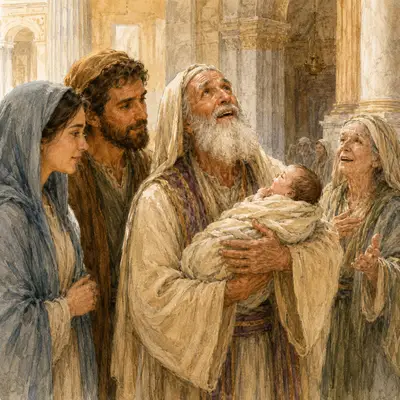
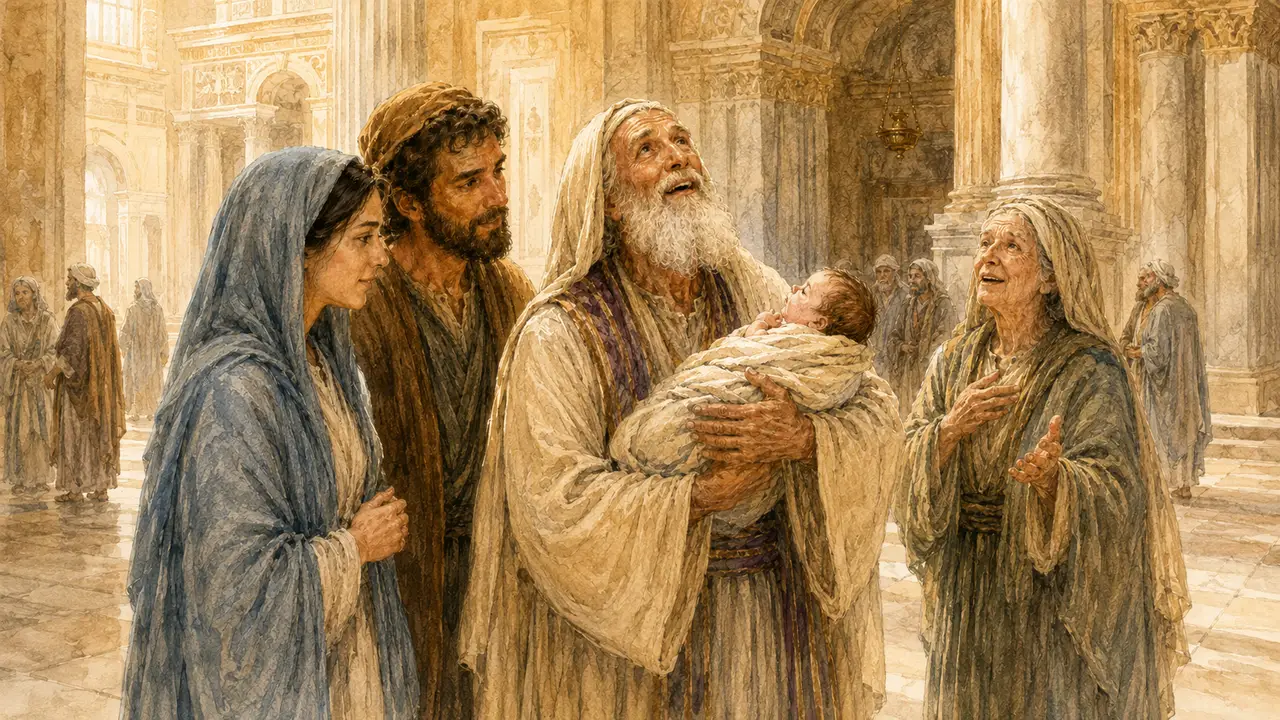
Luke now introduces another witness. “There was a man in Jerusalem whose name was Simeon”, whom Luke describes as righteous and devout, “waiting for the comfort of Israel”, with the Holy Spirit upon him.
“Comfort of Israel” takes us directly to Isaiah 40:1: “Comfort, O comfort My people,” says your God. Isaiah 40 begins the great section of Isaiah that announces Yahweh’s coming salvation. The chapter goes on to speak of the voice preparing the way for Yahweh, the revelation of His glory and the good news that God is coming to His people.
Luke used Isaiah 40 in chapter 1 to explain John’s ministry. John prepares the way for the Lord. Now Simeon waits for the comfort Isaiah promised.
The Holy Spirit has revealed to Simeon that he will not die before seeing “the Lord’s Christ”. He comes into the temple in the Spirit at the very moment Mary and Joseph bring Jesus in according to the Law. Luke again shows God directing events so that witnesses arrive at the appointed time.
Simeon takes Jesus into his arms and blesses God:
“Now Master, You are releasing Your slave in peace, according to Your word. For my eyes have seen Your salvation”
Simeon has waited for the Christ, and now he can die in peace because he has seen God’s salvation with his own eyes. He does not simply say that he has seen the one who will eventually bring salvation. He looks at Jesus and says, “my eyes have seen Your salvation.” Luke places God’s saving work in the person of the Child Simeon holds.
His words draw deeply from Isaiah. Isaiah 40:5 says that the glory of Yahweh will be revealed “and all flesh will see it together”. Isaiah 52:10 says, “Yahweh has bared His holy arm in the sight of all the nations, that all the ends of the earth may see the salvation of our God.”
He continues:
“Which You prepared in the presence of all peoples, a Light for revelation to the Gentiles, and for the glory of Your people Israel.”
Simeon sees from Scripture that the Messiah’s salvation reaches beyond Israel. Isaiah 42:6 says that Yahweh will appoint His Servant “as a covenant to the people, as a light to the nations”. Isaiah 49:6 says, “I will also give You as a light of the nations so that My salvation may reach to the end of the earth.”
Simeon recognises the promised Servant who will carry Yahweh’s salvation to the nations. Luke will develop this throughout Luke and Acts. When Paul and Barnabas turn explicitly to the Gentiles in Acts 13:47, they quote Isaiah 49:6. Before Jesus can speak or walk, Luke marks the start of the gospel’s journey from Israel to the nations.
Jesus is “a Light for revelation to the Gentiles” and “the glory of Your people Israel”. Israel’s glory reaches its highest point in the Messiah who comes from Israel and through whom God brings salvation to the world.
Mary and Joseph marvel at what Simeon says, but then Simeon turns specifically to Mary and speaks of the division Jesus will bring: “Behold, this Child is appointed for the fall and rise of many in Israel, and for a sign to be opposed.”
Isaiah 8:14–15 lies behind the language of falling. Yahweh says that He will become “a stone to strike and a rock to stumble over” to the houses of Israel, and that “many will stumble over them; then they will fall and be broken”. Jesus will expose Israel. Some will stumble over Him and fall. Others will rise. His presence will divide people according to their response to Him.
Simeon then adds that Jesus will become “a sign to be opposed”. Opposition therefore enters Luke’s Gospel before Jesus begins His public ministry. The angels announced great joy, peace and salvation, but Simeon makes clear that many will resist the One through whom that salvation comes.
Then he says directly to Mary, “and a sword will pierce through your own soul as well, that the thoughts from many hearts may be revealed.”
Luke does not identify the sword with one particular event. It appears within Simeon’s wider prophecy about division, opposition and the exposing of hearts. Mary herself will not be spared that exposure.
The chapter already begins that process. Later, when twelve-year-old Jesus speaks of His Father’s house, Luke says that Mary and Joseph “did not understand the statement which He had spoken to them”. Mary believes God, treasures His words and submits herself to Him, but she does not understand everything that Jesus’ identity and mission will require.
Luke later records another painful moment in Luke 8:19–21. Mary comes with Jesus’ brothers while He is teaching, and Jesus answers, “My mother and My brothers are these who hear the word of God and do it.” Luke records the visit itself without stating their motive. Mark gives the fuller context of that same family intervention in Mark 3:20–35. Jesus’ own people go out to take custody of Him because they are saying, “He has lost His senses”, and then His mother and brothers arrive outside asking for Him. John 7:5 also tells us that at this stage even Jesus’ brothers were not believing in Him.
Jesus’ ministry therefore cuts deeply into Mary’s own life. She cannot claim authority over His mission on the basis of her maternal relationship or natural family expectations. She must hear the word of God and do it, just like every other disciple.
Simeon’s sword fits that painful process. Jesus reveals hearts, and Mary herself does not stand outside that revelation. She will experience the pain of discovering that His mission repeatedly exceeds her understanding and that even her relationship to Him as His mother must stand beneath the will of His heavenly Father.
Luke does not leave Mary in unbelief or opposition. Acts 1:14 shows her with Jesus’ brothers among the disciples after the resurrection and ascension, continually devoting themselves to prayer. The family that once stood outside now stands inside the believing community. Simeon’s words therefore point to the deep personal pain through which Mary herself must come as the Messiah reveals what lies in human hearts.
Luke then introduces Anna, “a prophetess, Anna the daughter of Phanuel, of the tribe of Asher”. Luke carefully emphasises her great age. She had lived with her husband for seven years and then remained a widow into old age, serving in the temple “night and day with fastings and prayers”.
Luke’s pairing of Simeon and Anna, an aged man and an aged woman in Jerusalem, recalls Zechariah 8:4. In that prophecy Yahweh promises Jerusalem’s restoration: “Old men and old women will again sit in the streets of Jerusalem, each man with his staff in his hand because of age.” Zechariah looks forward to the day when Yahweh restores Zion and dwells again in Jerusalem.
Simeon waits for the comfort of Israel. Anna waits among those longing for Jerusalem’s redemption.
At the very moment Simeon speaks, Anna comes forward, gives thanks to God and begins speaking about Jesus “to all those who were waiting for the redemption of Jerusalem”.
The phrase “redemption of Jerusalem” also draws us back to Isaiah. Isaiah 52:9 says, “Break forth, shout joyfully together, you waste places of Jerusalem; for Yahweh has comforted His people, He has redeemed Jerusalem.”
Luke brings the prophetic language together carefully. Simeon waits for the “comfort of Israel”. Anna speaks to those waiting for the “redemption of Jerusalem”. Isaiah 52 places comfort and redemption side by side, then immediately says that Yahweh will reveal His saving power before all nations so that “all the ends of the earth may see the salvation of our God”. Simeon has just declared that he has seen that salvation and that Jesus will become a light to the Gentiles.
Anna therefore adds another Spirit-shaped witness to the Child. Luke keeps building testimony. The angel spoke. The heavenly host spoke. The shepherds saw and reported. Simeon spoke under the Holy Spirit. Anna, a prophetess, now speaks publicly to those waiting for redemption.
Luke then says that Mary and Joseph finish “everything according to the Law of the Lord” and return to Nazareth.
Luke describes the Child in verse 40: “Now the Child continued to grow and become strong, being filled with wisdom; and the grace of God was upon Him.”
The description also echoes Isaiah’s picture of the promised ruler from Jesse. Isaiah says, “Then a shoot will spring from the stem of Jesse, and a branch from his roots will bear fruit. The Spirit of Yahweh will rest on Him, the spirit of wisdom and understanding.” Luke has already established Jesus as the promised Davidic Son, and now shows Him growing and being filled with wisdom under that same Spirit.
The emphasis on wisdom will continue through the rest of the chapter. Luke does not embellish Jesus’ childhood with invented tales of miracles.
Luke then moves forward to Jesus at twelve years old. His parents go to Jerusalem each year for the Feast of the Passover. The Passover itself reaches back to Israel’s redemption from Egypt, when Yahweh delivered His people through the blood of the lamb and brought them out of slavery. Jesus therefore grows within the rhythm of Israel’s covenant feasts.
When Jesus reaches twelve, He travels with Mary and Joseph to Jerusalem. After the feast ends, Mary and Joseph begin the journey home, assuming Jesus is somewhere among the extended group of relatives and acquaintances. After a day they discover that He is missing, return to Jerusalem and search for Him.
After three days they find Him in the temple, “sitting in the midst of the teachers, both listening to them and asking them questions”. Everyone who hears Him becomes astonished at His understanding and His answers. Luke has already said that Jesus is being filled with wisdom. Now he gives an example of that wisdom in the temple.
Mary and Joseph are astonished as well. Mary says, “Child, why have You treated us this way? Behold, Your father and I have been anxiously searching for You.”
Jesus’ answer gives us His first recorded words in Luke:
“Why is it that you were searching for Me? Did you not know that I had to be in My Father’s house?”
Mary has just said, “Your father and I”. Jesus answers by speaking about “My Father”. Joseph truly functions as His earthly and legal father, and through Joseph Jesus belongs legally to the house of David. Yet Jesus knows that His deepest identity comes from His relationship to God as His Father.
Luke announced this before Jesus’ conception. Gabriel said that the holy Child “shall be called the Son of God”. At twelve years old Jesus speaks from that same identity. He belongs uniquely to His Father, and His Father’s purpose governs His life.
The words “I had to” also introduce an important theme in Luke. Jesus repeatedly speaks of what He “must” do because the Father’s purpose and the Scriptures determine His mission. He must preach the kingdom. He must suffer. He must be rejected. He must be killed and rise again. After the resurrection He will say that everything written about Him in Moses, the Prophets and the Psalms had to be fulfilled. Already at twelve, Jesus understands His life in terms of divine necessity.
Mary and Joseph “did not understand the statement which He had spoken to them”. Luke says this directly. Mary has heard Gabriel, Elizabeth, the shepherds, Simeon and Anna. She believes God and treasures His words, but she still does not understand fully what Jesus’ sonship means or where His mission will lead.
That prepares us for Simeon’s warning about the sword. Mary’s faith is genuine, but following the Messiah will require her to surrender her natural expectations of Him as her son. Even here she experiences anxiety, confusion and the realisation that His heavenly Father’s claim upon Him comes first.
Jesus then returns to Nazareth with them and “continued in subjection to them”. His awareness of His divine sonship does not lead Him to reject the authority God has placed over Him in His earthly family. The Son who knows God as His Father willingly submits to Mary and Joseph.
Luke again says that Mary “was treasuring all these things in her heart”. The wording returns us to verse 19 and again recalls Jacob in Genesis 37:11. Mary does not understand everything, but she keeps these words and events, pondering what God is revealing through her Son.
The chapter closes with another carefully chosen Old Testament echo: “And Jesus was advancing in wisdom and stature, and in favor with God and men.”
This closely echoes 1 Samuel 2:26: “Now the young boy Samuel was growing in stature and in favor both with Yahweh and with men.” Luke has already drawn heavily from the story of Hannah and Samuel. Elizabeth’s barrenness recalled Hannah. Mary’s song drew from Hannah’s prayer. John’s birth introduced another prophet whose arrival marked a major transition in God’s dealings with Israel. Now Luke describes Jesus’ growth in the language used of Samuel.
The comparison also shows Jesus surpassing the pattern. Samuel served in the sanctuary of Yahweh as a boy. Jesus enters the temple and calls it His Father’s house. Samuel grows in favour with Yahweh and men. Jesus grows in favour with God and men while advancing in the wisdom promised to the Davidic Messiah in Isaiah 11.
Luke 2 continues the movement that began in chapter 1. God fulfils His word in public history, using an emperor’s decree, the ordinary requirements of the Law, and the testimony of angels, shepherds, Simeon and Anna to bring His promised Son into the world. The aged Simeon and Anna stand in Jerusalem in a scene that recalls the old men and old women of Zechariah’s restoration prophecy, living long enough to see the beginning of what God had promised.
Every witness points towards the same Child. He is the Son of David born in Bethlehem, the Saviour, the Christ, the Lord, the light to the Gentiles, the glory of Israel, the One through whom Jerusalem’s redemption comes, and the Son who must carry out His Father’s purpose. He enters the world in humility, grows in wisdom, submits to His earthly parents and already understands that His life belongs wholly to His Father. Luke has moved from the manger to the temple, from angelic announcement to prophetic testimony, and from Mary treasuring words about Jesus to Jesus speaking for Himself. God’s promised salvation has entered history in His Son.